
How to Invest in Startups: A 7-Step Guide
Depending on the offering and your eligibility, you can invest in startups directly, through a syndicate or special purpose vehicle (SPV), on a regulated crowdfunding platform, or through a venture fund. Each route changes what you own, which deals you choose, how much work you do, and who may participate.
Some offerings accept commitments around $1,000. That is not a universal minimum, and a smaller check does not make a startup investment safe. Startup securities are speculative, often illiquid, and capable of a total loss.
For a focused look at the process errors that can undermine those decisions, see our guide to 12 angel investing mistakes and how to avoid them.
This guide is for general education, not investment, legal, or tax advice.
Compare four common ways to invest in startups
Start with the ownership and decision structure you want. The four main routes are:
- Direct startup investment. You buy a security from one company and make the company-level decision yourself.
- Syndicate or single-deal SPV. A lead brings an opportunity to a group of backers. If you join, you usually buy an interest in an SPV, and that vehicle owns the startup security.
- Regulation Crowdfunding. You invest in an offering through one online broker-dealer or funding portal registered with the Securities and Exchange Commission (SEC).
- Venture fund. You buy an interest in a pooled fund. You select the fund manager; the manager selects and oversees the startups.
| Route | What you own | Control and access | Costs and liquidity | Main tradeoff |
|---|---|---|---|---|
| Direct investment | Stock, an LLC interest, a convertible note, a SAFE, or another company security | You choose the company and security; private-offering eligibility applies | Company or personal legal costs may apply; resale is usually restricted | Maximum company choice, with more sourcing, diligence, and administration |
| Syndicate or single-deal SPV | An interest in a vehicle that owns the startup security | You choose each deal; the lead organizes it; many private deals require accreditation and suitability checks | Vehicle fees and carry may apply; resale is usually restricted | Lead support and a cleaner process, with conflicts and indirect rights to review |
| Regulation Crowdfunding | The security described in the Form C and offering documents; some offerings use a qualifying crowdfunding vehicle | You choose on a registered intermediary; non-accredited investors face aggregate limits | Platform or offering costs vary; resale is generally restricted for one year and may remain difficult | Retail access and required disclosure, but still high risk and usually illiquid |
| Venture fund | A limited-partner or other fund interest | The fund manager chooses; private-fund eligibility and minimums vary | Management fees, expenses, and carry may apply; withdrawals or transfers are limited | Delegation and exposure to a company portfolio, with manager risk and less deal control |
Direct startup investment
Direct investing gives you the clearest line between your decision and the company. You may meet the founders, develop your own view of the market, and negotiate or accept the security the company offers.
You also keep most of the work. You need to find opportunities, verify the founders' claims, review the cap table and financing terms, complete the paperwork, monitor the company, and decide whether to invest again later. The word "direct" does not promise a board seat, information rights, or pro rata rights. The documents control.
This route may appeal to well-connected founders, experienced operators, and sector specialists with the time and knowledge to source and diligence each opportunity.
Syndicate or single-deal SPV
A syndicate and an SPV are related, but they are not the same thing. The syndicate is the relationship between a lead and the backers who may join a deal. The SPV is the legal entity that pools their capital for the investment.
The lead may source the company, negotiate access, organize diligence, and prepare an investment memo. You still need to evaluate the company, the lead, and the vehicle. Ask how the lead is compensated, how conflicts and allocations are handled, which fees and carried interest apply, and which rights pass through the SPV.
This route may appeal to busy operators who want a lead to organize sourcing and administration but still want to choose each company.
Regulation Crowdfunding
Regulation Crowdfunding is one of the clearest US routes for non-accredited investors. The company files a Form C, and the transaction takes place through one SEC-registered broker-dealer or funding portal that is also a Financial Industry Regulatory Authority member.
Non-accredited investors have an aggregate 12-month investment limit tied to income and net worth. The limit is not a per-deal minimum. Each company or platform can set its own offering minimum.
The Form C can give you useful information about the company, management, use of proceeds, related-party transactions, financial condition, and offering terms. It is still lighter disclosure than a public company provides. Crowdfunding securities generally cannot be resold for one year, and a buyer may not exist after that restriction ends.
This route may appeal to people who need a retail-access path and are prepared to read the company disclosures and security terms themselves.
Venture fund
When you invest in a venture fund, your main decision moves from company selection to manager selection. You are backing the manager's thesis, team, access, portfolio construction, reserves, valuation policy, and judgment.
A fund can provide exposure to more companies than one direct investment or SPV. That does not remove concentration. The portfolio can still depend on one manager, strategy, sector, stage, and vintage. Private funds can also require a binding commitment followed by capital calls, so the cash pattern matters as much as the headline minimum.
This route may appeal to investors who want a manager to build and oversee the company portfolio and can meet the fund's eligibility, commitment, fee, and liquidity terms.
Check your eligibility and set a loss budget
Accreditation depends on the offering
Many private startup offerings restrict participation to accredited investors, but startup investing does not always require accreditation.
The SEC's accredited-investor criteria include several routes. Common individual routes include:
- Net worth above $1 million, excluding the value of a primary residence, alone or with a spouse or spousal equivalent
- Income above $200,000 individually, or $300,000 with a spouse or spousal equivalent, in each of the prior two years, plus a reasonable expectation of the same level in the current year
- A Series 7, 65, or 82 license in good standing
Other individual and entity categories also exist. The issuer chooses the exemption it relies on, and the applicable rule determines who may invest and what assessment or verification the issuer must perform; review the offering documents to identify the claimed exemption. Accreditation is an access test, not an endorsement of the investment.
Regulation Crowdfunding provides a retail path. Rule 506(b) can also include a limited number of sophisticated non-accredited purchasers under specific conditions, while a generally solicited Rule 506(c) offering may sell only to verified accredited investors.
Some deals start at $1,000; that is not a universal minimum
Can you invest in a startup with $1,000? Sometimes. Some syndicates, SPVs, and crowdfunding offerings accept commitments at or below that level. At Angel Squad, our angel-investing community, deal minimums typically start at $1,000.
Treat three numbers separately:
- Offering minimum: the smallest commitment the company, vehicle, or fund will accept.
- Cash required and net economics: Determine whether fees and expenses are added to your commitment or deducted from it, how much reaches the startup, and how carried interest reduces any profit distributions. Taxes depend on the structure and your circumstances; they are not a fixed deal fee.
- Total startup allocation: the full amount you can afford to lose and leave illiquid across all startup investments.
A $1,000 minimum only answers the first question. It does not tell you whether the deal fits your finances or whether the terms are fair.
Assume illiquidity and possible total loss
The SEC's private-placement risk bulletin is blunt: Regulation D private placements can involve a total loss, limited disclosure, restricted transfers, and the need to hold the securities indefinitely. A Form D filing is not SEC approval.
Only use money you can lose without disrupting near-term needs. Do not rely on a secondary sale, acquisition, or initial public offering by a particular date. Even a strong company may raise on terms that dilute you, stay private much longer than expected, or fail to return capital.
Decide your concentration limits before a pitch tests them
Our co-founder and general partner Elizabeth Yin puts the portfolio principle plainly: "Don't try to pick a co. Select a portfolio."
No company count makes startup investing safe. Diversification can reduce the damage from one company, but it cannot remove sector, stage, manager, vintage, or liquidity risk. A group of companies can still fail together, and fees reduce whatever returns remain.
If startup investing fits your situation, decide in advance how much one company, sector, stage, lead, and year may represent within the loss budget you set. Keep check sizing consistent enough that one exciting pitch cannot consume the plan.
Seven steps after choosing an investing route
1. Define what you will evaluate
Turn your constraints into a simple focus. Write down:
- The sectors, customer problems, or business models where you have a real edge
- How much time you can spend sourcing, diligencing, and helping
- Which fees, conflicts, and ownership structures you will not accept
- The evidence that would make you take a company seriously
This is a loose investment thesis, not a prediction that one narrow category will win. It helps you compare companies on consistent grounds and spot where your operating knowledge is useful. You still do not need to invest on a schedule.
2. Build deal flow before you write a check
New investors usually find opportunities through three channels:
- Platforms and communities. Crowdfunding portals, syndicates, angel groups, and investing communities can expose you to repeated opportunities. Review several before committing so you can compare how founders, leads, and terms differ.
- Trusted networks. Founders, operators, lawyers, accountants, accelerators, and other investors may share deals. Useful relationships compound when you make relevant introductions, answer quickly, and help without turning every interaction into a pitch.
- Direct founder outreach. This is a later-stage sourcing skill. A credible message explains why your operating experience, customer network, or sector knowledge could help that specific founder. Random LinkedIn messages and empty personal-brand activity rarely create the same trust.
Form your own view before reading the room. Review the company materials, write down the questions and risks you see, then compare notes with other investors. That order makes peer discussion a way to find gaps in your reasoning instead of a source of social proof.

3. Run an initial screen
The first screen should answer whether deeper work is justified. Check:
- Team: Can the founders build, learn, recruit, and adapt? Does their history match the claims in the pitch?
- Customer problem: Who has the problem, how painful is it, and what are they doing today?
- Market: Is there a plausible path to a large outcome, and is the timing credible?
- Product and traction: Are customers paying, returning, expanding use, or referring others? Separate repeatable behavior from one-off pilots and paid promotion.
- Business model: Who pays, how much, how often, and what must be true for attractive margins?
- Round: How much is the company raising, which security is offered, and what will the money fund?
- Fit: Does the opportunity match the constraints you already wrote down?
Most opportunities should not advance. A fast, reasoned pass saves time for the few that deserve deeper diligence.
4. Do deeper diligence
If the company passes the screen, test the claims that would change your decision.
Founders and team
- Speak with the founders and ask what changed their mind recently.
- Check relevant employment, product, and fundraising history.
- Ask customer, former colleague, and co-investor references specific questions.
- Look for honesty about weak points, not rehearsed certainty.
Customers, market, and economics
- Talk to customers or review direct customer evidence when possible.
- Map the alternatives, including doing nothing or using a manual process.
- Reconcile reported growth with the underlying customer count, contract terms, churn, and cash collection.
- Test market size from the likely customer base and price rather than relying only on a large top-down number.
Company and financing
- Review the cap table, current cash, burn, debt, prior securities, and use of proceeds.
- Understand what must happen before the company raises again.
- Check intellectual-property ownership, litigation, regulatory exposure, and other company-specific legal risks.
- Distinguish a latest-round valuation from cash a shareholder could actually receive.
Our 5T framework for evaluating startups offers another way to organize the company questions. The framework helps you ask better questions; it does not replace the documents or your own judgment.
5. Read the security and vehicle terms
The investment label is not enough. Read what you are actually buying.
- Stock or LLC interest: current ownership with rights defined in the charter, operating agreement, purchase agreement, and related documents.
- Convertible note: company debt that may convert into equity under specified conditions. Interest, maturity, cap, discount, and repayment terms matter.
- Simple Agreement for Future Equity (SAFE): a security that promises a future ownership interest if a specified event occurs. A SAFE holder does not own stock unless and until it converts. Caps, discounts, most-favored-nation clauses, and pro rata rights vary.
- SPV interest: an interest in a vehicle. The vehicle owns the underlying startup security, so you must read both layers.
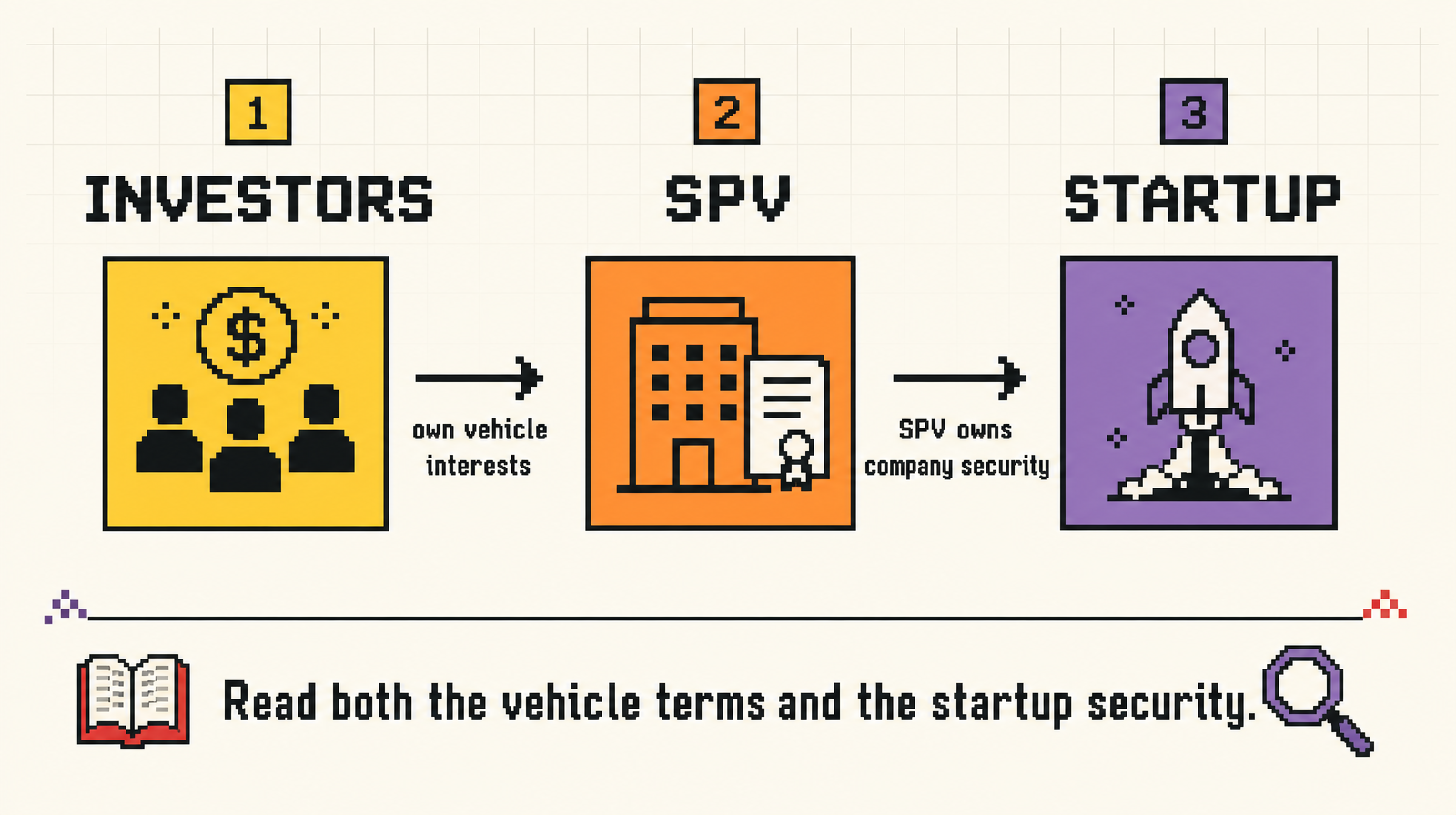
An SPV can put one vehicle on the startup's cap table instead of many individuals. In return, you add another set of economics and rules. Check:
- The lead's investment and carried interest
- Setup, administration, management, and pass-through expenses
- Allocation and conflict policies
- Voting, information, pro rata, distribution, and transfer rights
- Tax reporting and which entity handles administration
- What happens if the lead, manager, or platform changes or closes
For example, a $1,000 SPV commitment can create an interest in the vehicle tied to its underlying startup investment. It does not necessarily buy $1,000 of startup stock in your name. Disclosed fees may be charged on top, withheld from the investment, or allocated through the vehicle. The underlying security, carry, expenses, and distribution rules determine your economics.
Our guide to SPVs explains the wrapper in more detail. The SEC's startup-security guide is a useful primary reference for the instrument underneath it.
6. Write the decision memo
A short memo forces the investment to survive outside the pitch meeting. Include:
- Why you are considering the investment
- The evidence supporting the founder, customer, market, and business case
- What must be true for the investment to work
- The two or three risks most likely to break the thesis
- The security, valuation or conversion terms, rights, fees, and conflicts
- The reasons you would pass
- The check size allowed by the constraints you wrote before seeing the deal
Read the memo again after the meeting energy fades. If the evidence does not support the thesis, pass. There will be other companies.
7. Sign, fund, and record the investment
The closing flow depends on the route.
For a direct investment: review the company's purchase, subscription, or security documents; confirm the legal entity and wiring instructions; complete any eligibility forms; sign; fund; and obtain the final countersigned documents or confirmation.
For an SPV, syndicate, or crowdfunding offering: review the company materials plus the vehicle or platform documents; confirm your eligibility, fees, carry, and rights; commit; sign; fund; and wait for the vehicle or offering to close.
Before funding, verify the company or vehicle's legal name, any required intermediary registration, and the wire instructions through a known contact. For a Regulation Crowdfunding deal, review the filed Form C. For a Regulation D deal with prior sales, look for Form D, but remember that Form D is generally due within 15 days after the first sale and is only a notice, not SEC approval. Do not rely on a last-minute email changing the destination.
Store the final documents and record the company, date, amount, instrument, valuation or conversion terms, vehicle economics, founder or manager contact, and your original thesis. Good records make later tax, follow-on, and learning decisions easier.
What happens after you invest
Closing is the start of a long, uncertain holding period.
- Updates: Company or manager reporting may be quarterly, occasional, or triggered by an event. Read what the documents promise rather than assuming a cadence.
- Founder support: Offer a specific customer introduction, candidate referral, or piece of operating advice when it is useful and welcome. A small investor is not automatically an adviser.
- Follow-ons: Treat each later round as a new investment decision. Revisit the company, price, security, dilution, and your remaining loss budget. Pro rata rights are not automatic.
- Dilution: New financing, option grants, and other securities can reduce your ownership percentage. Liquidation preferences can also affect how exit proceeds are divided.
- Taxes and administration: Direct investments, SPVs, and funds can produce different tax documents and state-filing consequences. Ask a qualified tax professional how the structure applies to you.
- Liquidity: For many startup securities, turning an investment into cash generally requires a permitted secondary sale, company buyback or distribution, acquisition or merger, liquidation, or a public offering followed by a sale once any lockup and resale restrictions permit. None is guaranteed, and a quoted private-company valuation is not cash.
Learn with real decisions, without rushing one
You can learn a lot before investing. Review several opportunities, write practice memos, compare your view with experienced investors, and study what changed between one financing round and the next. The goal is not to get a check done. It is to build a repeatable process that helps you recognize when to invest and when to pass.
Through Angel Squad, we teach the early-stage frameworks we use at Hustle Fund and share optional startup opportunities selected from our pipeline. Members who choose to invest commit through AngelList. Accreditation is required to invest in those deals, but not to join the community for education and peer learning.
If that supported, deal-by-deal route fits what you wrote down, apply to Angel Squad. Every investment remains optional.







.png)