
Startup Investment Criteria for Angel Investors
Brian Nichols is the co-founder of Angel Squad, a community where you’ll learn how to angel invest and get a chance to invest as little as $1k into Hustle Fund’s top performing early-stage startups.
Pitch decks make almost every startup look inevitable. Your job is to find the evidence hiding beneath the story. A useful investment rubric forces you to compare deals consistently, expose the assumption most likely to break, and decide what would make you pass. Here is how we assess early-stage teams without pretending a spreadsheet can predict the future.
This content is educational and does not constitute investment, legal, or tax advice. Startup investments are speculative, illiquid, long term, and can lose their entire value. Base any decision on the governing documents and guidance from qualified independent financial, legal, and tax professionals.
What startup investment criteria are supposed to do
Startup investment criteria are the standards an investor uses to screen, investigate, and compare opportunities. They cover the founders, customer problem, market, product, distribution, traction, economics, deal terms, and fit within the investor's portfolio.
The criteria create discipline. They do not create certainty.
A survey of 885 institutional VCs found that investors considered the management team more important than product or technology and rated deal selection as their largest source of value creation. Angels and venture funds have different incentives, but the finding captures the central problem: judgment matters, and that judgment needs a repeatable process.
We use three layers:
- Pass/fail filters remove deals that cannot fit your strategy or risk budget.
- Business evidence tests whether this team can turn a real customer problem into a large, durable company.
- Deal and portfolio fit tests whether the security, price, rights, and exposure make sense for you.
A dazzling team cannot rescue an unusable deal structure. A large market cannot rescue a product customers ignore. Read the whole company as a system.
Apply four pass/fail filters first
Deep diligence is expensive. Use these filters before spending hours on a deal.
- Strategy fit: The stage, geography, sector, check size, and business model fit your written investment thesis. A good startup outside your strategy is still a pass.
- Risk capacity: You can hold the investment indefinitely and lose the entire check without impairing your financial plans. The SEC highlights total-loss risk, illiquidity, and limited disclosure among the core private-placement risks.
- Diligence access: The founders will answer material questions, provide the relevant documents, and permit reasonable customer or reference work. Evasion is information.
- Portfolio room: The check will not create accidental concentration in one company, founder network, sector, geography, or vintage.
Passing these filters only earns further work. It is not a reason to invest.
Evaluate the team for evidence of execution
At pre-seed, the company may have little revenue and an unfinished product. The founders are the mechanism that turns assumptions into evidence, so evaluate how they work.
Look for:
- Founder-market fit: Direct experience with the problem, customer, workflow, or enabling technology.
- Learning velocity: Specific examples of a belief the founders changed after new evidence arrived.
- Resourcefulness: Meaningful progress relative to time and capital spent.
- Commercial ability: The capacity to recruit customers, employees, partners, and future investors.
- Co-founder durability: Clear roles, honest disagreement, and a credible reason this team chose one another.
- Integrity: Consistency across the pitch, data room, references, and follow-up answers.
Our co-founder Eric Bahn describes hustle in unusually precise terms: “Great execution meets high velocity.”
Velocity is visible. Ask what the team shipped, learned, sold, or abandoned in the last six weeks. Then ask what changed because of it. Activity without a learning loop is motion, not execution.
Reference calls add another view. Ask former colleagues how the founder behaved when a plan failed, how quickly they learned an unfamiliar job, and whether they attracted strong people. Ask customers what happened after the sale. Generic praise carries little weight. Concrete stories do.
Test the customer problem before admiring the solution
Product demos are persuasive because they make an idea feel real. Start one step earlier: does the target customer have a painful, frequent, and costly problem?
Strong evidence includes money already spent on an inferior alternative, staff time lost to a workaround, missed revenue, compliance exposure, or a task customers repeatedly fail to complete. “People said they would use it” is weak. A customer changing behavior is stronger.
Ask founders:
- Who feels the pain most acutely?
- What do those customers do today?
- What event makes them search for a new solution?
- Who uses the product, who pays, and who can block the purchase?
- Which customer interview changed the product or ideal customer profile?
This is also where a team-only thesis breaks down. Our co-founder Elizabeth Yin changed her own view after watching companies with intense market pull survive plenty of mistakes: “Of course, a great team matters, but an amazing idea matters way more.”
The useful question is how team quality and customer pull interact. Strong founders find better evidence quickly. Strong pull gives those founders room to make recoverable mistakes.
Size the reachable market and find the wedge
A giant industry is not automatically a giant startup opportunity. Build the market from the initial customer and buying behavior upward.
Assess:
- Initial segment: The narrow group with the strongest pain and shortest path to purchase.
- Reachable spend: The money that group can realistically direct toward this solution.
- Expansion path: Adjacent customers, products, or geographies the company can enter after winning its wedge.
- Timing: A technical, regulatory, demographic, cost, or behavior change that makes the business possible now.
- Venture scale: A credible path to an outcome large enough for the type of capital being raised.
Be suspicious of “one percent of a trillion-dollar market.” It substitutes arithmetic for a route to customers. A bottom-up case should connect the number of possible buyers, realistic contract value or transaction volume, sales capacity, and time.
Judge differentiation where customers make the decision
“We have no competitors” usually means the competitive set is incomplete. Status quo, spreadsheets, internal teams, and doing nothing are alternatives too.
Useful differentiation changes customer behavior. It can come from dramatically lower cost, faster time to value, superior workflow, proprietary access, network effects, unique data, regulatory approval, community, or distribution.
Ask three questions:
- Why does the customer choose this product today?
- Why will that advantage become stronger as the company grows?
- What can an incumbent copy within twelve months?
A feature lead may disappear. A product embedded in a workflow, fed by unique data, and distributed through a hard-won channel has more staying power.
Separate distribution from market size
Plenty of startups address real problems in large markets. They stall because customer acquisition is slow, expensive, or founder-dependent.
Trace the go-to-market motion from a named customer to a repeatable channel. For a business-to-business company, examine the buyer, sales cycle, contract process, implementation burden, and expansion motion. For a consumer company, examine discovery, activation, retention, referral, and monetization. For a marketplace, examine how supply and demand start in the same narrow place.
Founder-led sales are normal early on. The question is whether those sales reveal a repeatable playbook. Ask which channel produced the best customers, how long conversion took, why prospects said no, and what will break when volume increases.
Match traction to the company's stage and model
Traction means verified movement toward a working business. Revenue is one form. The right evidence changes with stage.
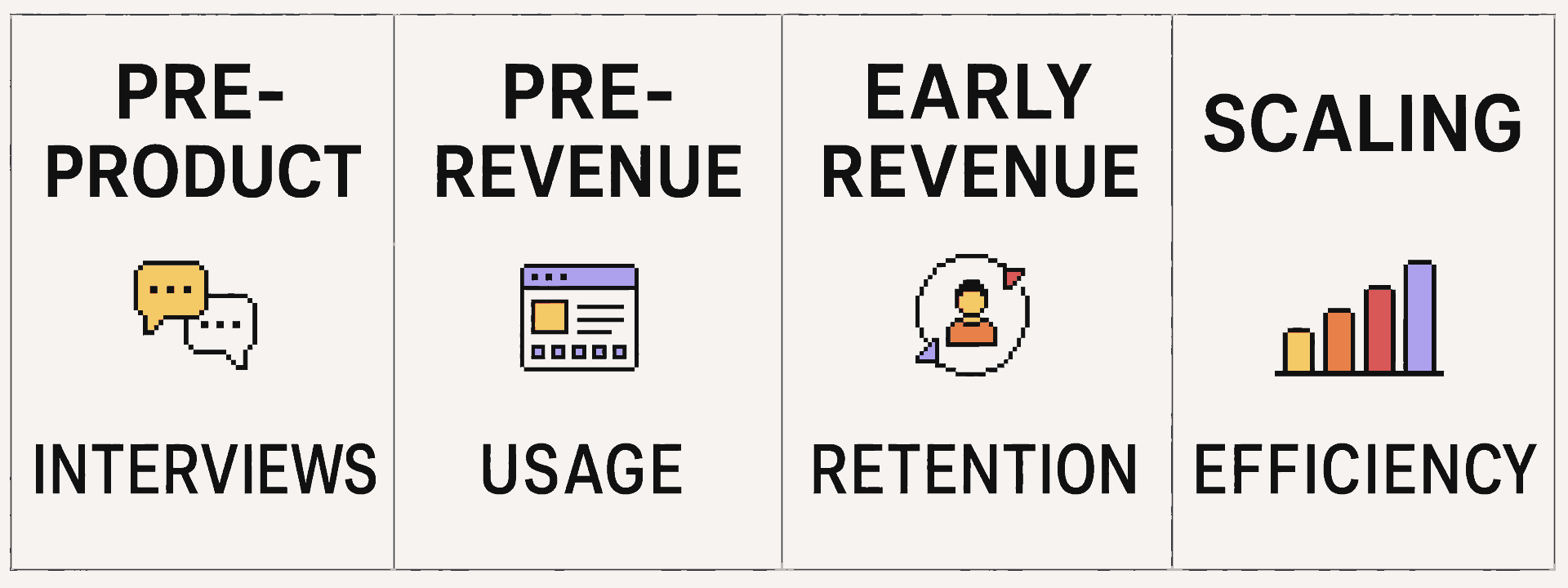
- Pre-product: Look for rigorous customer discovery, prototype tests, design partners, letters of intent, or another costly commitment from the customer.
- Pre-revenue: Look for activation, repeat usage, successful pilots, a growing waitlist with qualified users, or contracts contingent on delivery.
- Early revenue: Look for retention, repeat purchases, expansion, sales repeatability, and early contribution margins.
- Scaling: Look for stable cohort behavior, customer acquisition cost (CAC) payback, efficient growth, and evidence the organization can deliver at higher volume.
Use business-model-specific metrics. Monthly recurring revenue is useful for subscription software and mostly useless for a clinical-stage biotech company. Gross merchandise value can flatter a marketplace with weak take rate and poor retention. Downloads can flatter a consumer app nobody reopens.
Read the shape of the data as well as the endpoint. One large enterprise contract may be encouraging and dangerously concentrated. A small cohort with improving retention can reveal more than a large top-line number created by discounts.
Examine business model and unit economics
Understand who pays, how much, how often, and what it costs to deliver the product. Then identify what improves or deteriorates with scale.
For recurring software, retention and gross margin shape the model. For marketplaces, frequency, take rate, liquidity, and incentives matter. For hardware, manufacturing yield, working capital, service costs, and supply concentration can dominate. For regulated businesses, time to approval and compliance cost may control the pace of growth.
Early numbers are noisy. Treat them as evidence about the founders' command of the business. A strong answer explains assumptions, customer-level variation, and what has changed. A weak answer recites a blended average with no underlying drivers.
Also ask what the new capital must prove. The financing should buy a specific step-up in evidence, such as retention across several cohorts, a repeatable sales channel, technical validation, or a regulatory milestone. “Hire and grow” is not a financing plan.
Evaluate terms and the cap table as part of the company
The same startup can be a different investment at a different price or through a different security. Review the valuation or valuation cap, discount, dilution from outstanding Simple Agreements for Future Equity (SAFEs) and options, liquidation preference, information rights, pro rata rights, transfer restrictions, fees, and any special purpose vehicle (SPV) economics.
Then inspect the cap table for incentives and future financing risk. Founder ownership, option-pool needs, prior securities, debt, and investor rights can affect the company's ability to raise and retain talent.
Terms should match the risk still present. A high price requires the company to create more value before a future investor can justify a higher round. Investor-friendly control rights cannot turn weak fundamentals into a good company.
Find the one thing the startup must de-risk
Flat checklists fail because every business has a different bottleneck. After reviewing the standard criteria, name the one or two assumptions that must become true for the company to work.
For a vertical software company, the constraint may be a sales cycle that makes small contracts uneconomic. For a marketplace, it may be enough local liquidity to create a reliable experience. For a medical device, it may be clinical or regulatory validation. For a consumer app, it may be durable retention after novelty fades.
Run diligence toward that bottleneck:
- State the failure mode: “This company fails if...”
- Name the evidence: What observation would materially reduce that risk?
- Seek disconfirmation: Which customer, former employee, competitor, or data point is most likely to break the thesis?
- Set the pass condition: Decide what answer is unacceptable before you hear it.
- Record residual risk: Some uncertainty will remain. Name it instead of smoothing it away.
This approach is especially useful outside your industry expertise. You do not need to master every technical detail. You do need to identify where technical, regulatory, or scientific uncertainty controls the outcome, then bring in someone qualified to assess it. Pass when that central risk remains unreadable.
In Angel Squad, our angel-investing community, members can compare notes with operators from different industries and watch experienced investors question founders. That cross-check helps separate a universal business risk from a domain detail that only sounds intimidating.
Write a decision memo before the round creates urgency
Put the case in writing before you commit. A short memo should answer:
- What does the company do, for whom, and why now?
- Which evidence best supports the investment?
- What is the must-de-risk assumption?
- What evidence contradicts the pitch?
- What do customer and founder references reveal?
- How do the terms change the risk and potential upside?
- What role would this check play in the portfolio?
- What would make you invest, wait, or pass?
Keep unresolved questions visible. If the round closes before you can answer a material one, pass. Urgency is a deal condition, not business evidence.
Red flags that can override the rest of the rubric
Some signals deserve more weight than an otherwise attractive scorecard:
- The founder's answers change across meetings or conflict with documents.
- Customer references do not support the claimed usage, urgency, or results.
- Traction depends on discounts, one relationship, paid acquisition with unknown retention, or a metric unrelated to value.
- The company cannot explain why its wedge leads to a larger market.
- The go-to-market plan assumes a sales cycle, channel, or conversion rate the team has never tested.
- The founders cannot explain their burn, runway, cap table, or intended use of the round.
- A critical technical, regulatory, or legal claim receives no independent scrutiny.
- The deal structure or fee stack is too opaque to understand what you will own.
One red flag does not always end the conversation. Dishonesty should. Other weaknesses become the agenda for the next diligence step.
Use criteria to compare deals, not justify a favorite
Your rubric should make a pass easier as well as make a yes more rigorous. Keep the criteria stable, adjust the evidence for stage and business model, and review past memos to see which signals you consistently overrate.
If you want live practice evaluating founders, peer feedback on your reasoning, and curated opportunities from Hustle Fund, apply to Angel Squad. You can join the community to learn without accredited-investor status; accredited-investor status is required for relevant private investments.













.png)