
How Angel Communities Build Startup Due Diligence Skill
A startup due diligence framework is easy to download. The hard part is learning when a retention figure matters, when a market claim is hand-waving, and when your own experience creates a blind spot. That judgment grows through structured practice and feedback from people who see the same pitch differently.
For the substantive deal review, use our angel investing due diligence checklist. A good angel community adds the learning layer: peer review and shared templates that improve each member's judgment.
Community learning builds pattern recognition
Pattern recognition is more than seeing a stream of startups. You have to record what you believed, identify the evidence behind it, hear how other investors read the same facts, and revisit the call later. Otherwise, exposure can reinforce a hunch just as easily as it can correct one.
Elizabeth Yin makes the process point directly:
“The more disciplined you are in your thought process/rubric, the more you can improve over time.”
A useful community learning cycle has three parts:
- Before the pitch: Research independently, calibrate the questions to the company's stage, and write down what must be true for the opportunity to fit your thesis.
- During the pitch: Capture claims and evidence separately. Record how the founders respond when a question challenges their story.
- After the pitch: Verify the important claims, compare independent reads, document the decision, and later compare the original reasoning with what happened.
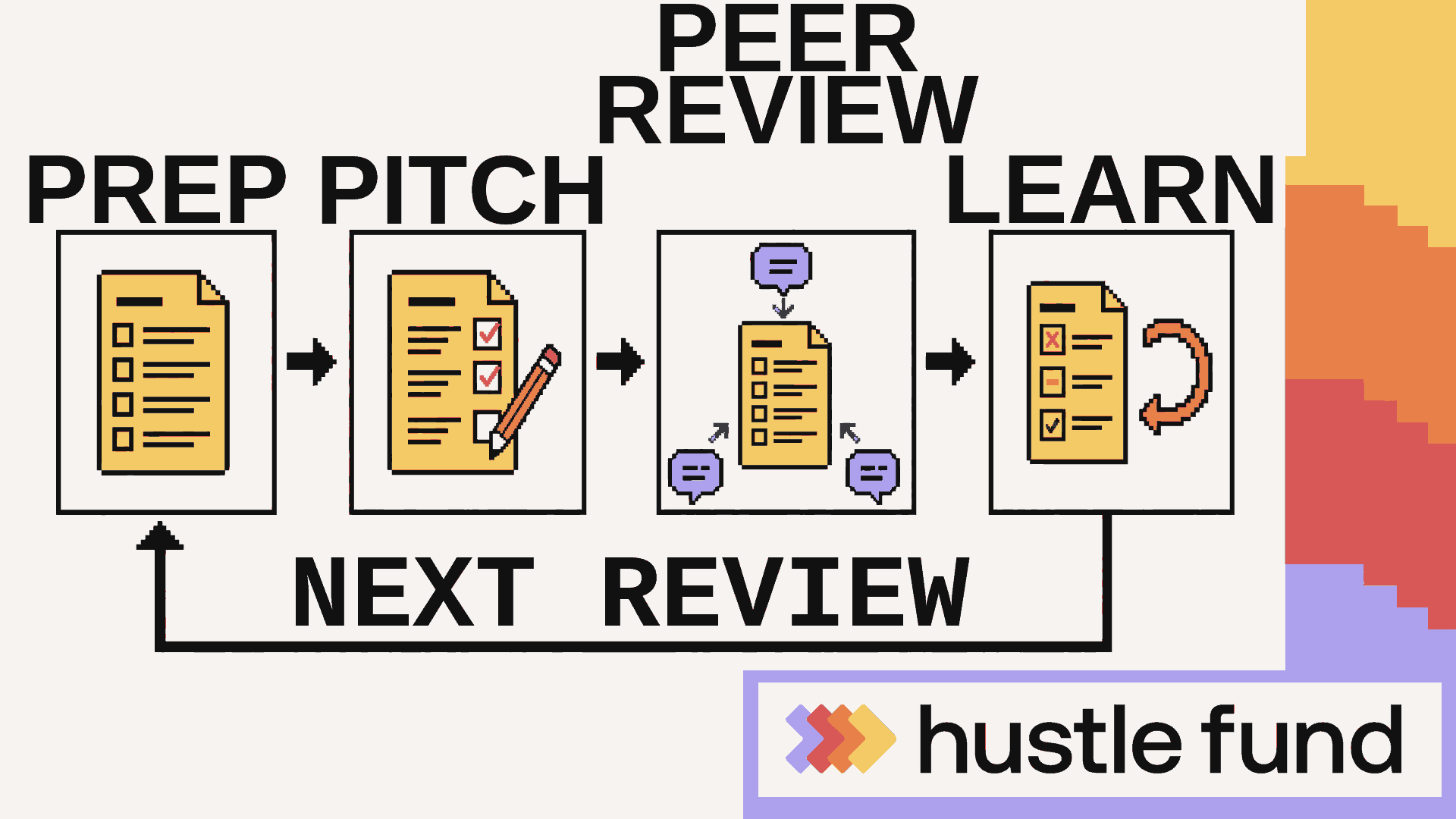
These five tools support that cycle. They are learning aids, not a substitute for legal, financial, technical, or customer diligence.
Shared template 1: pre-pitch research and questions
Complete this worksheet alone before opening anyone else's notes. The point is to arrive with a view that peers can challenge, rather than borrowing the first confident opinion in the room.
Copy these fields:
- Company, round, stage, and business model
- My two-sentence read: What does the company do, and what must be true for it to work?
- Stage-appropriate proof: What can reasonably exist now? A pre-seed company may have customer discovery and a rough product. A seed company should have more evidence around usage, retention, or repeatable acquisition.
- Known evidence: Facts supported by the deck, product, customers, or other primary material
- Open assumptions: Claims that are plausible but still unverified
- The first-100-customers test: Who are the first 100 customers, how will the founders reach them, who makes the buying decision, and what could block the sale?
- Forward-looking prompts: What breaks first at 10 times the current scale? What could the unit economics look like at scale? Which non-obvious alternative already solves the customer's problem?
- Three questions I need answered: Include why each answer could change the decision
- My blind spots: Sector gaps, personal relationships, prior wins or losses, and any conflict of interest
Stage calibration belongs at the top. A survey of institutional VCs, covering 885 investors, found that investment practices differ across stage, industry, geography, and past success. The lesson for angels is simple: do not grade a pre-seed company with a Series A rubric.
Your investment lens also needs a label. At Hustle Fund, our venture lens asks whether the potential outcome can be large enough for venture economics and whether the founders have a unique insight or access advantage. That is our approach, shaped by our portfolio model. It is not a universal test of whether a company is good, or whether it fits a personal angel portfolio.
How peers use it: Swap worksheets only after everyone has finished. Ask one another which assumption carries the decision, whether the requested proof matches the stage, and which question would produce the most information. Keep disagreements. They are the raw material for the debrief.
Practice tool 2: live-pitch notes and claim verification
Most pitch notes mix facts, forecasts, and impressions into one blur. A claim-verification sheet forces you to separate them while the conversation is still fresh.
Capture each important claim with these fields:
- Claim: Use the founder's words or the exact metric shown
- Type: Observed fact, founder report, forecast, or investor inference
- Scope: Period, cohort, customer segment, geography, and denominator
- Evidence offered: Demo, dashboard, contract, customer comment, or none yet
- Follow-up asked: The question and the founder's response
- Verification needed: What source could corroborate or contradict the claim?
- Decision relevance: What changes if the claim is wrong?
This is where peers can challenge a pitch on retention or customer acquisition cost (CAC) without asking generic metric questions. If a founder says revenue is growing 10% month over month, one investor can ask whether growth comes from retained cohorts or newly signed customers. Another can ask whether CAC includes founder time, agency fees, and sales compensation. A third can test whether the assumed payback period survives lower gross margin or higher churn.
Record founder behavior with equal care. Early-stage facts will change, so watch for:
- Adaptability: Do the founders update their view when credible evidence conflicts with it?
- Execution speed: How quickly did they move from an insight to a test, shipment, or customer conversation?
- Self-awareness: Can they name the team's gaps and explain how they will cover them?
- Specificity under pressure: Do answers get clearer when challenged, or slide into vague language?
These observations need examples. “Coachability: 4/5” teaches you little. “Changed onboarding after five users failed at the same step, shipped the revision in four days, and measured completion again” gives peers something they can assess.
Shared template 3: post-pitch evidence tracker
After the pitch, move the decision-relevant claims into one evidence tracker. This stops duplicated work and makes open questions visible to the whole review group.
Use these fields:
- Claim and why it matters
- Stage-matched evidence expected
- Best available source
- Status: Corroborated, contradicted, partially supported, or open
- Evidence found: Link or short note, with access limited to people authorized to see it
- Reviewer and relevant experience
- Alternative explanation
- Red-flag level: Watch, material concern, or stop pending resolution
- Escalation question: What must be answered next?
- Resolution and effect on conviction
Red-flag escalation matters because every anomaly is not a deal-breaker. A young company's rough forecast may reflect immaturity. A traction claim that changes after a direct question may point to a trust problem. The tracker records the difference and assigns the next step instead of letting concern circulate as gossip.
Escalate the review when a founder:
- Repeatedly blames the market without adapting: Slow growth may have external causes, but the team should still be running tests and changing its approach.
- Cannot explain why now: The problem may be real while the timing, buyer behavior, or enabling technology is not ready.
- Has raised repeatedly without clear progress: Compare the milestones promised in earlier rounds with what the capital produced.
- Stays vague about the use of proceeds: Ask which milestones the new money funds and how those milestones reduce risk.
- Shows more fundraising polish than product or traction: A strong deck and smooth answers should lead to stronger product evidence, customer proof, or execution history.
Each signal should trigger investigation rather than automatic rejection. Record the follow-up question, the evidence received, and whether the answer changes the concern.
Sector expertise should enter through a specific question. Ask an enterprise seller about procurement length, a clinician about workflow adoption, or a marketplace operator about liquidity. Record the expert's evidence, confidence, and the limits of their experience. Their title does not settle the decision.
Our Angel Squad community gives members current educational resources, virtual events with live startup pitches, deal memos, and a network of operators and investors. That creates a shared base for practice. The worksheet and evidence tracker give people a consistent way to compare what they noticed and route a hard question to someone with relevant operating experience.

Peer review tool 4: the pitch-session debrief rubric
A debrief works when it tests reasoning. It fails when the most experienced or enthusiastic person gives a verdict first and everyone else adjusts around it.
Require each reviewer to record an independent view before discussion. In a controlled experiment, even mild social influence narrowed the diversity of estimates without improving the group's accuracy. Startup decisions are more complex than the study's estimation tasks, but the practical safeguard carries over: preserve independent views before inviting persuasion.
Run the debrief in five rounds:
- Independent read: Each person records invest, pass, or investigate further, plus the assumption driving that view.
- Evidence round: Each reviewer names the strongest evidence, the weakest claim, and one missing fact.
- Challenge round: Peers test retention, CAC, market access, founder adaptability, and any alternative explanation for the traction.
- Expert input: A reviewer with relevant domain experience answers the narrow question assigned to them and states what they cannot infer.
- Update round: Everyone records whether their view changed, what changed it, and what remains unresolved.
The peer debrief rubric should contain:
- Stage and appropriate proof bar
- Strongest supported claim
- Highest-impact unverified claim
- Retention and CAC question, if relevant
- First-100-customers access risk
- Founder adaptability, execution speed, and self-awareness evidence
- Sector-expert input and its limits
- Red flag and escalation owner
- Conviction before and after discussion
- Dissenting view worth preserving
Do not force consensus. A well-supported disagreement helps each investor locate the differences in thesis, risk tolerance, and domain knowledge.
Practice tool 5: decision record and later outcome-review log
The decision record is the bridge between diligence and learning. It does not need to duplicate the company's history or every document reviewed. Its job is to freeze your reasoning before the outcome rewrites your memory.
Add these fields to your decision memo or review log:
- Decision date, information available, and rubric version
- Decision: Invest, pass, or wait
- Core thesis: The one or two things that must be true
- Best disconfirming evidence
- Open risks consciously accepted
- Peer challenge that changed my view
- Dissent I chose not to follow, and why
- Confidence and what would move it
- Next material update to review
Then add a later outcome-review entry when new evidence arrives:
- What happened?
- Which original claim gained or lost support?
- Was the miss caused by weak reasoning, missing information, execution after the decision, or luck?
- What should change in my personal rubric?
- Where should this lesson apply, and where should it not?
Review good and bad outcomes. A pass on a future winner can still have been a sound decision for your thesis. An investment that marks up quickly can still have come from sloppy reasoning. In the original outcome-bias experiments, people rated identical decision processes more favorably when they were told the outcome was good. A written record lets peers judge what you knew at the time before discussing what happened later.
Repetition and feedback should change your personal rubric
Repetition creates useful pattern recognition only when the pattern is named, challenged, and tested. Shiyan Koh makes the calibration point in another investing context:
“The more funds we evaluate, the better we can benchmark one against another.”
Startup review works the same way. Keep a rubric change log with the old rule, the new rule, the decisions that prompted the change, and the types of companies where it applies. Do not rewrite a rubric around one vivid outcome. Look for repeated evidence and ask peers to find counterexamples.
A good community supplies three feedback loops: immediate challenge after a pitch, evidence updates while claims are verified, and later decision postmortems. The postmortem should ask where the group was well calibrated, which dissent proved useful, what it missed, and what changes before the next review. No deal-count milestone turns judgment on automatically. Skill grows when each repetition produces a specific correction.
No community can remove startup risk or make every decision right. It can make your reasoning visible, testable, and easier to improve.
If you want live startup pitches, investing education from our team, and a community of operators and investors to practice with, apply to Angel Squad. Bring these five tools to each review, compare notes after the pitch, and update your rubric when the evidence proves you wrong.













.png)