
Equity Crowdfunding: The Investor’s Reality Check
Equity crowdfunding has made private startup deals visible to far more investors. Access is the easy part. Understanding the security, the valuation, and the path to a return still takes work.
Here’s how the process works in the US, what the campaign page can’t tell you, and the checklist we’d use before committing a dollar.
What equity crowdfunding actually means
Equity crowdfunding lets a company raise money online from many investors. In exchange, each investor receives a security tied to the business. That security might be stock, a Simple Agreement for Future Equity (SAFE), or another instrument with equity-like economics.
This differs from the crowdfunding you see on Kickstarter or GoFundMe. A donation gives you no financial claim. A rewards campaign may send you a product. An equity crowdfunding investment gives you contractual rights and the possibility of a financial return. It also puts your capital at risk.
In the US, “equity crowdfunding” is broader than one securities exemption. Public campaigns can rely on Regulation Crowdfunding, commonly called Reg CF, or Regulation A. Some online startup offerings use Regulation D and accept accredited investors only. The exemption named in the offering documents determines who can invest, what the company must disclose, and which resale rules apply.
We focus on Reg CF because it permits both accredited and non-accredited investors to participate. The market is no longer tiny. SEC crowdfunding statistics show 9,461 Reg CF offerings from the exemption’s 2016 launch through December 2025. Across 4,303 offerings that reported proceeds, issuers reported raising $1.546 billion. The SEC describes that proceeds figure as a lower-bound estimate because some completed offerings lack a complete progress filing.
This material is educational and does not constitute legal, tax, or investment advice. Get independent advice from qualified legal and tax professionals on an offering’s terms and tax consequences.
How a Reg CF investment works
A polished campaign page can make the process feel like online shopping. The legal and financial path is quite different.
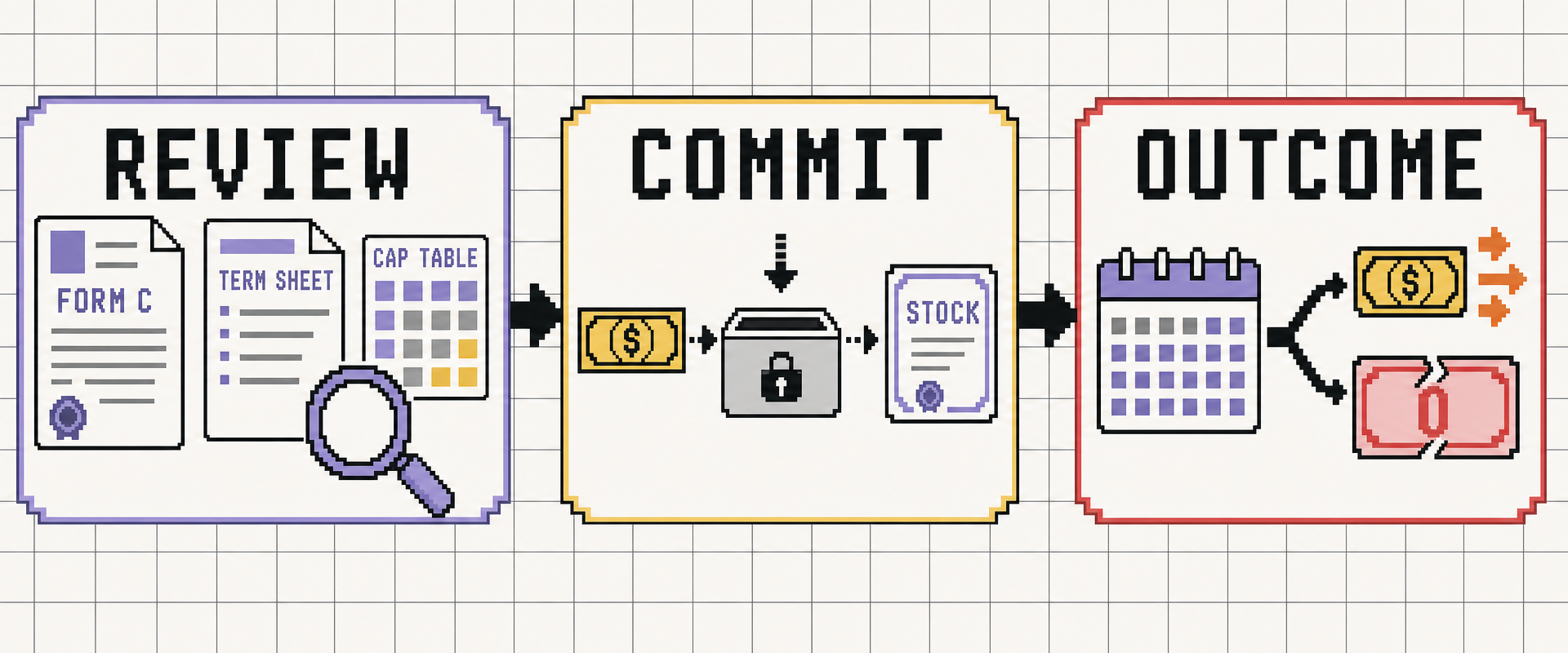
- You find an offering through an intermediary. A Reg CF transaction must run through one SEC-registered broker-dealer or funding portal. Our platform comparison explains how several common options differ.
- You review the disclosure and terms. The company files Form C on EDGAR and posts its offering information through the intermediary. This includes the business, team, ownership, use of proceeds, financial condition, target amount, deadline, security, and related-party transactions.
- You make a commitment. Your money goes to a qualified third party until the offering reaches its target. Under Reg CF, you can generally cancel until 48 hours before the deadline. A material change requires investors to reconfirm their commitments.
- The offering closes or fails to reach its target. If it closes, the issuer receives the proceeds and you receive the security described in the documents. If it misses the target, committed funds are returned.
- You wait for a company outcome. A return may come from an acquisition, public listing, company-approved secondary sale, repurchase, dividend, or other distribution. None is guaranteed.
Reg CF currently permits an issuer to raise up to $5 million in a 12-month period. Accredited investors have no Reg CF-specific investment cap. Non-accredited investors have a rolling 12-month cap across all Reg CF offerings:
- If either annual income or net worth is below $124,000, the cap is the greater of $2,500 or 5% of the greater of annual income or net worth.
- If both are at least $124,000, the cap is 10% of the greater figure, up to $124,000.
The current limits and filing requirements are set out in the SEC’s issuer guidance. A legal maximum says how much the rules allow. It says nothing about how much fits your finances or risk tolerance.
What you own depends on the instrument
“Invest in this company” is marketing shorthand. Read the actual security before you model a return.
Common or preferred stock gives you equity now. The rights can vary widely. Look for voting rights, information rights, transfer restrictions, liquidation preferences, and the class of stock. Crowdfunding investors may hold non-voting shares while later investors negotiate stronger protections.
A SAFE is a contract that may convert into equity after a specified financing or other trigger. It is neither current stock nor debt. The valuation cap, discount, conversion mechanics, liquidity provisions, and termination language determine the economics. Pre-money and post-money versions can produce different ownership results, which we break down in our guide to pre-money and post-money SAFEs.
A convertible note is debt intended to convert into equity under stated conditions. It adds interest and a maturity date, though repayment at maturity can still be uncertain when the issuer is an early-stage startup.
Your security may be held directly or through a crowdfunding vehicle. A vehicle can keep many small investors grouped on the company’s capitalization table, but its governing documents determine who votes, communicates with the issuer, handles distributions, and makes decisions in a transaction.
Value flows from the signed instrument. The company logo contributes nothing to your contractual rights.
The upside and the risks
Equity crowdfunding has real benefits for investors:
- Access: You can see private-company offerings without an introduction from an established angel network.
- Lower minimums: Many campaigns let you spread a startup budget across more companies than direct angel checks would allow.
- Relevant expertise: Operators can use their knowledge of customers, technology, regulation, or distribution to assess a business in their field.
- Personal alignment: You can back a product, local business, or mission you understand and care about.
The tradeoffs deserve more attention than the campaign video:
- Total loss: Early-stage companies can run out of cash, fail to raise again, or build something customers do not buy.
- Illiquidity: Reg CF securities generally cannot be resold for one year, subject to limited exceptions. Once that restriction ends, a buyer still may not exist.
- Dilution: New shares, options, and convertible securities can shrink your percentage ownership.
- Preference stack: Debt and preferred investors may receive proceeds before common holders in a sale.
- Limited reporting: Reg CF issuers generally file annual Form C-AR reports, but the rules allow reporting to end after certain conditions are met. Public-company reporting standards do not apply.
- Unequal access: Later investors may negotiate information, pro rata, voting, or liquidation rights you do not receive.
- Selection risk: A visible campaign and a large amount “reserved” show attention. They do not establish a fair valuation or a strong business.
Funding portals must provide investor education, perform specified background checks, and deny platform access when they have a reasonable basis to suspect fraud or other investor-protection concerns. Those intermediary duties are useful safeguards. They are not an endorsement of investment merit.
Angel Squad, our angel-investing community, helps operators build an independent decision process through investor education and peer discussion. You do not need accredited-investor status to join. Investing in opportunities shared through the community does require it.
“Investing in risky/uncertain things (such as startups) is a total mindwarp.”
Elizabeth Yin, Hustle Fund co-founder and general partner
Crowdfunding makes the transaction easier. Startup outcomes remain just as uncertain.
The return math most campaign pages skip
Headline valuation, dilution, time, and payout priority all affect your result.
Suppose you invest $1,000 at a $12 million post-money valuation. Your starting ownership is roughly 0.0083%. If future financings cut that stake in half, you own about 0.0042%.
If the company later sells for $120 million and every dollar is distributed pro rata, your share would be about $5,000. That is a 5x gross multiple. If the money arrives eight years after your investment, the annualized gross return is about 22%.
That tidy example ignores platform or vehicle fees, taxes, debt, transaction expenses, liquidation preferences, participation rights, and the exact conversion of any SAFE or note. Each can reduce the payout. A company can also keep operating for years without creating any liquidity for shareholders.
Run this calculation in three cases before investing:
- Base case: Use a plausible exit value and meaningful dilution.
- Downside case: Assume no return or a sale where senior claims consume the proceeds.
- Outlier case: Ask how large the company must become for the investment to return the entire amount you plan to deploy across startups.
“Don't try to pick a co. Select a portfolio.”
Elizabeth Yin, Hustle Fund co-founder and general partner
That mindset matters because one exciting campaign can easily absorb a budget meant for several years of investing.
Our equity crowdfunding due diligence checklist
Treat the campaign page as the start of diligence. The Form C, cap table, financial statements, and security documents carry more weight than the pitch video.
1. Confirm the legal path
Identify the exemption, intermediary, issuer’s exact legal name, and Form C filing. Use FINRA’s list of regulated funding portals and the issuer’s EDGAR history. Read every Form C/A amendment, not only the original filing.
2. Understand the team and ownership
Study founder experience, commitment, references, prior companies, compensation, and ownership. Then map major shareholders, option pools, debt, SAFEs, notes, and related-party transactions. A founder with little remaining ownership or a crowded stack of convertibles can create future incentive and dilution problems.
3. Separate traction from activity
Revenue quality matters more than a big waitlist. Look for customer concentration, retention, gross margin, repeat purchases, sales-cycle length, and whether growth came from durable demand or short-term promotion. Ask what evidence would disprove the company’s core claim.
4. Reconcile the cash plan
Start with cash on hand, monthly burn, debt service, and the amount the campaign expects to net. Divide usable cash by monthly burn to estimate months of runway. Then connect the use of funds to one milestone that could improve the next financing or move the company toward self-sufficiency.
5. Price the deal
Compare the valuation with current revenue, growth, margins, stage, and similar financings. A beloved product can still be a poor investment at an aggressive price. Model dilution and exit proceeds rather than relying on the campaign’s valuation graphic.
6. Read every economic term
Identify what you own now, what converts later, and what happens in a financing, acquisition, shutdown, or maturity. Note the valuation cap, discount, interest, preference, voting rights, information rights, pro rata rights, transfer limits, and fees.
7. Map the next round
Estimate how much capital the company needs after this campaign. A business that must raise repeatedly carries financing risk. Future investors may demand terms that dilute or subordinate the crowd.
8. Define the reporting relationship
Record where updates will appear, who handles securities records, and how the issuer communicates after the portal campaign ends. Watch for Form C-AR annual reports and any Form C-TR that terminates reporting.
9. Write your decision before committing
Capture the thesis, major risks, expected holding period, ownership estimate, and reasons to pass. Our one-page investment tear sheet gives you a repeatable format. A written record also makes it harder to rewrite your reasoning after the outcome is known.
Set your portfolio process before you browse
Crowdfunding feeds are designed to keep deals moving. Your process should slow the decision down.
Set a multi-year startup allocation that you can afford to lose and leave illiquid. Break it into planned check sizes. Reserve room for future deals. Pass when the instrument or reporting is too weak, even if you love the product.
Then use the same rubric every time. Repetition exposes where your judgment is solid and where a charismatic pitch still pulls you off course.
Equity crowdfunding can widen your deal flow. Your advantage still comes from disciplined diligence, sensible pricing, and a portfolio built to survive losses and long waits.
If you want to build that discipline with education, peer discussion, and startup investment opportunities sourced by Hustle Fund, apply to Angel Squad.












.png)