
Crowdfunding vs. Venture Capital: What Investors Should Know
Crowdfunding and venture capital can both finance a startup, yet they create very different incentives, rights, and signals. For an investor, the label on the round tells you less than the security, terms, fundraising goal, and people involved. Here is how each route works, what the current data shows, and how to underwrite a startup that has raised from the crowd, a VC fund, or both.
Crowdfunding means four different funding models
Crowdfunding collects relatively small contributions from many people, usually through an online platform. That broad definition covers four models with different economic relationships:
- Donation crowdfunding: Backers give money without expecting a product, repayment, or ownership.
- Rewards or preorder crowdfunding: Backers receive a product, early access, or another perk. They are customers or supporters, not investors.
- Debt crowdfunding: Investors lend money under terms that set repayment and, usually, interest. The debt instrument may be a security.
- Equity crowdfunding: Investors buy an ownership interest in the company.
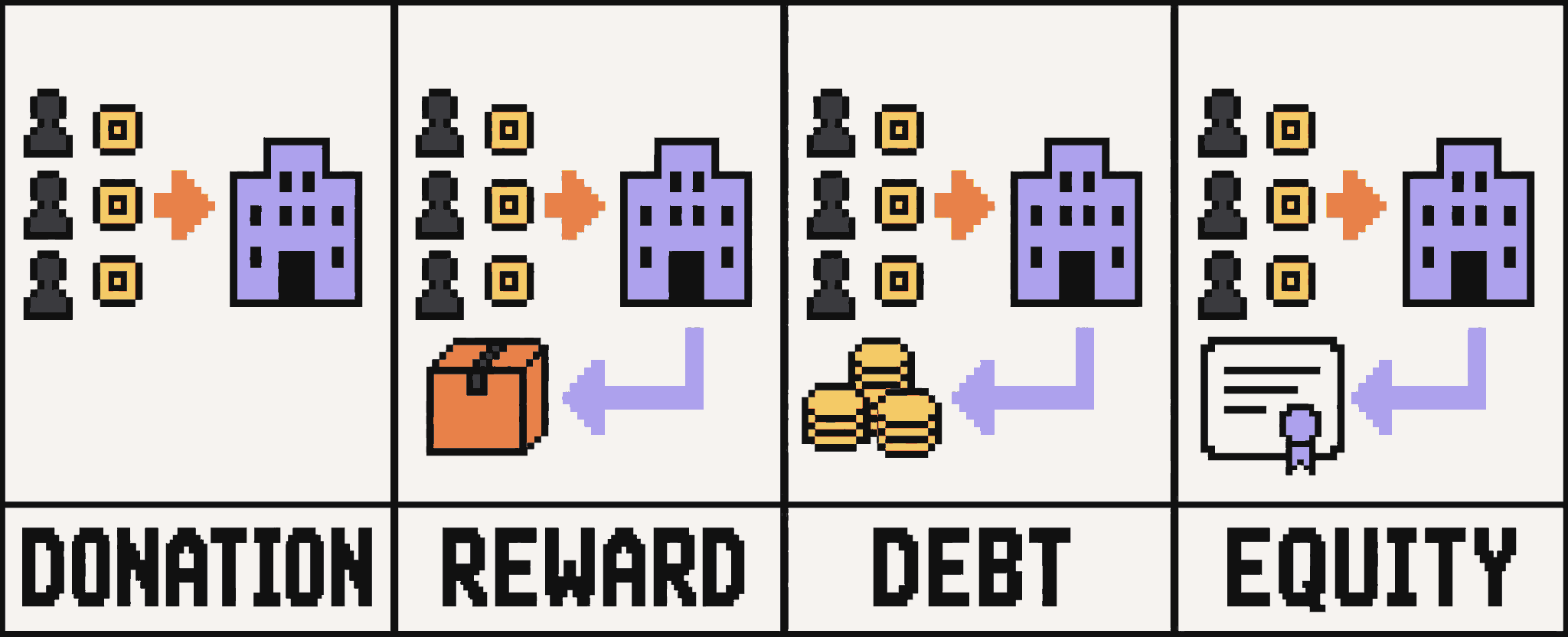
These models describe the backer's economic relationship with the company. They do not map one-to-one to securities law. Stock, a Simple Agreement for Future Equity (SAFE), and crowdfunded debt can all be securities. In the United States, securities crowdfunding under Regulation Crowdfunding may therefore use equity, debt, or SAFEs.
Equity crowdfunding is the closest like-for-like ownership comparison with a priced VC round. Securities crowdfunding is the closest investment comparison with venture financing more broadly because both routes sell financial instruments. Other crowdfunding models can also finance a startup without giving the crowd ownership. A successful preorder campaign can still matter to an investor because it may show demand and distribution skill. It does not give backers equity, information rights, or a claim on a future exit.
In the United States, Regulation Crowdfunding, often shortened to Reg CF, lets eligible companies raise up to $5 million in a rolling 12-month period. The offering must run through one SEC-registered broker-dealer or funding portal. The company files a Form C with business, ownership, offering, and financial information, and securities generally cannot be resold for one year. The Regulation Crowdfunding rules also limit how much a non-accredited investor can invest across Reg CF offerings.
Early-stage securities are high-risk and illiquid. Many startups fail, and investors can lose their full investment. This discussion is educational rather than individualized investment advice, and it does not constitute legal or tax advice. Issuers and investors should seek independent review from qualified legal and tax professionals for the specific offering.
How venture capital works
A venture fund pools capital from limited partners and invests it through professional fund managers. A startup usually raises from a small group of funds and angel investors rather than hundreds or thousands of public backers.
The parties negotiate the investment instrument, valuation, economics, and rights. At pre-seed, the instrument may be a SAFE. In a priced equity round, a lead investor may negotiate a preferred share class, board representation, information rights, pro rata rights, protective provisions, and liquidation preferences. The actual documents decide what the investor receives.
VC fund economics also shape which companies qualify. A healthy small business may be a poor fit for a fund that needs a few investments to return a large portfolio.
“Investors are looking for THE VERY HIGHEST ROI opp. NOT great businesses.”
Elizabeth Yin, Democratizing Knowledge
That distinction matters when you read a funding announcement. A VC pass is not proof that a business is weak. It may mean the expected outcome, timing, industry, ownership, or capital need does not fit that fund.
Crowdfunding vs. venture capital: seven differences that affect investors
When crowdfunding sells securities, both routes can end with an investor owning a startup security. The route to that security changes how the deal is sourced, priced, governed, and supported.
- Capital source and motivation. A crowdfunding round may attract customers, local supporters, retail investors, and accredited investors at once. A VC round draws professional funds and angels whose mandate centers on financial returns. Crowd enthusiasm can help distribution, although enthusiasm does not replace underwriting.
- Security and ownership. Rewards crowdfunding causes no equity dilution. Equity crowdfunding does, while SAFEs and convertible debt may dilute ownership when they convert. Straight debt generally creates a repayment claim rather than ownership. Reg CF offerings can use equity, debt, or SAFEs, so “crowdfunded” does not tell you what an investor owns. Venture rounds also use several instruments. A lead investor often helps set the terms.
- Check concentration. Crowdfunding spreads the raise across many investors. VC concentrates capital among fewer investors with larger checks. Under the Rule 3a-9 requirements, a qualifying crowdfunding vehicle may consolidate the crowd's interest into one line on the issuer's cap table. The company and vehicle are co-issuers and jointly file Form C. Without a clean structure, communication, voting, and future consents can get messy.
- Access and solicitation. Reg CF opens an offering to non-accredited investors, subject to investment limits and platform rules. Private venture rounds commonly rely on exemptions such as Rule 506(b) or Rule 506(c). Those exemptions have different rules for investor eligibility and general solicitation. The SEC's capital pathways show why “private round” is also too broad a label.
- Governance and support. A VC may take a board seat, reserve approval rights, recruit executives, make introductions, and help with the next round. Crowd investors usually have less direct influence. That can preserve founder autonomy, but it can also leave the company without one investor who owns the job of helping.
- Cost and disclosure. Crowdfunding adds intermediary compensation, legal work, financial-statement requirements, campaign production, and ongoing reporting. VC fundraising consumes founder time and creates legal costs, dilution, and negotiated rights. Neither route is free.
- Follow-on financing. A venture investor may reserve capital and help assemble the next round. A crowdfunding campaign can be repeated or followed by another exemption. Follow-on capital is still uncertain. Investors need to see the company's plan after the current cash runs out.
For investors, the useful question is: What job is this capital supposed to do, and does the structure help the company do it? Inside Angel Squad, our angel-investing community, we use our investing experience at Hustle Fund, curated opportunities, and peer discussion to examine that question in the context of real early-stage deals.
What the Reg CF data actually shows
Broad claims about crowdfunding tend to lean on a few famous campaigns. The larger U.S. dataset is more sobering and more useful.
An SEC analysis of Reg CF examined filings from the exemption's launch in May 2016 through December 2024. It found:
- 8,492 offerings were initiated, excluding withdrawals.
- 3,869 offerings reported proceeds, totaling about $1.3 billion. The SEC describes that total as a likely lower bound because Form C-U filing practices vary.
- The median offering that reported proceeds raised about $113,000.
- Across initiated offerings, 43% used equity, 31% used debt, and 25% used SAFEs.
- Among 3,253 issuers that reported proceeds, 3.4% later received venture capital financing, according to the SEC's matching with venture-backed company data.
These figures correct three common assumptions.
First, a $5 million legal ceiling is not a typical raise. The median reported result was far smaller. Second, securities crowdfunding does not always sell current equity. One in four offerings in the SEC sample used a SAFE, whose conversion and priority depend on its terms and later events. Third, crowdfunding can precede VC. The available data does not support treating VC follow-on as the standard outcome.
There is another signal problem. A rewards campaign can provide evidence that people will pay for a product, though refunds, cancellations, and fulfillment failures still matter. A securities campaign proves that people committed investment capital. It does not, by itself, prove product demand, retention, healthy unit economics, or a repeatable go-to-market motion.
Can a startup use crowdfunding and venture capital together?
Yes. The routes can complement each other when each round has a clear purpose and compatible documents. The sequence matters.
Rewards crowdfunding before VC can work for a consumer product with a visual demo and an existing audience. Investors should separate gross pledges from cash left after platform fees, refunds, manufacturing, shipping, taxes, and support. The strongest signal comes after the company delivers and customers keep buying at sustainable margins.
Securities crowdfunding alongside professional capital can let customers and supporters invest in the same financing. Equity makes them owners, debt makes them creditors, and a SAFE gives them contractual rights to future equity if it converts. A credible lead investor, consistent terms, a sensible valuation, and a crowdfunding vehicle can make the round easier to assess. Conflicting side letters, several security classes, or a loose collection of direct holders create work for the next financing.
Securities crowdfunding before VC can fund a specific milestone, such as regulatory clearance, a production run, or enough sales evidence to support a larger round. The founder should know how much runway the net proceeds buy and which proof point will change the next investor's view.
VC firms should be judged as carefully as crowdfunding structures. As our managing partner Shiyan Koh writes:
“Many VCs claim to add value, but the reality is often different.”
Shiyan Koh, our managing partner
Ask what the fund has actually done for companies at this stage. Capital is useful. Specific recruiting, customer, regulatory, operating, and follow-on help can be worth more.
A six-question diligence framework
Ignore the prestige of the route for a moment. Work through these six questions before comparing one deal with another.
- What exactly was raised? Identify the crowdfunding model, securities exemption, instrument, share class, valuation cap or price, discount, interest, maturity, conversion mechanics, and investor rights.
- What milestone does the money buy? Translate gross proceeds into net cash, monthly burn, runway, and a dated operating milestone. “Growth” is too vague.
- Who set the terms? Learn whether a lead investor negotiated and priced the round, whether insiders participated, and whether the crowd received the same economic terms. A lead is a useful signal, not a substitute for your own work.
- What does the ownership structure look like? Review the fully diluted startup cap table, outstanding SAFEs and notes, option pool, investor vehicle, side letters, and consent rights. Model what converts in the next priced round.
- Which traction is customer traction? Separate followers, backers, reservations, investment commitments, shipped orders, repeat customers, and recognized revenue. Ask for cohort retention, gross margin, and customer acquisition evidence where those metrics fit the business.
- What happens after this round? Understand ongoing reporting, investor communication, remaining authorized securities, future capital needs, likely dilution, and the founders' plan if the next round takes twice as long as expected.
Our members in Angel Squad practice this kind of diligence with shared frameworks and feedback from other operators and investors. That repetition matters because the next attractive pitch will still come with a different instrument, market, and set of risks.
Which route fits the startup's financing job?
The best fit follows from the use of funds, the company's growth model, and the kind of help it needs.
- Rewards crowdfunding fits a consumer product company with a demonstrable product, an engaged audience, credible fulfillment economics, and a need to validate demand or finance an initial run.
- Equity crowdfunding fits a U.S. company that can activate a real community, can work within the Reg CF cap, accepts public disclosures and ongoing obligations, and has terms that still leave room for future financing.
- Venture capital fits a company pursuing a large outcome, needing substantial follow-on capital or specialist help, and willing to exchange ownership and some control for that support.
- Revenue, grants, or debt, including crowdfunded debt, may fit better when the business can grow from cash flow, has grant-eligible research, owns financeable assets, or does not need venture-scale outcomes.
A founder can prefer control and still choose VC. A community-backed company can still choose a private round. The financing job and the documents decide the fit.
Frequently asked questions
Is crowdfunding cheaper than venture capital?
There is no blanket winner. The SEC estimated compensation to intermediaries at roughly 7.7% to 8.1% of proceeds across the Reg CF offerings it studied, with variation and incomplete fee reporting. Issuers may also pay legal, accounting, campaign, and marketing costs. VC rounds may avoid a platform commission. Legal fees, dilution, preferences, governance rights, and founder time carry real economic cost.
Does crowdfunding dilute founders?
Rewards and donation crowdfunding do not issue securities, so they do not dilute ownership. Equity, SAFE, and convertible-security crowdfunding can dilute founders and earlier investors. Debt without conversion or equity features generally does not dilute ownership. The amount of dilution depends on the price, valuation cap, discount, conversion terms, and later financing.
Do venture capital firms avoid crowdfunded startups?
Some firms may dislike a complicated cap table, weak reporting, unusual terms, or a campaign that missed its target. Others may value the community, revenue, or distribution evidence. The SEC found subsequent VC financing among 3.4% of Reg CF issuers that reported proceeds through 2024. That figure describes observed outcomes, not a rule about any one company or a measure of why investors passed.
Can non-accredited investors join a crowdfunding round?
They can participate in a U.S. Reg CF offering, subject to the applicable aggregate investment limits. Rewards campaigns do not require investor accreditation because backers are not buying securities. Other private offering exemptions have different eligibility and solicitation rules.
Build judgment across more than one deal
Crowdfunding expands access, and venture capital can bring concentrated capital and hands-on help. Either route can finance an exceptional startup or a weak one. Read the instrument, model the ownership, trace the money to a milestone, and judge the people who will remain after the round closes.
If you want to build that judgment through real startup opportunities, operator peers, and frameworks drawn from our investing practice at Hustle Fund, apply to Angel Squad.







.png)