
Convertible Note Terms for Angel Investors
Brian Nichols is the co-founder of Angel Squad, a community where you’ll learn how to angel invest and get a chance to invest as little as $1k into Hustle Fund’s top performing early-stage startups.
Important: This material is for general education. It is not investment, legal, tax, accounting, or valuation advice. Startup investments are speculative, illiquid, long-term, and can result in a total loss. Past results and current marks do not guarantee future results. Every example here is hypothetical and simplified, not a projection. Actual outcomes depend on the governing documents, cap table, fees, carry, taxes, valuation policies, and timing. Read the governing documents and work with qualified, independent advisers in each relevant field.
A short note can create a long list of consequences. One definition can change your conversion price, your share count, or your options when the startup never raises the expected round. Angel investors need to read convertible note terms as a connected system, then model what happens at financing, maturity, a sale, and failure. That discipline matters more than memorizing a supposedly standard cap or discount.
What are convertible note terms?
A convertible note is a loan from an investor to a company. It starts as debt and can convert into equity under the conditions written in the instrument. Startup notes typically contemplate conversion in a future financing, but conversion is never safe to assume. The note may also specify repayment, extension, holder elections, sale treatment, and default remedies.
Startup convertible notes are generally securities. The company must register the offering or rely on an available exemption, and the exemption affects who can invest. The SEC's startup securities overview describes notes as a common early-stage instrument that typically converts at the next financing or another agreed event.
The note is only part of the package. A note purchase agreement can contain representations, closing mechanics, and amendment rules. Side letters may add rights for individual investors. The cap table supplies inputs that the legal text alone cannot.
The 16 convertible note terms to check
There is no universal set of standard convertible note terms. Market habits do not replace the signed documents. Review these 16 items every time.
-
Principal. Confirm the amount advanced, funding date, and treatment of later advances. Principal is the starting balance, not necessarily the full amount that converts.
-
Interest. Identify the rate, simple or compound method, day-count basis, and any default rate. Accrued interest may convert, remain payable in cash, or receive another treatment.
-
Maturity date. Maturity does not guarantee repayment or force conversion. It may create repayment, conversion, extension, default, or acceleration rights.
-
Qualified financing. This contract-defined event, not a statutory category, often triggers conversion. Check the proceeds threshold, counted securities and closings, and whether converted notes count toward it.
-
Sub-threshold financing. A smaller round may allow conversion or leave the note outstanding. Find who elects, the notice deadline, and the price formula.
-
Valuation cap. The cap is an input to a conversion-price formula. It is not the company's current valuation, a ceiling on the next round's valuation, or a promised ownership percentage.
-
Discount. This reduces the new investors' price for conversion purposes. A 20% discount commonly appears as an 80% multiplier.
-
Cap-versus-discount interaction. Many notes use the lower conversion price. Others apply one method or use different formulas by event.
-
Company capitalization. Check how the cap formula treats common and preferred shares, issued and reserved options, warrants, other convertibles, the new option pool, and new money.
-
Conversion amount and security. Confirm whether principal, interest, or both convert, then identify the share class and its price, voting terms, and liquidation preference.
-
Change of control. A sale or merger may trigger repayment, conversion, a premium, or a holder election. Define the covered transactions and timing.
-
Dissolution and default. Read the payment, notice, cure, and acceleration terms. Recovery depends on assets remaining after higher-priority claims and costs.
-
Security and priority. Determine whether the note is secured or unsecured and ranks senior, equally with, or behind other debt. Contractual subordination can control priority.
-
Prepayment. Check whether early repayment is allowed, requires holder consent, or carries a premium. It can remove the opportunity to convert.
-
Amendments and waivers. Find the consent threshold, vote weighting, and individual-approval rights. A majority-in-interest clause may bind smaller holders.
-
Separate investor rights. Most favored nation (MFN), pro-rata, information, governance, and inspection rights are not inherent. Find their scope, duration, transferability, and termination in the signed package.
A repeatable checklist makes it easier to compare deals and learn from outcomes. As our co-founder and general partner Elizabeth Yin writes, “The more disciplined you are in your thought process/rubric, the more you can improve over time.”
How valuation caps and discounts change the share count
The conversion price connects the note to the cap table. Under a common structure, the note compares two prices:
- Discount price: the price paid by new investors multiplied by one minus the stated discount.
- Cap price: the valuation cap divided by the company capitalization defined in the note.
The lower price creates more conversion shares for the same converting balance. That result applies only when the note says to use the lower price. An uncapped note removes the cap calculation, but it can still include a discount and other conversion provisions.
A hypothetical, simplified share-count example
Assume the following terms for one direct investment:
- $100,000 principal funded on September 1, 2026
- 6% simple annual interest
- $7.5 million valuation cap
- 20% discount
- Principal and accrued interest convert after exactly one year
- New investors pay $2.00 per share in a qualified financing
- Defined company capitalization is 5,000,000 shares immediately before the financing
- The note says to use the lower of the cap price and discount price
Now run the math:
- Accrued interest: $100,000 × 6% × one year = $6,000.
- Converting balance: $100,000 principal + $6,000 interest = $106,000.
- Discount price: $2.00 × 80% = $1.60 per share.
- Cap price: $7,500,000 ÷ 5,000,000 shares = $1.50 per share.
- Applicable conversion price: $1.50 per share because this hypothetical note uses the lower price.
- Conversion shares: $106,000 ÷ $1.50 = 70,666.67 shares, subject to the document's rounding rule.
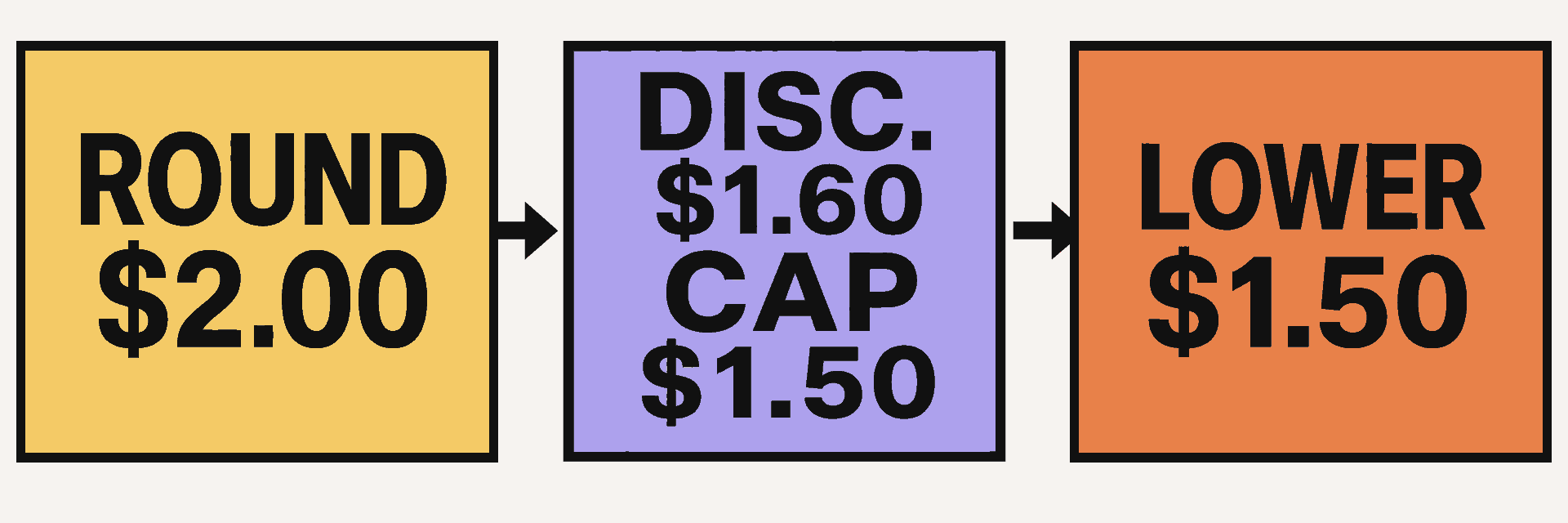
If only principal converted, the same formula would produce 66,666.67 shares. If the capitalization definition produced a different denominator, the cap price would also change. A new option-pool increase, other convertibles, and the treatment of reserved equity can all matter.
The 70,666.67 shares do not represent a realized return, a guaranteed ownership percentage, or $141,333 of cash value. The financing price belongs to a specific preferred security at one point in time. Dilution, liquidation preferences, later financings, company performance, fees, carry, taxes, and an eventual liquidity event determine the investor's outcome. Our cap-table primer explains why the denominator deserves as much attention as the headline cap.
What happens at each event
Read the note by event rather than assuming the next priced round arrives on schedule.
Qualified financing
The note commonly converts automatically using its stated formula. Confirm the threshold, balance, price, share class, closing date, and documents to sign. The priced-round term sheet matters because its preferences and option-pool changes affect the security and cap table.
Financing below the threshold
The note may stay outstanding or permit optional conversion. The company, holder, or a stated holder group may choose. Notice and pricing can differ from a qualified financing.
Maturity
Possible outcomes include repayment, extension, conversion, or default. A contractual demand right does not give the company cash, so a payment demand may lead to negotiation rather than recovery.
Acquisition or change of control
The holder may receive principal plus interest, a premium, conversion proceeds, or the better of stated alternatives. The contract's definition and election process control.
Dissolution or default
An outstanding note can rank ahead of equity while still recovering little or nothing. Secured lenders, senior debt, bankruptcy costs, and other claims may consume the available assets first. Check collateral, guarantees, contractual subordination, pari passu (equal-ranking) obligations, cure periods, and enforcement rights. A debt label is a place in a priority stack, not a promise of repayment.
Stacked notes and side letters create hidden interactions
Different caps, discounts, maturities, financing thresholds, and capitalization definitions can complicate conversion. Add instruments such as a Simple Agreement for Future Equity (SAFE), plus warrants and an option-pool increase, and the headline valuation reveals little about the final ownership split. As our co-founder and general partner Eric Bahn explains, “It is really easy to mess up these calculations when you have so many different kinds of pre-money valuations stacking on top of each other with capital that you raised before your Series A, or whenever your post-money raise takes place.”
Build a security-by-security schedule of issuance date, principal, interest treatment, cap, discount, conversion formula, maturity, seniority, and amendment threshold. Model all notes and SAFEs converting together.
Track side letters separately. An MFN clause may let its holder elect specified later terms, subject to contractual notice and election mechanics. Pro-rata rights create an opportunity to buy, not an obligation or a right beyond the agreement. Information and governance rights may end at conversion or below an ownership threshold.
Read voting provisions across the stack. A later lead cannot erase earlier rights; a waiver works through the governing consent mechanism. Compare instruments, side letters, and the cap table because one favorable clause may conflict with other rights or the next financing.
In Angel Squad, our angel-investing community, we share our early-stage evaluation approach. Members receive deal memos covering the company, founders, terms, and investment thesis, and can network with other operators and investors.
Three hypothetical negotiation scenarios
These hypothetical situations show document-specific tradeoffs, not universal terms to demand.
-
Maturity arrives before a qualified financing. The company asks for more time, while holders have a repayment or conversion election. An extension may preserve a financing path; repayment pressure may consume operating cash. Clarify liquidity, expected financing, interest during the extension, any conversion change, and the approval threshold.
-
Stacked notes use conflicting terms. The company wants every instrument to convert together despite different caps, discounts, capitalization definitions, or share classes. A uniform amendment may simplify the cap table while shifting value among holders. Model both versions, including MFN clauses, priority, interest, and consent thresholds.
-
A majority waiver can bind smaller holders. A financing needs a threshold waived, and the majority supports it. Clarify whether the clause can be waived collectively, which rights require individual consent, and whether price, priority, maturity, or the conversion security changes.
Bring the language and cap-table model to independent counsel. Ask who controls each election, what can change without individual consent, whether instruments conflict, and which rights survive conversion.
Convertible note vs. SAFE
A SAFE also converts or settles under specified future events, but it is not debt. The standard YC post-money SAFE has no interest rate or maturity date. Negotiated SAFE forms can differ, so the signed instrument still controls. Our SAFE agreement guide covers that instrument in depth, while YC offers a concise SAFE comparison for its forms.
The practical tradeoff is clear:
- A convertible note creates a debt claim, accrues interest under its terms, and has a maturity date. Those features add deadlines, priority questions, and possible repayment or default negotiations.
- A standard YC post-money SAFE has no interest or maturity date, so it can remain outstanding until a defined event. Its dissolution and liquidity provisions replace ordinary debt remedies.
Neither label tells you whether the economics are attractive. Model the cap, discount, capitalization definition, dilution, security, and event outcomes for the exact document.
U.S. securities and tax boundaries
The investor eligibility rule follows the offering exemption, not the fact that the security is a convertible note. For example, Rule 506(b) can permit up to 35 non-accredited purchasers when each, alone or with a purchaser representative, has sufficient financial and business knowledge and experience to evaluate the prospective investment. Disclosure and other Rule 506(b) conditions also apply. Rule 506(c) requires every purchaser to be accredited and requires reasonable verification. Regulation Crowdfunding and Rule 504 follow different frameworks.
A Form D notice for a Regulation D offering is not SEC registration, review, or approval. Federal antifraud rules still apply. Resale restrictions and applicable state notice, fee, and antifraud requirements depend on the exemption, securities, and transaction.
Tax treatment also needs instrument-specific review. Stated interest and original issue discount (OID) can create taxable income even when the investor receives no cash. The equity conversion discount described earlier is a contract price term, not automatically tax OID. Conversion does not automatically produce tax-free treatment, turn accrued interest into capital gain, or guarantee Qualified Small Business Stock status or holding-period credit. IRS Publication 550 explains the federal interest and OID framework, but the note, holder, company, and later stock issuance all matter.
An investor's pre-signing review checklist
Use the same sequence on every deal:
- Collect the full package. Read the note, purchase agreement, disclosure materials, amendments, and every side letter that affects the round.
- Confirm the offering path. Identify the exemption, purchaser-eligibility rule, transfer restrictions, and required filings or representations.
- Rebuild the cap formula. Tie the capitalization definition to a current cap table, including the option pool, warrants, SAFEs, and every outstanding note.
- Calculate the conversion balance. Model principal and interest separately so you can see whether each converts, remains payable, or disappears under a waiver.
- Run at least five events. Model a qualified financing, sub-threshold financing, maturity, sale, and dissolution or default.
- Map priority. List secured, senior, equal-ranking, and subordinated obligations. Compare the claim with the company's cash and realizable assets.
- Inspect the conversion security. Review the share class, liquidation preference, voting rights, protective provisions, and documents you must sign at conversion.
- Audit consent mechanics. Record who can amend, extend, waive, or accelerate the notes and whether any right needs individual consent.
- Track side rights. Put MFN, pro-rata, information, governance, and inspection rights on a calendar with their notice rules and termination dates.
- Stress the stack. Convert every note and SAFE together. Then add the expected financing, option-pool increase, and any pro-rata participation.
- Get independent review. Bring legal, tax, accounting, and valuation questions to qualified advisers before signing or wiring funds.
- Write the decision down. Record why the terms fit your thesis, which outcomes would change your view, and how the check fits your total startup-investing budget.
Peer review can reveal a denominator, side letter, or event clause that one reader missed.
Read the contract, then run the outcomes
A cap and discount are only the visible layer of a convertible note. The capitalization definition determines the cap price. The event provisions determine whether the note converts, continues, or becomes payable. Priority and company assets shape the downside. Amendments and side letters decide who can change the deal later.
If you want to learn our early-stage evaluation approach and connect with an angel-investing community, apply to Angel Squad.













.png)