
Venture Capital Term Sheet: How to Read and Negotiate One
A venture capital term sheet can look deceptively short. A few pages can set the price of a round, shape who controls major decisions, and determine what each holder receives if the company sells.
Across more than 500 term sheets our team has reviewed, the hard part has rarely been finding the headline valuation. It is reading how the clauses work together. Founders and investors should understand that package before signing, when the negotiating window is still open.
What is a venture capital term sheet?
A venture capital term sheet is a written outline of the main terms on which an investor proposes to finance a startup. It is the bridge between an investment decision and the longer, definitive agreements that create and sell the securities.
The term sheet has three jobs:
- Record the proposed deal. It states the investment amount, valuation, security, ownership calculation, investor protections, governance rights, and closing conditions.
- Surface disagreements early. The parties can resolve the terms that affect money and control before counsel drafts a full document set.
- Set the path to closing. It gives both legal teams a drafting roadmap and may start a deadline, confidentiality duties, and an exclusivity period.
Signing usually does not mean the financing is certain. Diligence can uncover a problem, a closing condition may fail, or the parties may not agree on the definitive documents.
“What's ‘standard’? What's no longer common? What should you care about?”
That last question matters most. A familiar clause can still be a bad fit for a particular company, stage, or round. Read the actual language and model its consequences.
Is a term sheet legally binding?
Most financing terms in a VC term sheet are expressly nonbinding. The investor is generally proposing to negotiate and enter definitive agreements later, rather than making an unconditional promise to fund at signing.
Some provisions may be binding because the term sheet says they are. Common examples include:
- confidentiality;
- no-shop or exclusivity obligations;
- access to information;
- responsibility for legal expenses;
- governing law; and
- the effect and duration of the term sheet.
The list varies. A no-shop clause is not automatically binding simply because it appears in a term sheet, and it is not the only provision that can bind the parties. The wording, signatures, governing law, and surrounding facts all matter.
This is educational information, not legal, tax, accounting, or investment advice. Founders and investors should have qualified legal counsel review the entire term sheet and definitive document set, and should bring tax questions to a qualified tax professional.
The three parts of a VC term sheet
Read a startup term sheet in three passes: economics, control, and deal structure. The categories overlap, but they stop a favorable headline valuation from hiding an unfavorable package elsewhere.
1. Economic terms: price, dilution, and payouts
Investment amount. This is the new capital the investor or syndicate proposes to put into the company. Check whether the amount is a firm commitment, a target round size, or contingent on other investors participating.
Pre-money valuation, price per share, and post-money valuation. The pre-money valuation describes the negotiated value immediately before the new investment. The post-money valuation is usually pre-money valuation plus the new primary capital in a simple priced round. The price per share depends on the agreed fully diluted capitalization, so the capitalization definition matters as much as the headline valuation. Our guide to pre-money versus post-money valuation works through that denominator.
Option pool. An unallocated pool reserves shares for future employee grants. If investors require the pool to be increased before the financing, the new pool shares are usually included in the pre-money capitalization and dilute existing holders. A post-money increase shares more of that dilution with new investors. The right pool is tied to a credible hiring and grant plan through the next expected financing, rather than a generic percentage.
Liquidation preference. This clause determines what preferred holders can claim from the proceeds available to shareholders in defined events such as a sale or wind-down. A 1x non-participating preference generally lets an investor take the stated preference or convert and take the as-converted common payout, whichever the documents provide as the better result. It does not guarantee the return of invested capital because debt, expenses, senior claims, and limited proceeds can leave less available. Read our liquidation preference guide for full waterfall examples.
Participation. Participating preferred may receive its preference and then share in the residual proceeds. A cap may limit that participation, though the exact clause can preserve a larger as-converted payout. This can change exit distributions far more than a small valuation adjustment.
Dividends. Check whether dividends are discretionary or cumulative, their rate, whether they compound, and whether unpaid amounts add to a liquidation preference or conversion calculation. Startups rarely resemble mature dividend-paying public companies, but the clause can still affect an exit.
Anti-dilution. Price-based anti-dilution adjusts the preferred stock's conversion price or ratio after specified lower-priced issuances. Broad-based weighted-average protection accounts for both the new price and the size of the issuance. Full-ratchet protection can reset the conversion price to the lower price regardless of how small the issuance is. Neither mechanism preserves an investor's ownership percentage by itself. Exempt issuances and the exact formula matter, as our anti-dilution guide explains.
2. Control terms: who can approve what
Board composition. The term sheet may allocate seats to common holders, preferred holders, and an independent director. A board seat gives a director a vote on board matters and fiduciary duties to the corporation and its stockholders. It is different from a contractual investor veto. Any investor designation right should state when it ends, often by reference to a negotiated ownership or shareholding threshold.
Protective provisions. These provisions require approval from a specified preferred class or series for defined corporate actions. They may cover issuing senior securities, amending charter rights, changing board size, taking on debt above a threshold, or selling the company. The scope, threshold, class voting mechanics, and exceptions decide whether the right protects a major investment or creates an operational choke point.
Voting agreement and drag-along. A drag-along provision can require specified stockholders to support and participate in a qualifying sale approved by the board and the required stockholder groups. It is not a blanket right for any simple majority to force any transaction. Review the approval conditions, liability limits, treatment of consideration, and protections for dragged holders.
“growing old together”
Our co-founder and general partner Eric Bahn, Raise Millions, page 118
A board relationship can last through good years and ugly ones. Founders should reference-check the individual likely to take the seat, including with founders whose companies struggled. Investors should be candid about how they work when the plan breaks.
3. Deal structure and investor rights
Security. A priced equity round typically issues a new series of preferred stock. A convertible note begins as debt and can convert under stated triggers. A Simple Agreement for Future Equity (SAFE) is a contract for a possible future equity interest, generally without interest or a maturity date. A SAFE is itself an investment agreement, so an early-stage company may issue one without first negotiating a separate term sheet. Its valuation cap, discount, most favored nation provision, pro rata side letter, and liquidity-event language still need careful review.
Pro rata rights. A pro rata right gives an eligible investor the option to buy securities in a future financing, subject to the agreement's thresholds, notice rules, exclusions, and allocation mechanics. Maintaining 20% ownership requires another purchase. It is not free protection from dilution. Our pro rata rights guide explains when following on may or may not make sense.
Information and inspection rights. These can require periodic financial statements, budgets, capitalization information, and reasonable access to records or personnel. Check the reporting frequency, confidentiality restrictions, investor qualification thresholds, and the company's capacity to deliver.
Right of first refusal and co-sale. A right of first refusal may let the company or investors match a proposed transfer of founder or other covered shares. A co-sale right may let eligible investors participate in that sale. Both depend on notice mechanics, exclusions, and transfer limits.
Registration rights. Demand rights can require the company to file a registration statement after negotiated eligibility and threshold conditions are met. Piggyback rights can let investors include shares in a company-initiated registration, subject to underwriter cutbacks and other limits. These rights support future resale. They do not give one investor an unrestricted ability to force an initial public offering.
Pay-to-play. This provision can require existing investors to participate in a qualifying future financing to keep specified rights. The penalty might include losing anti-dilution protection or converting preferred stock to common, depending on the documents. It is sometimes negotiated in a difficult financing, but it has no single automatic effect.
No-shop or exclusivity. A no-shop clause limits the company's ability to solicit, encourage, or negotiate alternative financing or sale proposals for a stated period. Scope, duration, permitted conversations, notice obligations, and remedies all matter. Because the clause may be binding while the financing proposal is not, resolve material terms before signing it. Our guide to the venture capital no-shop clause covers those tradeoffs.
Closing conditions and expenses. Look for required diligence, approvals, legal opinions, minimum financing amounts, document execution, and who pays counsel if the deal closes or falls apart. An expense cap can prevent a short term sheet from creating an open-ended bill.
How to read a venture capital term sheet
Use the same order every time. It prevents legal language near the end from changing a deal you thought you understood on page one.
- Identify the round and security. Confirm what the company is selling and whether the investor's commitment depends on a minimum round size or other participants.
- Reconcile the headline numbers. Put the investment amount, pre-money valuation, post-money valuation, price per share, ownership percentage, and fully diluted capitalization in one model.
- Locate the option-pool assumption. Calculate who bears any increase and whether outstanding SAFEs, notes, warrants, or promised grants are in the denominator.
- Model exit payouts. Run low, middle, and high outcomes for liquidation preference, participation, dividends, seniority, and conversion.
- Map decision rights. Separate board votes, preferred-stockholder approvals, common-stockholder approvals, and individual investor consent rights.
- Read future-round rights. Mark anti-dilution, pro rata, pay-to-play, information, transfer, and registration provisions.
- Circle every binding provision. Record the no-shop period, confidentiality duties, expense terms, governing law, expiration time, and any stated remedy.
- Write down every ambiguity. If the term sheet says “customary” or leaves a bracket open, resolve the issue before it becomes expensive drafting.
Inside Angel Squad, our angel-investing community, members practice reading startup documents and discussing how individual clauses affect the full deal. That repetition is useful because memorizing definitions is easier than spotting how two reasonable-looking terms interact.
Worked venture capital term sheet example
Assume NewCo receives this Series A proposal:
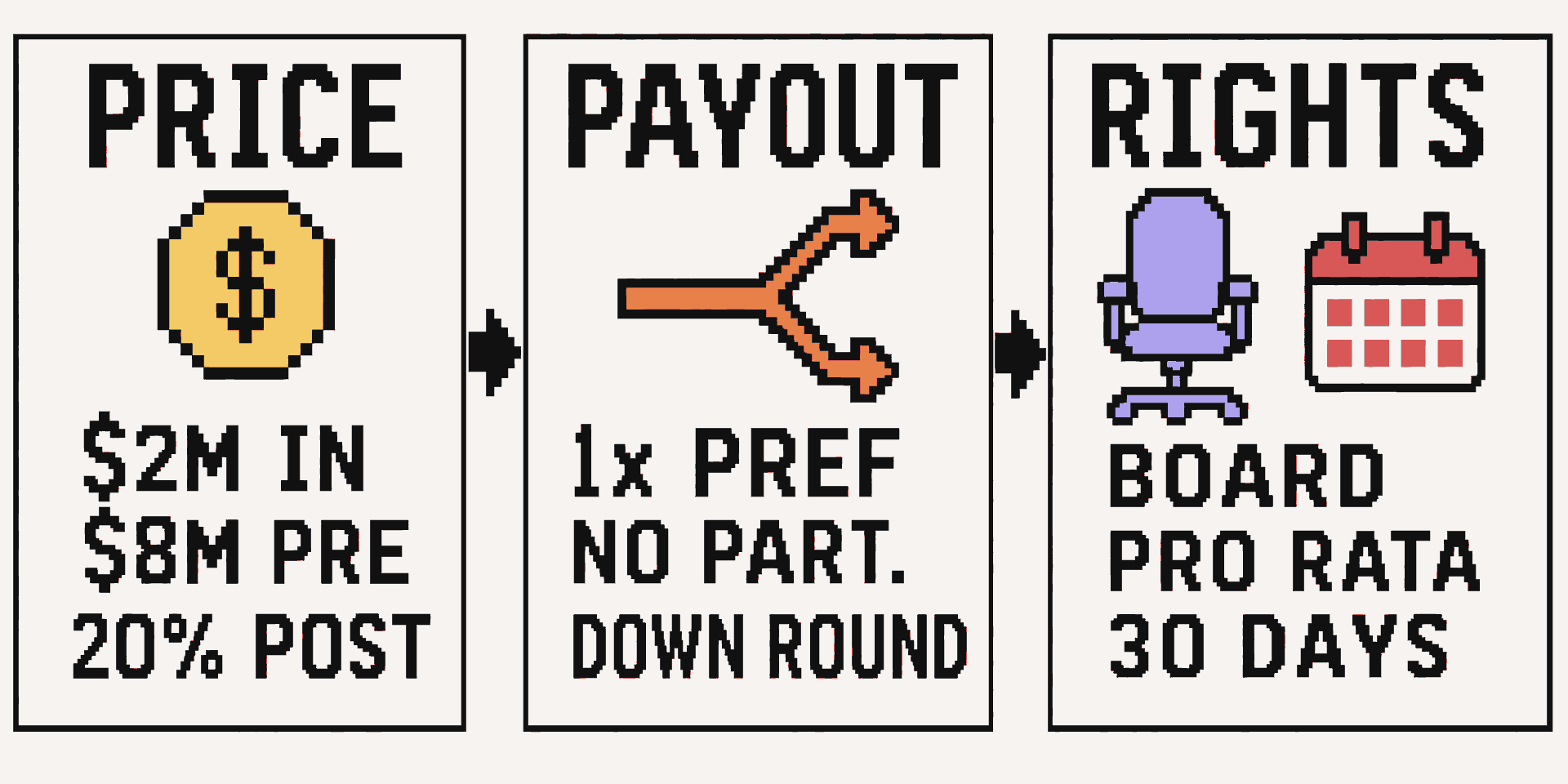
- $2 million investment at an $8 million pre-money valuation;
- $10 million post-money valuation and 20% investor ownership, before later dilution;
- enough pre-money option-pool shares to leave a 10% unallocated pool after closing;
- 1x non-participating liquidation preference;
- no participation and broad-based weighted-average anti-dilution;
- a three-person board with one common seat, one preferred seat, and one mutually agreed independent seat;
- preferred approval for a sale, senior securities, adverse charter amendments, and debt above a negotiated limit;
- pro rata, quarterly information, and registration rights for qualifying major investors; and
- a binding 30-day no-shop clause.
Here is what each line changes.
Price and ownership
The basic ownership calculation is $2 million divided by the $10 million post-money valuation, or 20%. That shortcut only works if the post-money denominator matches the term sheet's capitalization definition.
Suppose NewCo currently has 9.5 million issued shares and a 0.5 million-share unused pool. To make the unused pool equal 10% of the post-financing fully diluted capitalization while keeping the investor at 20%, the company would add about 0.86 million pool shares before closing. In this simplified model, the pre-round issued holders end with about 70%, the unused pool has 10%, and the new investor has 20%.
Without that top-up, the same issued holders would have about 76%, the old unused pool about 4%, and the investor 20%. The extra dilution lands on the pre-round holders because the top-up is in the pre-money capitalization. By contrast, if a fresh pool equal to 10% of post-pool capitalization were created after the financing, every holder would share the dilution and a 20% investor stake would fall to 18%.
Preference and participation
For these simplified exit examples, assume the option-pool shares have been issued or exercised, the investor owns 20% of the outstanding shares on an as-converted basis at exit, and there has been no later dilution.
At a $5 million sale, ignoring debt, expenses, other preferred stock, and dilution, the investor compares a $2 million preference with a $1 million as-converted payout. The investor takes the $2 million preference, leaving $3 million for common holders.
At a $12 million sale, 20% as converted is $2.4 million, which is better than the $2 million preference. The investor converts and takes $2.4 million.
If the term instead allowed uncapped participation, the investor could receive the $2 million preference plus 20% of the remaining $10 million at that $12 million sale, for a total of $4 million. One changed word can move $1.6 million in this simplified outcome.
Down-round protection
Broad-based weighted-average anti-dilution would adjust the investor's conversion economics if NewCo later sold covered shares below the Series A price. The adjustment depends on both price and size. A full-ratchet clause would be more aggressive because it can reset the conversion price to the lower issuance price without weighting for the issuance size.
Neither clause writes the investor a check or maintains 20% automatically. The investor would still need to exercise pro rata rights and invest more to target the same ownership in a later round.
Board, veto, and information rights
The preferred director gets one vote on a three-person board. The protective provisions create a separate approval layer for the listed actions. The debt threshold and the definition of “adverse” amendment deserve numbers and precise language; vague rights create later disputes.
The preferred designation right should also have a negotiated sunset. It might end when the lead holder falls below a stated share or ownership threshold. A future financing does not automatically remove the seat unless the agreements say so.
Quarterly information rights tell NewCo what it must report and when. Pro rata rights preserve an opportunity to buy in a later round. Registration rights address potential future public resale subject to their conditions. None of the three changes today's 20% ownership for free.
No-shop and closing risk
For 30 days, the example clause may prevent NewCo from shopping the deal while the investor finishes diligence and counsel drafts documents. The company has given up negotiating leverage during that window even though the investor has not made an unconditional commitment to close.
NewCo should therefore negotiate a defined scope, a realistic period, prompt diligence deadlines, and clear expense treatment before signing. The investor should request enough time to complete the agreed work, rather than using exclusivity to hold the company in limbo.
How to negotiate a term sheet
Term sheet negotiation works better when both sides treat it as package design rather than a contest over one number.
- Lead with the headline terms. Put investment amount, pre-money valuation, anticipated post-money ownership, security, option-pool treatment, and major closing conditions at the top.
- Name the deal-breakers. If a board seat, financing minimum, or specific protective provision is essential, say so before the no-shop starts.
- Ask what risk each clause addresses. A concrete concern can often be handled with a threshold, exception, sunset, or reporting covenant instead of a broader veto or economic preference.
- Model every counterproposal. Compare cap tables and payout waterfalls, not adjectives such as “founder-friendly” or “market.” A valuation increase can be offset by a larger pre-money pool or participating preference.
- Trade across surfaces. Price, pool timing, preference, participation, board composition, veto thresholds, pro rata eligibility, information frequency, expenses, and exclusivity duration are separate negotiating surfaces.
- Keep the language plain. Define the intended result first. Then let experienced counsel translate it into consistent legal drafting.
- Set a decision deadline. An expiration date keeps the offer from lingering, while a separate no-shop period governs conduct after signing. They are different clocks.
- Resolve the term sheet before legal drafting. Founders often have their best leverage before signing exclusivity. Investors also benefit from learning early whether the parties disagree on a core term.
Market conditions affect leverage, but they do not make aggressive terms automatically appropriate. Company performance, financing urgency, investor competition, stage, jurisdiction, and the rest of the package all shape the negotiation. Use market reports as context, then price the actual risk in front of you.
Mark Kahn, a Sheppard Mullin corporate attorney who advises startups and venture investors and is an Angel Squad member, has shared four practical points with us:
- Build the option pool from the company's hiring and equity-grant budget through the next expected financing.
- Tie an investor board designation right to a clear threshold or other negotiated sunset so inactive holders do not occupy seats indefinitely.
- Specify protective provisions at the term-sheet stage, including whether later series vote together or separately.
- Treat pay-to-play as a defined financing mechanism. State the participation requirement, affected holders, triggering round, and penalty instead of assuming it is simply part of anti-dilution.
Concise red flags
Pause when you see any of these:
- ownership math that does not reconcile to the cap table;
- a large pre-money pool with no hiring plan;
- senior, multiple, or participating preference without a modeled waterfall;
- full-ratchet anti-dilution presented as ordinary dilution protection;
- investor consent rights over routine operating decisions;
- a board seat with no clear designation threshold or end point;
- registration rights described as a unilateral right to force an IPO;
- drag-along language without approval, liability, and consideration protections;
- undefined “customary” terms left for the definitive documents;
- an open-ended expense obligation; or
- a long no-shop period without prompt diligence and drafting commitments.
What happens after signing a term sheet?
The term sheet starts a process. It does not replace the process.
- Binding provisions take effect. Any stated confidentiality, exclusivity, access, expense, or governing-law terms begin according to their wording.
- The parties complete diligence. Investors confirm legal, financial, commercial, technical, and ownership information. Founders should also complete investor reference checks. Our startup due diligence guide shows how depth can vary with the decision.
- Counsel drafts definitive documents. For a priced preferred-stock round, the core set often includes an amended and restated certificate of incorporation, stock purchase agreement, investors' rights agreement, voting agreement, and right of first refusal and co-sale agreement.
- The parties negotiate the full language. Representations, warranties, covenants, disclosure schedules, indemnification, closing mechanics, and the detailed rights behind the term sheet are resolved.
- Corporate approvals and closing conditions are satisfied. Boards and stockholders approve the financing as required, documents are signed, and any other conditions are completed.
- The financing closes. Funds are wired, securities are issued, the cap table and corporate records are updated, and required filings and post-closing obligations follow.
A mismatch between the signed term sheet and the definitive documents should be surfaced immediately. The definitive documents control the actual security and rights after closing.
Venture capital term sheet templates
Templates are useful for spotting missing terms and seeing how a clause fits into the final document set. They are starting points, not substitutes for counsel.
- The YC Series A term sheet is a concise venture capital term sheet example. It is useful for seeing how headline economics and governance can be stated plainly.
- The NVCA model documents include a term sheet and the principal definitive agreements for a U.S. venture financing. The forms include drafting options because one set of terms does not fit every deal.
- The YC SAFE documents are the appropriate reference when the company is raising on a SAFE rather than a priced preferred-stock term sheet.
Never copy a venture capital term sheet template and assume its optional clauses, definitions, or jurisdiction fit the deal. Reconcile the template to the cap table, tax position, corporate documents, and commercial agreement, then have qualified counsel produce the final language.
Venture capital term sheet FAQ
Who prepares a venture capital term sheet?
The lead investor commonly sends the initial term sheet, often using a form maintained or reviewed by its counsel. A company can also circulate proposed terms in some financings. Both sides should use independent counsel for review and negotiation.
How long is a term sheet valid?
A term sheet often states an expiration date and time for acceptance. There is no universal duration. The right window depends on deal complexity, diligence completed, investor process, company runway, and competing interest. The acceptance deadline should not be confused with the post-signing no-shop period.
Does signing a term sheet mean the company is funded?
No. Signing records the proposed deal and may activate binding process clauses, but funding generally occurs only after diligence, definitive agreements, approvals, closing conditions, signatures, and the wire.
Is a SAFE the same as a term sheet?
No. A term sheet summarizes a proposed transaction. A SAFE is the investment contract itself. A company may negotiate a SAFE's key terms in email or a short summary, but the signed SAFE governs the investment.
Read the whole deal, then decide
The best term sheet is clear about price, payouts, control, future rights, and the path to closing. It gives both sides enough detail to make a real decision without hiding material issues for the legal documents.
If you want repeated practice evaluating early-stage deals with our team and a thoughtful investor community, apply to Angel Squad.













.png)