Seed Investors: How Networks Shape Access and Deal Flow
Brian Nichols is the co-founder of Angel Squad, a community where you’ll learn how to angel invest and get a chance to invest as little as $1k into Hustle Fund’s top performing early-stage startups.
This is educational content, not investment, legal, or tax advice. Private startup investments are speculative, illiquid, long-term, and can result in a total loss. The SEC warns that private placements may provide limited disclosure. Eligibility depends on the offering and applicable securities rules. Review the governing documents and seek advice from qualified independent professionals.
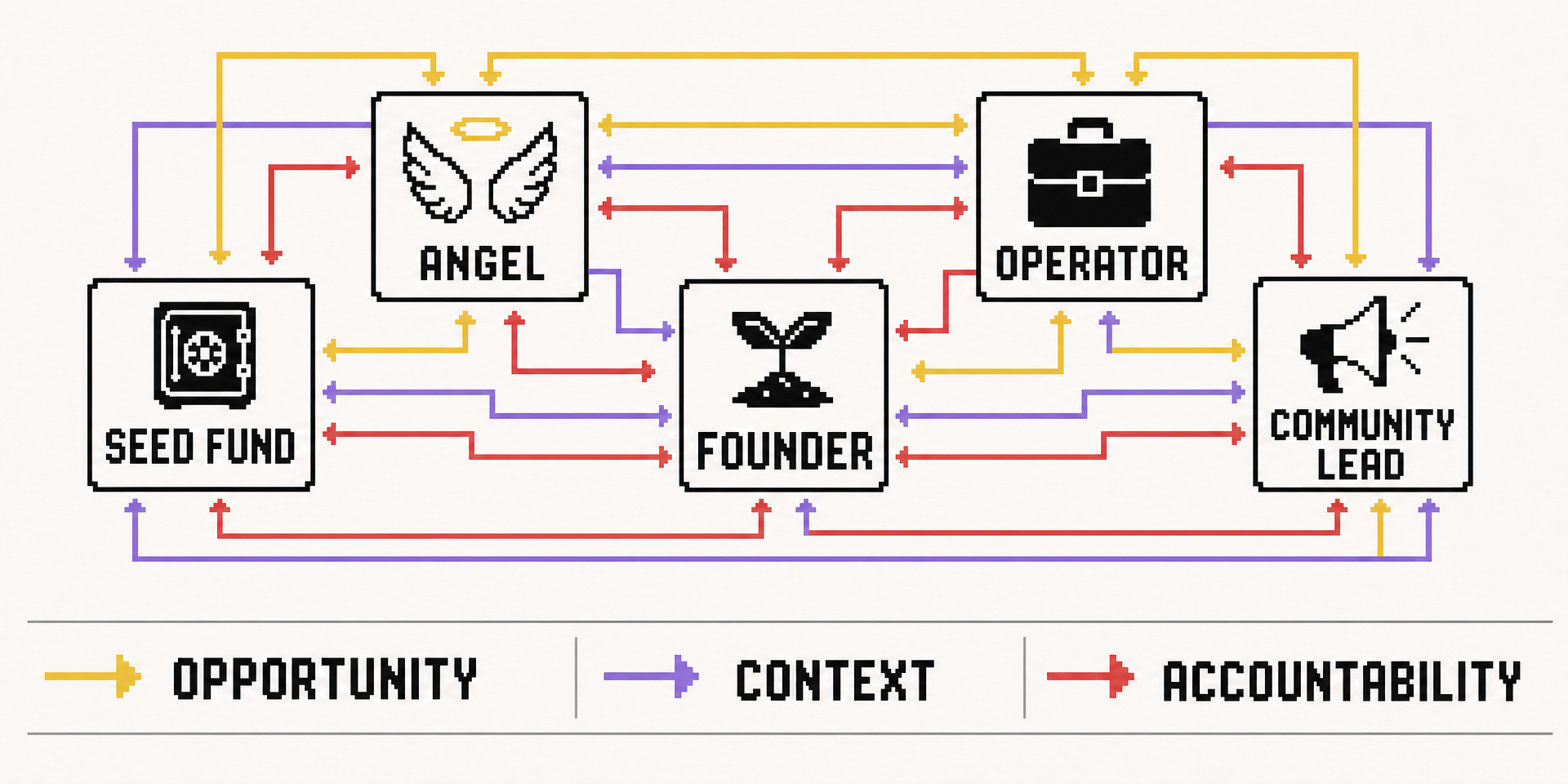
Seed investors are often described as check writers. In practice, seed investing happens inside a relationship system. Founders, angels, seed funds, operators, and community leaders pass opportunities, context, and reputational signals between one another. Understanding that system explains why two investors with similar capital can see very different deal flow.
What are seed investors?
A seed investor is an individual or institution that supplies capital during a startup’s seed stage, when the company is still proving its market, product, and ability to execute. The label follows the stage of the company. It does not describe one specific job title or investment vehicle.
That is why “seed funding investors” can refer to several participants. Individual angels usually invest their own money. Seed fund investors deploy capital from a venture fund according to its mandate and decision process. A seed round can include both, along with a lead investor who coordinates the round and other participants who make independent decisions.
The network around those seed round investors includes more people than the names on a cap table:
- Founders and portfolio founders originate opportunities, provide references, and tell other founders how an investor behaves.
- Individual angels contribute capital, operating knowledge, and their own relationships.
- Seed fund investors bring institutional processes, a defined thesis, and connections to other fund managers.
- Community leaders and syndicate leads curate opportunities and organize shared context around them.
- Operators, customers, and subject-matter specialists help the network interpret technical, market, hiring, and go-to-market claims.
- Other early-stage and follow-on investors add another point of view and may remain involved as a company raises later rounds.
Imagine a founder introduced by a former colleague. An angel asks a security operator to examine the technical claim. A seed fund partner decides the company fits the fund’s thesis. Other investors receive the opportunity with notes from those earlier conversations. Capital moves at the end of that chain. Information and trust have been moving all along.
A seed investor network is a routing system
A contact list records who knows whom. A functioning seed investor network also determines which opportunity reaches which person, when it arrives, and how much context travels with it.
That routing matters because no investor can give equal attention to every startup. In a survey of 885 institutional VCs, more than 30% of deal flow came through professional networks, with another 20% referred by other investors. Angels and venture funds operate differently, so those figures should not be copied directly onto individual angel behavior. They still show how much early-stage opportunity discovery depends on relationships.
Networks route three things together:
- Opportunity. A founder, deck, introduction, or round reaches an investor.
- Context. The investor learns why the source made the referral, what has already been examined, and where uncertainty remains.
- Accountability. The referrer’s own reputation becomes attached to the quality and accuracy of the introduction.
A trusted introduction can move an opportunity higher in someone’s queue. It cannot turn an uncertain company into a sound investment. The receiving investor still owns the decision.
Our guide to angel investor networking handles the practical work of building relationships. The system-level point is simpler: access appears when the network expects an interaction to be worth everyone’s time.
Trust and reputation tell the network where to route attention
Trust and reputation are related signals, but they are not the same.
Trust is local. It exists between people with direct experience of each other. An investor trusts a founder who has been candid through difficult updates. A community lead trusts a member who protects confidential information and separates facts from guesses.
Reputation travels. It is the network’s shared memory of repeated behavior. It spreads through founder references, co-investor experiences, public writing, and the gap between what someone promises and what they deliver.
You control your behavior. Other people form your reputation. That distinction is why a polished profile rarely creates durable access by itself.
The network pays attention to small, repeated signals:
- Does the investor respond clearly, including when the answer is no?
- Do their introductions fit both parties?
- Can they explain what they know and where their knowledge stops?
- Do they keep sensitive information inside the intended circle?
- Does their behavior after an investment match their behavior before it?
These signals do not prove investment skill. They predict whether involving that person will create useful work or extra friction. Over time, the network routes more relevant questions and opportunities toward people who have been useful and dependable.
Contribution converts access into reciprocal deal flow
Networks weaken when every participant wants deals and nobody wants to do the work around them. Contribution is the input that keeps information moving.
For a seed-stage investor, useful contribution can take several forms:
- Interpretation: applying real operating or sector experience to a claim.
- Coordination: summarizing open questions, decisions, and next steps without creating noise.
- Connection: making a relevant customer, candidate, adviser, or investor introduction.
- Challenge: raising a well-supported dissenting view when the group is converging too quickly.
- Follow-through: doing what was promised after the meeting or investment closes.
Our co-founder and general partner Elizabeth Yin writes in Democratizing Knowledge, “Investors use their life perspective to assess.” A network becomes more useful when those perspectives are distinct and made legible. Ten people repeating the same view add less information than one person with direct knowledge of the market.
Inside Angel Squad, Hustle Fund-sourced opportunities, investor education, and peer discussion give members shared context for contributing their own operating experience. The value of that context depends on members thinking independently, including when their conclusions differ.
Contribution also helps the source. A precise pass can teach a founder more than vague enthusiasm. A focused question can show another investor where a thesis is thin. A relevant introduction can keep a promising conversation moving. Each interaction gives the network new information about who is useful for which problem.
Relationships shape deal flow over time
Seed investing has a long memory. Founders remember who was prepared, fair, responsive, and useful. Investors remember who surfaced a thoughtful opportunity, gave a calibrated read, or flagged a risk before consensus formed.
In Raise Millions, our co-founder and general partner Eric Bahn uses the phrase “growing old together” to describe the founder-investor relationship. The phrase is short because the point is simple. One seed check can create a relationship that lasts through later rounds, hard operating periods, an exit, or another company.
The network compounds through a recurring loop:
- A relationship routes an opportunity to an investor.
- The investor contributes judgment, work, or a useful connection.
- Founders and peers observe the quality of that contribution.
- Their experience strengthens or weakens the investor’s reputation.
- Future opportunities are routed with more context, less context, or not at all.
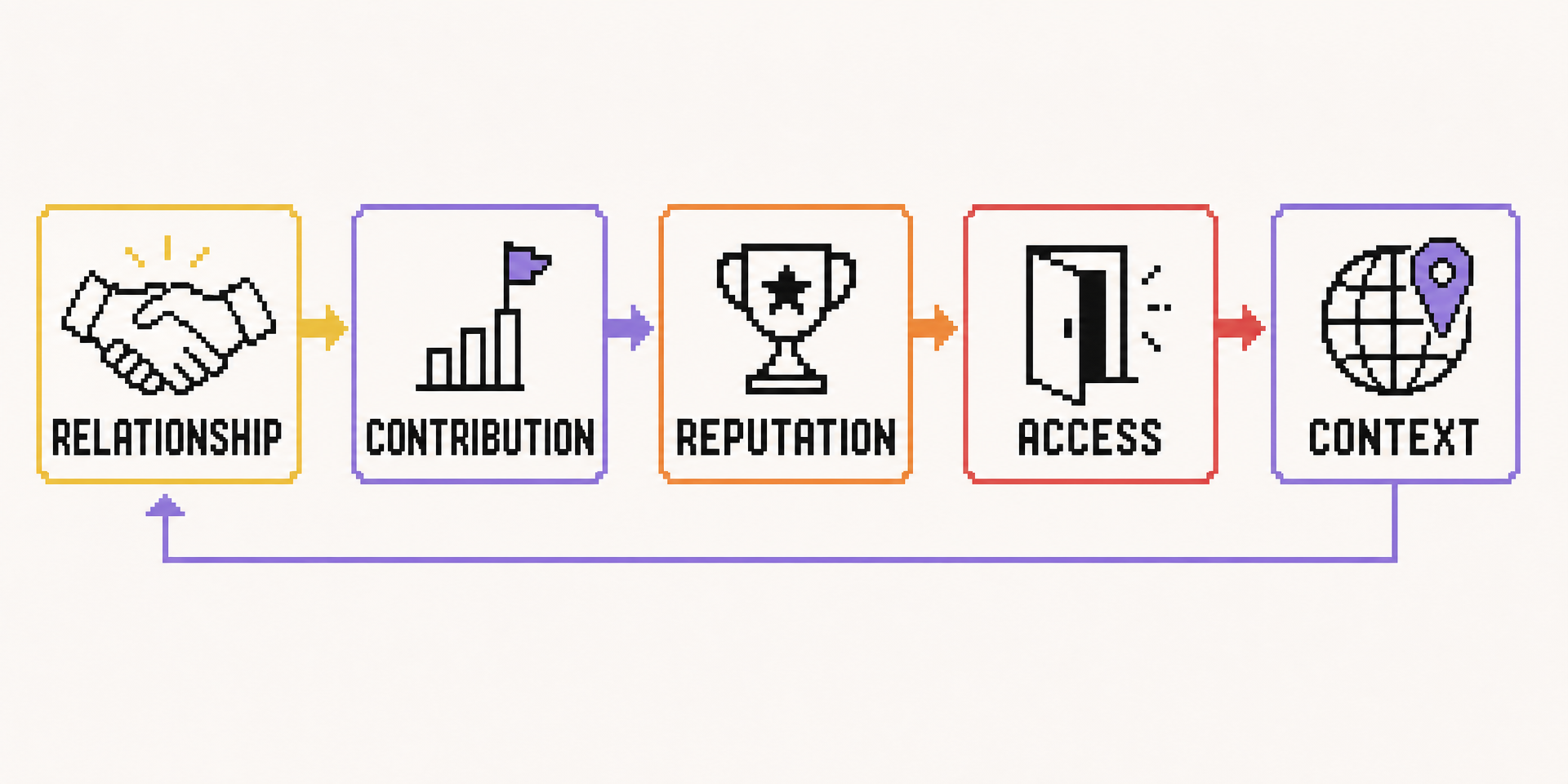
Research on institutional venture firms found that better-networked VCs experienced better fund performance in the study period. That finding does not guarantee results for an angel, and network position may reflect other advantages. It does reinforce that relationships are part of the investing system, rather than a social layer added around it.
The negative loop compounds too. A careless forward, broken promise, leaked detail, or inflated claim can reduce future access. The consequence may be quiet. People simply stop routing their highest-context opportunities through that investor.
Where seed investor networks break down
Relationship systems can improve the flow of context and still produce bad decisions. Four failure modes deserve attention.
Closed loops narrow the opportunity set
When every referral comes from people with similar careers, geographies, and assumptions, the network keeps rediscovering familiar founders. Research on networking frictions has shown how informal access can contribute to gender gaps in early-stage fundraising. A trusted network can widen access, or reproduce the boundaries it inherited.
Reputation becomes borrowed conviction
A respected investor’s involvement can make a deal worthy of attention. It cannot replace your own work. When participants treat another person’s reputation as the investment case, the network has shifted from sharing information to outsourcing judgment.
Activity gets mistaken for information
Busy channels, large events, and constant deal sharing can create the feeling of strong deal flow. Useful networks reduce uncertainty or direct it to the right expert. More messages alone do neither.
Reciprocity becomes transactional
Healthy reciprocity develops across many interactions. It is rarely a one-for-one trade. Keeping score on every introduction encourages low-quality forwarding and weakens trust.
These failure modes apply across platforms, communities, groups, and syndicates. Our investor-network model comparison explains how those structures differ. Whatever the structure, a network works only when it preserves independent judgment, useful dissent, and clear accountability.
The system is the edge
Seed investors do more than fund a company. They participate in a system that decides where opportunities travel, what context travels with them, and whose judgment gets invited into the room.
Capital may open one conversation. Contribution, trust, and founder experience determine whether the next one arrives. If you want to learn inside an angel-investing community with curated deal flow and experienced peers, apply to Angel Squad.