
Angel Investor Network Fees: Your Total-Cost Check
.png)
Brian Nichols is a co-founder of Angel Squad, our angel-investing community.
Angel investor network fees are easy to misread because several charges can sit around one check. A network may charge dues for access, a platform may add payment costs, an investment vehicle may allocate operating expenses, and a profitable exit may trigger carried interest. Those charges do not apply to every network. Before you join or wire, what are you paying, to whom, when, and on what basis?
Important: This is educational only. It is not investment, legal, tax, accounting, or valuation advice. Private startup investments are speculative, illiquid, long-term, and may result in total loss. Past results and current marks do not guarantee future results. Actual outcomes depend on governing documents, fees, carry waterfalls, taxes, cap tables, valuation policies, and timing. The examples below are hypothetical, simplified, and not projections. Read the subscription, offering, and vehicle documents, and obtain advice from qualified independent investment, legal, tax, and accounting professionals.
Start with the investor fee stack
Begin with a simple distinction: membership dues are a cost; invested capital buys the security or interest. Paying $3,000 to join a network does not mean $3,000 reached a startup. An expected annual investing level is also separate from dues.
Provider snapshot: The terms and prices below were checked August 27, 2026. They are provider-specific snapshots, not market benchmarks, and should be rechecked on the provider's official page and in the governing documents before you pay.
Here are the six layers that can appear in an angel network or group.
-
Membership dues. The member pays the network or group operator when joining or renewing. A fee may recur monthly, quarterly, or annually, or appear once as an initiation charge. Its basis may be flat, tiered, prorated, or tied to geography. Verify it in the membership agreement, renewal terms, and invoice. VentureSouth's investor FAQ says membership costs $3,000 per year and, "There are no minimum investment requirements." It separately states that, if a member decides to invest, the minimum for one investment is $5,000. New York Angels' membership FAQ lists $4,000 in annual dues and says members are expected to invest $50,000 per year. Those figures describe two providers, not a market range.
-
Payment or transaction charges. The investor, issuer, lead, or sponsor may pay a platform or payment processor when an investment is confirmed. The charge can apply once per payment, including a later increase to an existing commitment, and its basis may change with the payment method. Verify the exact amount at checkout and on the receipt. Wefunder's investor fee schedule lists a 2% fee for ACH or wire, with an $8 minimum and $150 maximum. It lists a 5.5% plus $2 fee for credit card, Apple Pay, or Google Pay, with an $8 minimum and no maximum. Those are Wefunder's payment terms, not general angel-network rates.
-
An investor's allocated special purpose vehicle costs. A special purpose vehicle (SPV) typically pools investor capital for one portfolio-company investment. Each investor may bear formation, state filing, recordkeeping, administration, tax reporting, distribution, and wind-down costs in proportion to their commitment. The SPV usually remits amounts to service providers and regulators, while the investor may bear the economic cost through a separate contribution or an amount withheld at close; a manager, lead, sponsor, or issuer may instead absorb some costs when the documents say so. Charges may be one-time, annual, or intended to cover the vehicle's lifetime. Verify the allocation in the SPV documents, platform cost schedule, closing statement, and tax documents. AngelList's SPV cost schedule lists an $8,000 setup cost plus a $2,000 state regulatory fee for a standard SPV. Setup and state regulatory fees are capped at 10% of the amount raised, and optional add-ons sit outside that cap. These are vehicle-level costs allocated among investors, not a $10,000 charge to each investor. Our guide to how SPVs work explains the vehicle itself.
-
Management fees, where present. An investor pays the manager for ongoing work when the governing documents call for it. The fee can recur during the investment period or vehicle life. Its basis may be committed capital, invested capital, assets under management, or another defined amount. Verify the rate, base, step-downs, term, and expense offsets in the governing offering documents and fee schedule. Some networks and SPVs have no management fee. Others do.
-
Carried interest under the actual waterfall. A waterfall is the rules and order for allocating distributions. The investor bears carry as a deduction from a distribution, and the manager, lead, sponsor, or general partner receives it when a realization produces the result defined in those rules. Carry may be calculated deal by deal or across a broader vehicle, and distributions can happen more than once. Verify the profit base, return-of-principal rule, hurdle, expense treatment, clawback, and distribution order in the waterfall. AngelList's SPV carry guide says the manager sets carry and 20% is standard on its platform. Its example applies carry to profit after investors receive their original capital. Other documents can work differently.
-
Investment minimums and commitment obligations. An investment minimum is the smallest amount an investor may put into one deal. A commitment is an obligation to fund an agreed amount, either at signing or later under a funding schedule or capital call. The investor pays capital to the issuer or vehicle in exchange for the security or interest. The minimum and commitment are separate from dues and fees. Verify the minimum, total commitment, due dates, funding schedule, consequences of failing to fund, and treatment of unused cash in the subscription agreement and other governing documents.
Elizabeth Yin, our co-founder and general partner, captured why this breakdown matters:
“fees / carry are taken from it without you knowing.”
Elizabeth Yin, Democratizing Knowledge (Hustle Fund, 2021), p. 94
Unknown is the problem. A fee can be reasonable, expensive, waived, absorbed, or inapplicable. You cannot tell which from the network's headline price.
What membership dues can pay for
Dues can support staff, member meetings, screening tools, education, travel, and group operations. VentureSouth's dues explanation identifies those categories for its own group. That tells you what one provider funds. It does not prove the usefulness of its programming or the quality of any investment.
Ask what you receive during the paid term:
- How often are educational sessions and deal presentations held?
- Who screens opportunities, and what work happens before members see them?
- Which community tools, office hours, or member events are included?
- Does the network assist with closing, reporting, or portfolio communication?
- Which services require another payment?
As of August 27, 2026, members of our Angel Squad community learn with peers and access Hustle Fund deal flow. Investing is optional and deal by deal, and minimums typically start at $1,000. AngelList handles legal paperwork, wires, and tax documents. The checkout and governing documents for each opportunity control its terms and costs. Membership does not require accreditation, but investing in Angel Squad deals does.

Community and education can be worth paying for when they match your goals, schedule, and preferred way of learning. They do not guarantee access, allocation, better decisions, or returns. Assess the service separately from the price.
Calculate the all-in cost without mixing the buckets
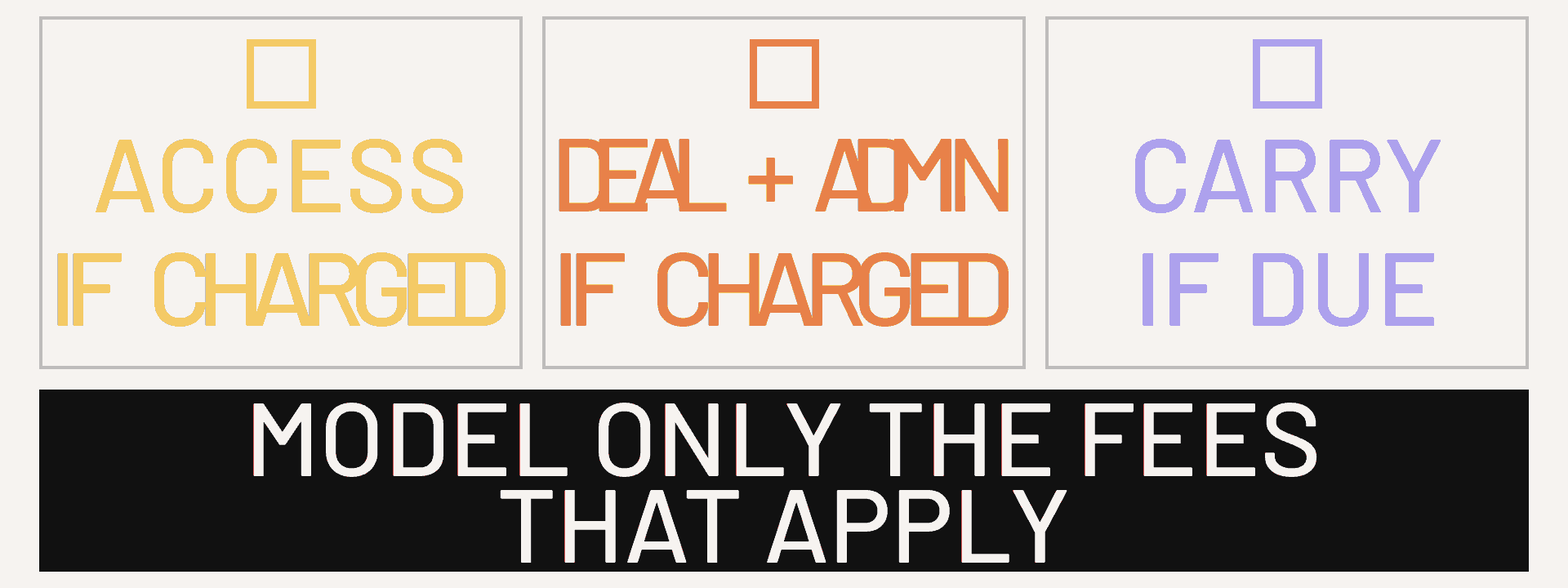
The U.S. Securities and Exchange Commission (SEC) recommends asking about charges to buy, sell, and hold an investment, along with how a professional is paid. For an angel network, model only the charges that apply:
Total non-capital cost = dues + payment charges + your allocated vehicle costs + management fees + carry + personal wire, custody, legal, and tax-preparation costs.
Keep four figures separate: cash paid, capital that reaches investments, gross distributions from investments, and net distributions after applicable fees. Then compare loss, return-of-capital, and profitable outcomes under the stated waterfall. Fixed costs still exist when an investment loses money. Carry may be zero when there is no defined profit.
“Decisions are never in isolation - they are a comparison game.”
Elizabeth Yin, Democratizing Knowledge (Hustle Fund, 2021), p. 287
Compare networks over the period you expect to remain a member, using the same number and size of checks. A zero-dues offer still requires the payment, SPV, management-fee, carry, and personal-cost checks.
Hypothetical carry calculation
Hypothetical and simplified, not a projection. At the August 27, 2026 modeling date, this example covers one investor's fully realized SPV investment, with $5,000 of initial capital and no follow-on investment. It uses $15,000 of gross realized distributions before carry and no unrealized mark. The investor distribution below is net of carry and gross of taxes and all other costs. The example applies 20% carry to profit after return of original capital. It assumes no hurdle or clawback and excludes management fees, vehicle expenses, taxes, dilution, liquidation preferences, debt, valuation-policy effects, and timing. The governing waterfall controls.
- Original capital returned: $5,000.
- Profit base: $15,000 gross distribution minus $5,000 original capital = $10,000.
- Carry: 20% of $10,000 = $2,000.
- Investor distribution after carry: $15,000 minus $2,000 = $13,000, before taxes and other costs.
Do not apply 20% to every distribution automatically. The governing documents' definition of profit and distribution order decides the calculation.
Hypothetical all-in calculation
Hypothetical and simplified, not a projection. At the August 27, 2026 modeling date, this example covers one investor, two membership years, and two investments. Each modeled distribution is fully realized, with no unrealized mark. It is gross of taxes and excluded costs; the net cash result subtracts the cash-paid basis. It assumes $10,000 of initial capital in total, no follow-ons, annual dues of $800, two $25 payment charges, and two $300 allocated SPV and administration charges. Fees are paid separately, so all $10,000 reaches the investments. No management fee or carry applies. No fee is withheld from a distribution. Each distribution below is before taxes. The net cash result includes the separately paid modeled costs. The example excludes taxes, wire, custody, legal, dilution, liquidation-preference, debt, valuation-policy, and timing effects. The actual checkout and governing documents control.
- Cash paid: $10,000 capital + $1,600 dues + $50 payment charges + $600 allocated vehicle costs = $12,250.
- Capital reaching investments: $10,000.
- At a $15,000 distribution before taxes, with no fee withheld from that distribution, the net cash result is $15,000 minus $12,250 = +$2,750.
- At a $0 distribution, the net cash result is $0 minus $12,250 = -$12,250.
- At a $10,000 distribution before taxes, the net cash result is $10,000 minus $12,250 = -$2,250.
- At a $20,000 distribution before taxes, the net cash result is $20,000 minus $12,250 = +$7,750.
- At a $50,000 distribution before taxes, the net cash result is $50,000 minus $12,250 = +$37,750.
Changing who pays a vehicle cost, whether it is withheld, or whether carry applies changes those results. Mixing one network's dues with another platform's fee schedule creates fake precision.
Fee red flags involve disclosure, conflicts, or registration
A high number alone does not establish illegality or a bad investment. Focus on disclosure, conflicts, registration where required, and the governing terms. Pause when:
- marketing copy and the membership or offering documents show different charges;
- the recipient of a fee is unknown;
- the trigger, frequency, or calculation base is undefined;
- an SPV expense has no allocation method or cap where the documents promise one;
- a carry percentage appears without the waterfall;
- the organization will not provide the membership, subscription, offering, or vehicle documents before payment;
- someone earns transaction-linked compensation but will not explain their role, registration, or exemption.
The SEC's broker-dealer registration guide is informal and nonbinding. It says activities such as finding investors, soliciting securities transactions, negotiating, or receiving transaction-based compensation may require registration, depending on the facts and applicable exemptions. A transaction fee is not automatically illegal. The role, conduct, and exemption matter.
Membership and investment eligibility are separate
The applicable offering exemption sets the legal eligibility conditions, and the issuer or offering documents may impose stricter requirements. Our accredited investor guide explains the common qualification paths for angel investors.
Under Rule 506(b), an offering may sell to unlimited accredited investors and no more than 35 non-accredited purchasers. Each non-accredited purchaser, either alone or with a purchaser representative, must have enough financial and business knowledge and experience to evaluate the investment. When non-accredited purchasers participate, the issuer must provide specified disclosure and financial information. Under Rule 506(c), every purchaser must be accredited and the issuer must take reasonable verification steps.
Securities bought in Rule 506(b) and Rule 506(c) offerings are restricted and often illiquid. Private placements can provide less disclosure than registered offerings and can result in total loss. A Form D filing is not SEC approval, as the private-placement bulletin explains.
Your pre-payment fee check
Before paying dues or funding a deal, collect:
- the membership agreement, renewal terms, and invoice;
- the final checkout screen, payment-method charge, and receipt;
- the subscription agreement and any private placement memorandum or other offering/disclosure materials;
- the SPV cost schedule, closing statement, and expected tax documents;
- the management-fee schedule and carry waterfall;
- Form D filings in the SEC's EDGAR database, where applicable;
- FINRA's BrokerCheck for a broker-dealer, or the SEC's EDGAR database plus FINRA's funding-portal directory for a Regulation Crowdfunding funding portal, where applicable;
- independent investment, legal, tax, and accounting advice for your circumstances.
The right question is concrete: who pays, who receives the money, what triggers it, how often it recurs, what amount it is based on, and where it is written. If you want to learn this discipline with peers and review optional deals from our pipeline, apply to Angel Squad.













.png)