
Angel Portfolio Management: A Practical Guide
Once startup holdings multiply, the hard part is keeping cash movements, company updates, marks, documents, deadlines, and decisions synchronized. A good angel portfolio management system tells you what happened, what needs attention, and which figures deserve skepticism.
The goal is a reliable operating system, without turning your personal portfolio into a miniature back office.
This is general investment education, not investment, legal, or tax advice. Startup investments and governing documents are fact-specific. Seek independent review from qualified investment, legal, and tax professionals.

Brian Nichols is GM - Angel Squad, our angel-investing community.
What angel portfolio management must answer
Portfolio management begins after the wire clears. It covers the records, reviews, controls, and decisions required to manage direct startup investments and positions held through special purpose vehicles (SPVs), syndicates, or other entities.
Your system should answer four questions quickly:
- What do I own? Show the instrument, holding entity, cost basis, ownership evidence, rights, and conversion or transfer history.
- What changed? Log financings, dilution, amendments, milestones, secondary sales, acquisitions, initial public offerings (IPOs), shutdowns, and distributions.
- What needs action? Surface a follow-on notice, consent request, document gap, stale update, tax record, or approaching deadline.
- How is the portfolio behaving? Separate cash returned from paper value, then show deployment, concentration, and performance by a consistent method.
That last question matters because you are managing a set of bets rather than a folder of unrelated companies.
“Don't try to pick a co. Select a portfolio.”
Our co-founder Elizabeth Yin, Democratizing Knowledge
Private startup investments can be highly illiquid, provide limited disclosure, and result in total loss. The SEC's private-placement bulletin makes those risks clear. A clean dashboard cannot remove them. It can prevent avoidable recordkeeping failures and expose weak assumptions before they drive another decision.
Build one source of truth from linked records
Use one master register even if your investments sit across several portals and administrators. Those systems can remain the home for original transaction documents. Your register is the cross-portfolio index that shows where every authoritative record lives.
Keep three linked record types:
- Position record: the durable facts about one holding or tranche.
- Transaction and event log: every cash movement and material noncash event, each with an exact date.
- Decision log: the trigger, alternatives, rationale, approval, owner, and next action for every meaningful choice.
One company may need several position records when you invested through different entities, at different times, or in different securities.
Fields every position record needs
Capture these field groups:
- Company identity: legal and common name, jurisdiction, website, sector, stage at entry, founder contacts, and current status.
- Holding and custody: investing entity, direct or beneficial holding, holder of record, SPV or nominee, administrator, portal, and account identifier.
- Execution: signed date, funded date, amount, currency, round, instrument type, exact form or version, and links to signed and countersigned documents.
- Entry economics: for a Simple Agreement for Future Equity (SAFE), record the valuation cap, discount, and most-favored-nation term when present. For a convertible note, add principal, interest rate, maturity date, cap, and discount. For priced equity, record price per share, share count, and round valuation. Give every term a source and as-of date.
- Changes to the position: conversions, amendments, waivers, transfers, cancellations, splits, new certificates, and the source document for each change.
- Basis by tranche: cash invested, allocated fees where relevant, disposition amount, remaining basis, and adviser-approved tax adjustments. Do not overwrite the original tranche when a follow-on arrives.
- Ownership and dilution: shares or units, security class, ownership estimate, fully diluted denominator, capitalization source, as-of date, and dilution since the previous record.
- Rights: information, pro rata, consent, voting, transfer, board, or observer rights, plus the executed agreement or side letter that creates each right.
- Tax file: issuer evidence, acquisition and conversion dates, tax forms, and a Qualified Small Business Stock (QSBS) review field containing the tax professional's conclusion, review date, assumptions, and supporting documents. An unreviewed position stays labeled unreviewed.
- Operating record: last company update, current milestones, milestone changes, portfolio-company requests, and the next expected update.
- Mark: value, method, source, valuation date, entry date, confidence level, freshness threshold, and the security-specific rationale.
- Follow-on record: notice date, response deadline, eligibility, offered security and terms, requested amount, reserve impact, decision, and rationale.
- Liquidity and loss events: secondary offers, sales, acquisitions, IPOs, shutdowns, insolvency notices, escrow, earnouts, cash proceeds, and noncash proceeds tracked separately.
- Next action: owner, due date, status, and link to the source request.
A one-page investment tear sheet can summarize one company. The portfolio register connects those company summaries and exposes missing data across holdings. Use our cap-table guide when you need to track ownership and dilution.
Your tracker remains an internal control. For a Delaware corporation, the legal stock ledger records holders of record and registered shares under the state's stock-ledger rules. A beneficial SPV interest can differ from the issuer's record. Reconcile your tracker to signed documents, issuer records, certificates, and administrator statements.
A worked position and transaction example
Consider a fictional $10,000 investment in Northstar Robotics:
- Position: Northstar Syndicate SPV I LLC is the holder of record; the investor owns a beneficial SPV interest. The saved instrument is a post-money SAFE, form version 1.1, with an $8 million valuation cap and no discount. Those economics come from the signed SAFE as of May 10, 2024; funding arrived May 13, 2024.
- Basis: tranche A is $10,000. A $5,000 Series A follow-on funded February 20, 2026, at $1.25 per share adds 4,000 shares and becomes tranche B rather than replacing tranche A. The price and share count link to the closing documents.
- Conversion: the SAFE converted on August 15, 2025, into 5,000 Seed Preferred shares. The tracker links to the conversion notice and the capitalization table dated that day. Ownership is 0.40% using the documented 1,250,000-share fully diluted denominator.
- Rights: a signed side letter is the source for pro rata eligibility. A February 1, 2026 notice offered up to $5,000 of Series A shares with a February 10 deadline. The decision log records the terms, reserve impact, and approval rationale.
- Tax and mark: QSBS status is unreviewed, so no tax benefit is assumed. The $18,000 mark is dated March 31, 2026, sourced to the Series A closing package, rated medium confidence, and flagged stale after 180 days.
- Events: an acquisition closes July 15, 2026. The event log separates $4,000 cash received, 200 acquirer shares received as noncash proceeds, and $1,000 held in escrow. It assigns an owner to obtain the closing statement and update remaining basis.
The linked transaction log then reads: May 13, 2024, initial investment, negative $10,000 cash; August 15, 2025, SAFE conversion, zero cash; February 20, 2026, follow-on, negative $5,000 cash; July 15, 2026, cash distribution, positive $4,000; July 15, 2026, noncash distribution, 200 shares. Nothing is lost inside one “amount invested” cell.
Choose the right angel portfolio management tool
Tool choice depends on complexity, controls, and maintenance time rather than a magic company count. Compare every setup across the same requirements: instruments, imports, documents and key performance indicators (KPIs), alerts, permissions and security, exports and backups, support, price model, and migration path. An application programming interface (API) lets one system exchange data with another automatically; a CSV import requires a manual file transfer.
The product and price details below were verified in August 2026. Features and pricing can change.
1. A spreadsheet or database stack
Best suited to: hands-on angels with a manageable set of direct holdings and one clear process owner.
A spreadsheet or linked database plus an encrypted document store and calendar gives you flexible instruments, custom fields, CSV imports, manual KPI intake, deadline alerts, and transparent formulas. It usually follows a free, storage-based, or per-seat price model.
You own the control work. Restrict access by role, require multifactor authentication, export the register on a schedule, back up the document archive separately, and maintain a manual deadline calendar. Component vendors can help with their software, but no one supports the complete portfolio workflow unless you define an owner.
Move to a dedicated system when conversions and follow-ons create repeated reconciliation errors, several investing entities require different views, document intake becomes inconsistent, or quarterly review consumes more time than judgment.
2. A dedicated private-investment tracker
Best suited to: active angels who need portfolio analytics, document history, reminders, and multiple instruments or entities in one system.
Two current product sets show how this category varies:
- Seraf's portfolio-management page lists company profiles, investment details, a transaction ledger, documents, customizable KPIs, important-date reminders, overdue-report alerts, bulk uploads, and email forwarding. Its individual-investor pricing shows Advanced at $600 per year or $60 per month and Professional at $800 per year or $80 per month, along with Excel and CSV exports and plan-level support. Seraf states that logins use Secure Sockets Layer/Transport Layer Security (SSL/TLS), which encrypts data in transit between a browser and the service. Its privacy policy explains that control.
- 8FIGURES' angel investment tracker covers startup equity, SAFEs, convertible notes, valuations, stake, dilution, money multiple, and internal rate of return, with Carta syncing for private positions. The tracker details also cover portfolio and news alerts and data exports. Its current pricing starts with a seven-day trial followed by $20 per month. For other linked assets, 8FIGURES says account connections are encrypted and read-only. The public feature set emphasizes automated position data and cross-asset analysis, so the durable document archive, company KPI intake, and contractual-rights calendar still need an explicit home.
Neither tool removes source discipline. An imported value needs a source and as-of date. An alert needs an owner. A vendor export needs an independently stored, restorable backup. If a platform cannot represent a converted SAFE, two basis tranches, a partial exit, and a beneficial SPV holding, it cannot hold the full record described above.
3. A fund or SPV administration system
Best suited to: syndicate leads, family offices, and investors managing outside stakeholders, legal entities, capital calls, distributions, tax forms, and formal reporting.
AngelList's fund-administration platform supports digital LP onboarding, document access, capital calls, distributions, performance tracking, compliance and year-end tax work, and investor K-1 delivery. Human support and controlled stakeholder access matter more in this category, while portfolio-company KPIs and internal underwriting decisions may still live in a separate tracker.
Treat deal-discovery platforms as a separate category. A marketplace or syndicate portal may preserve documents for deals completed there, but sourcing and transaction execution do not create a cross-platform portfolio system. Keep your independent register and export path.
Run a review cadence with failure controls
A tracker becomes useful when a calendar drives it. A practical cadence has four checkpoints.
At investment close: capture
Create the position, transaction, and decision records before filing the deal away. Save signed documents, wire evidence, the investment memo, contacts, source terms, and expected reporting channel. Record the original thesis in a few sentences while it is fresh.
Monthly: triage
Process founder updates, administrator notices, and portal messages. Save the original item, update milestones and source dates, and assign every request or deadline. Flag an expected update as overdue without inventing a valuation from silence.
Quarterly: reconcile and review
Reconcile new investments, conversions, transfers, distributions, and exits to source documents. Refresh ownership and marks only when evidence supports a change. Review open rights, data gaps, company requests, concentration, reserves, cash returned, and the decision log.
Annually: archive and recover
Lock a year-end snapshot, export the register and transaction log with current document locations, assemble tax records by entity, and run a recovery drill. A trusted person or adviser should have a map of the portfolio, providers, document locations, and account-recovery process. Keep passwords and recovery keys in a password manager, outside the tracker.
Protect the system between reviews:
- Confidentiality: collect only necessary information, use least-privilege access, require multifactor authentication, and keep sensitive founder updates out of shared public workspaces.
- Freshness: show the source date, entry date, expected refresh date, and owner for every update, cap table, mark, and action.
- Backup: take scheduled exports, keep an encrypted backup separate from the primary vendor, and retain a data dictionary that explains every field.
- Recovery: run a restore drill in which another authorized person rebuilds the register and locates source documents without relying on your browser history.
- Manual fallback: maintain an exportable deadline list and a simple transaction ledger that still work if a portal, integration, or portfolio tool is unavailable.
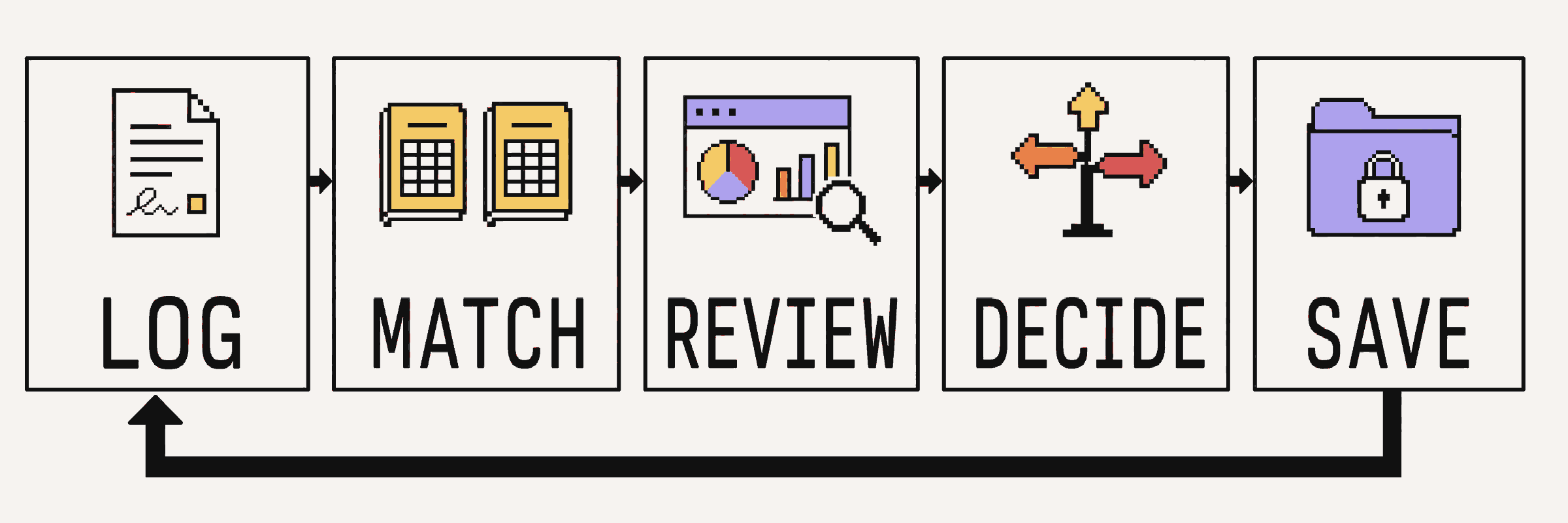
This creates one repeatable loop: log new information, match it to source records, review the portfolio, decide, and save an archive.
Measure performance without fooling yourself
Private-company dashboards look precise. Their inputs rarely are. Separate cash facts from estimates and use the same definitions every quarter.
Set the reporting boundary first
For an SPV position, choose an investor-interest view or a look-through view and use it consistently.
- Investor-interest view: use the investor's actual contributions and distributions plus the reported value of the SPV interest. If that value already deducts vehicle fees and carried interest, label the result net.
- Look-through view: allocate the underlying company cost, value, and cash flows according to the investor's economic interest and the vehicle waterfall. Show gross performance before vehicle fees and carry, then net performance after them.
Never count both the SPV interest and its underlying company position in the same portfolio total. Every dashboard and export should state the measurement date, currency, reporting boundary, and whether returns are gross or net.
Start with cash and marked value
Track invested capital by tranche and exact date. Track cash proceeds separately from noncash distributions, escrow, and unrealized marks.
Gross multiple on invested capital (MOIC) is:
(realized proceeds + current unrealized value) ÷ invested capital
The ILPA performance definitions use this core relationship for portfolio gross MOIC. An individual angel can adapt it while applying the reporting boundary and fee treatment above.
At a June 30, 2026 measurement date, suppose $40,000 invested directly across four companies has produced $30,000 in realized proceeds and $36,000 in current unrealized marks. Gross MOIC before vehicle fees and carry is ($30,000 + $36,000) ÷ $40,000, or 1.65x. Only $30,000 has come back. Show the $36,000 estimate beside the multiple instead of hiding it inside one number.
For irregular cash flows, XIRR is a spreadsheet function that estimates an annualized, money-weighted internal rate of return using the exact date of each cash flow. Use dates for checks, follow-ons, proceeds, and the terminal marked value on the measurement date. Microsoft's XIRR documentation requires matching dates and at least one negative and one positive cash flow.
Apply a written mark policy
The latest financing price is evidence, not an automatic value for every security. The 2025 valuation guidelines from the International Private Equity and Venture Capital Valuation Board call for reassessment at each measurement date. Security rights, preferences, dilution, market changes, and distressed financings can all matter.
Store a confidence label and freshness status with every mark. “Medium confidence, Series A closing package, March 31, 2026, stale after 180 days” is useful. “$18,000” by itself is spreadsheet theater.
Compare sector, stage, and vintage consistently
Use the same measurement date and denominator across every comparison. For each sector, stage at entry, and investment vintage, show:
- invested capital and its share of total invested capital
- realized proceeds and cash returned
- unrealized marked value
- gross MOIC and, when dates support it, XIRR
- company count and amount of capital represented
- percentage of marked value based on stale or low-confidence marks
Do not rank a two-company sector against a twelve-company sector without an obvious small-sample warning. Keep “stage at entry” separate from the company's current stage. Keep vintages tied to initial investment year, then apply the same rule to every holding. If one view uses invested capital and another uses marked value, label the denominator rather than calling both “exposure.”
Review cost concentration and marked-value concentration separately. A large paper markup can make one company dominate marked value without creating liquidity. Use new and follow-on checks to shape exposure because private holdings usually cannot be rebalanced like public stocks. Our portfolio risk-management guide goes deeper on diversification, concentration, and liquidity.
Keep follow-on decisions compact and operational
A follow-on notice belongs in the decision log the day it arrives. Record the notice source, response deadline, eligibility, offered security and terms, requested amount, current ownership and denominator, reserve impact, competing uses of capital, decision owner, rationale, and final response.
Then ask three questions: What changed in the original thesis? What does this round buy the company? Is this the strongest current use of the reserve?
“Decisions are never in isolation - they are a comparison game.”
Our co-founder Elizabeth Yin, Democratizing Knowledge
An AngelList study ran 10,000 simulations across a small set of follow-on strategies using 1,218 seed investments made from 2014 through 2017. Always following, never following, and a simple markup rule produced close outcomes. The analysis was gross, simulated, mark-dependent, and based on a historical platform sample, so it does not establish a universal rule. It supports fresh underwriting rather than automatic participation. Read our guide to pro rata rights for the underlying mechanics.
Prepare for exits, losses, and continuity
Your portfolio record should be ready before a liquidity event appears. For a secondary sale, acquisition, or IPO, log the offer terms, restrictions, security exchanged, closing date, fees, escrow, earnout, taxes withheld, cash received, noncash securities received, and remaining basis. A headline company valuation does not tell you what reaches your account. Our long-form exit strategy explains exit paths and preparation in more detail.
Keep signed instruments, conversion records, wire confirmations, capitalization evidence, distribution notices, tax forms, and shutdown or insolvency correspondence even when a company goes quiet. An internal zero mark does not establish a tax deduction. IRS Publication 550 applies a complete-worthlessness standard to worthless securities and contains separate rules for nonbusiness bad debts and certain small-business stock. Classification and timing require professional review.
Continuity matters too. A spouse, executor, business manager, or adviser should be able to identify every position, locate governing documents, see the last reconciliation date, and find the correct company or administrator contact. Give them a map and recovery process rather than shared credentials.
Start with the control you will maintain
Begin with one register, one transaction and event log, one decision log, and one quarterly calendar event. Backfill active and valuable positions first. Give every missing source, stale mark, and open deadline an owner and next action.
The result is a portfolio you can explain without opening twelve browser tabs. You will know which numbers are cash, which are estimates, which rights have deadlines, and which decisions need fresh work.
If you want to build that judgment alongside experienced operators and early-stage investors, apply to Angel Squad. Bring your tracker. We will help you make the process behind it stronger.













.png)