
Angel Investing for Beginners: No MBA, No Problem
No. You do not need an MBA to become an angel investor. Business school can teach useful concepts, but a degree does not establish your legal eligibility or your readiness to risk money on startups. You need risk capacity, basic business literacy, a repeatable decision process, and enough deal exposure to improve your judgment. Here is how to build those things without turning angel investing into another credential chase.
.png)
Brian Nichols co-founded our Angel Squad angel-investing community.
Separate legal eligibility from educational readiness
New investors often mix up two questions:
- Am I legally eligible to invest in this offering?
- Am I prepared to evaluate the risk and make a sound decision?
An MBA answers neither question by itself.
U.S. legal eligibility depends on the offering
Many U.S. private offerings limit participation to accredited investors or restrict participation by non-accredited investors. Other exemptions allow some non-accredited participation. The issuer's exemption and offering documents determine who may invest.
For individuals, the SEC currently recognizes several ways to qualify as accredited. These include net worth over $1 million excluding a primary residence, individual income over $200,000 or income with a spouse or partner over $300,000 in each of the prior two years with a reasonable expectation of the same in the current year, and certain financial professional credentials. An MBA is absent from the SEC's accredited-investor criteria.
Accreditation is a regulatory classification. It is not proof that someone understands startup finance, and a smart non-accredited investor does not gain access to an accredited-only offering through knowledge alone.
This is educational information, not legal, tax, or investment advice. Use independent qualified legal and tax professionals to review your situation and the documents for a specific offering.
Educational readiness starts with your capacity for loss
Private startup investments can lose their entire value. They can also remain illiquid for an indefinite period, with limited disclosure compared with public securities. The SEC's private-placement bulletin tells prospective investors to consider whether they can withstand a total loss and hold an investment indefinitely.
Before you study pitch decks, set a personal risk policy:
- Use only money whose total loss would not change your housing, emergency savings, retirement plans, debt payments, or family commitments.
- Decide the total amount you can expose to startups before any exciting deal reaches your inbox.
- Decide how you will divide that amount across opportunities and over time.
- Keep money for taxes, legal review, and other obligations outside that budget.
- Assume there may be no quick sale, predictable distribution, or rescue round.
If those constraints make a startup allocation impractical, stay in learning mode. Passing is an investment decision too.
Learn the business basics you will actually use
You do not need to reproduce a two-year general-management curriculum. You do need enough fluency to understand what a startup sells, why customers care, how the company spends money, and what your investment agreement may become.
Start with four areas.
1. Customers, markets, and distribution
Identify the specific customer, the painful problem, the current workaround, and the reason this team can reach buyers. A huge top-down market estimate cannot compensate for a vague customer or an implausible route to market.
Ask what evidence exists today. At an early stage, that may be interviews, pilots, usage, repeat behavior, revenue, or a founder's unusual access to the problem. The appropriate evidence depends on the company and stage.
2. Basic financial literacy
Learn revenue, gross margin, burn, runway, cash balance, and the main unit economics for the business model. You should be able to trace a simple chain: what the company earns, what it spends to deliver and sell the product, and how long its current cash may last.
Early forecasts are scenarios, not facts. Read them for assumptions. Which hiring plan, sales cycle, price, conversion rate, or margin must be true for the model to work?
3. Startup financing mechanics
Know both what you own and the structure through which you own it. You may buy shares, a Simple Agreement for Future Equity (SAFE), or a convertible note directly from a startup. When you invest through a special purpose vehicle (SPV), you typically buy an interest in that vehicle, while the vehicle holds the startup's security or contract. These routes create different rights, fees, conversion mechanics, reporting, and administrative relationships.
Learn valuation caps, discounts, dilution, pro rata rights, liquidation preferences, information rights, and follow-on rounds well enough to spot the questions that need professional review. Our plain-English guide to how angel investing works goes deeper on the transaction mechanics.
4. Power-law outcomes and portfolio thinking
Startup returns are uneven. Investors call this a power-law pattern: a small number of outcomes can drive much of a venture portfolio's performance, while other investments may return little or nothing. That makes a single startup a fragile way to express an investing thesis.
Our co-founder and general partner Elizabeth Yin puts the point plainly:
“Don't try to pick a co. Select a portfolio.”
Elizabeth Yin, Democratizing Knowledge (Hustle Fund, 2021), p. 130
Portfolio thinking begins before the first check. Choose a total startup budget, a pace, and a check-size range that leave room for several independent decisions. Do not copy a universal company count or assume diversification removes risk. A diversified startup portfolio is still a high-risk, illiquid allocation. Our guide to startup portfolio diversification explains the tradeoffs in more detail.
Turn career expertise into an investing lens
Your career can give you more useful signal than a generic credential.
- Engineers and product leaders can probe technical feasibility, development pace, product tradeoffs, and whether the proposed architecture fits the problem.
- Sales and marketing leaders can examine the buyer, sales cycle, positioning, channel dependence, and customer acquisition assumptions.
- Operators and finance leaders can question hiring plans, cash controls, pricing, margins, and whether milestones match the capital requested.
- Designers and researchers can evaluate workflow fit, user behavior, accessibility, and the quality of the team's customer discovery.
- Sector specialists can recognize regulation, procurement habits, incumbents, and edge cases that a generalist may miss.
Domain knowledge is a starting lens. It does not excuse weak diligence or make an adjacent market familiar. Write down where your expertise applies and where you need another person's help.
Varied professional backgrounds can also widen the patterns investors notice. That only works when investors explain their reasoning and stay open to evidence that challenges it.
Build judgment through a real learning loop
Pattern recognition does not come from memorizing what a successful founder supposedly looks like. It comes from reviewing many different companies, recording your reasoning before you know what happens, and comparing your expectations with later evidence.
Use this loop:
- Review a startup. Read the deck and available materials. Identify what the company claims about the team, customer, product, traction, market, and terms.
- Write a short thesis. Record the strongest reason to invest, the strongest reason to pass, the assumptions that must hold, and the evidence that could change your view.
- Decide or pass. Make the decision against your risk policy and portfolio plan. A compelling company can still be the wrong investment at the offered terms or at that moment in your portfolio.
- Track outcomes. Revisit your notes when the company reports progress, misses a milestone, changes direction, raises again, or stops operating. Separate good reasoning from lucky outcomes and bad reasoning from unlucky ones.
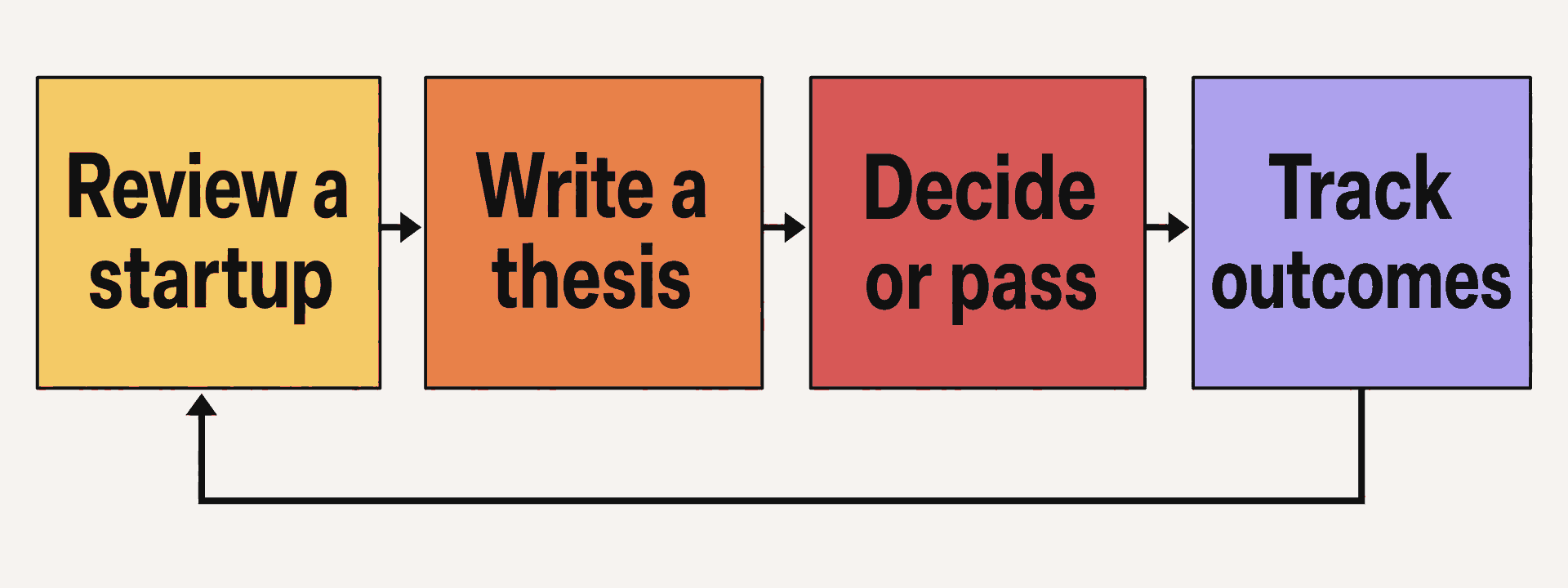
The written record matters because memory edits old decisions. A simple deal log lets you see whether you repeatedly overvalue a polished pitch, underweight distribution, ignore price, or apply your domain knowledge too broadly.
Real deal exposure makes the loop useful. You can get it through founder introductions, demo days, syndicates, investing platforms, or communities. Access alone does not create judgment. Compare deals, ask questions, hear disagreement, and get feedback on your thesis.
Calibrate diligence to the risk
Diligence cannot remove early-stage uncertainty. Its job is to test the claims that matter, identify avoidable problems, understand the terms, and make the remaining uncertainty visible.
Start with a consistent evaluation frame. Our beginner startup checklist covers the first pass. Our 5T framework organizes the decision around team, total addressable market, traction, timing, and technology.
Then go deeper where the deal demands it:
- Check founder and company identities, incorporation, ownership, and material litigation or regulatory issues.
- Ask for evidence behind customer, revenue, partnership, intellectual-property, and market claims.
- Understand the cap table, current round, use of funds, existing obligations, and the instrument you are signing.
- Read the risk factors and conflicts, including fees or carry charged by an SPV or syndicate.
- Speak with customers, references, or sector specialists when their input could change the decision.
- Write down unanswered questions and decide whether each one is tolerable, resolvable, or a reason to pass.
Use our full due-diligence checklist when you are actively evaluating a deal. Legal, financial, technical, and tax specialists should handle questions outside your competence.
Choose a learning route that includes practice
Self-study, courses, communities, and MBA programs solve different problems. The most direct route for a prospective angel is focused self-study paired with repeated exposure to real deals and honest feedback.
Self-directed learning
Books, practitioner essays, public pitch reviews, and startup finance resources are flexible and inexpensive. You control the pace and can focus on the gaps that matter to you.
The weakness is feedback. It is easy to confuse familiarity with competence when nobody challenges your reasoning. Add a deal log and regular conversations with active investors.
Best suited to: disciplined operators who already have access to founders or experienced angels and will maintain their own learning routine.
A focused course
A well-designed course can sequence vocabulary, portfolio concepts, diligence, and terms. It is useful when scattered reading leaves gaps.
Inspect who teaches it, whether the material reflects current deal structures, whether you evaluate real companies, and whether feedback continues after the lessons end. Completion is less important than the decisions you can explain afterward.
Best suited to: independent learners who want a defined curriculum before reviewing live opportunities.
An investing community
A good community can combine deal exposure, peer debate, practitioner feedback, and operational context. The tradeoff is that quality and incentives vary. Ask who sources deals, how opportunities are selected, what conflicts exist, what members can learn before investing, and how terms and fees are presented.
Our general partner Shiyan Koh offers a useful test for any learning or deal source:
“Show me the incentives, and I'll show you the outcome.”
In our Angel Squad, members learn from Hustle Fund investors, discuss early-stage opportunities with peers, and can review real deals. Joining the community does not require accredited-investor status, while participation in a specific offering depends on that offering's eligibility rules.

Best suited to: busy operators and sector specialists who want recurring deal exposure, feedback, and peers alongside self-study.
An MBA or other formal program
An MBA offers broad management education, a professional network, recruiting access, and a recognized career credential. Those benefits can be valuable. The curriculum is rarely designed around small-check, early-stage investing, and the time and financial commitment reach far beyond this one skill.
Best suited to: people who want the degree for a broader career move and also plan to use the network or electives to explore venture investing.
When formal education may still help
Formal education can make sense when angel investing is one part of a wider goal:
- You need a credential for a career change, promotion, or recruiting path.
- You want structured depth in accounting, finance, management, or a regulated field.
- Your employer funds the program and the opportunity cost fits your plans.
- A specific program offers sustained access to active investors, founders, and real investment work.
- You intend to manage other people's capital professionally and need broader training, supervision, and relevant licenses or legal guidance.
Even then, the degree remains separate from SEC eligibility and from the judgment built through live decisions. Classroom cases have known facts and tidy endings. Startup investing gives you incomplete information, uncertain timing, and no answer key.
Angel investing readiness checklist
You are ready to consider a first investment when you can answer yes to each of these:
- I know whether I am eligible for this specific offering.
- I can lose the full investment without harming my financial obligations or plans.
- I can hold the investment indefinitely and do not depend on a secondary sale.
- I have a written startup allocation, check-size range, and portfolio plan.
- I can explain the customer, problem, business model, distribution path, burn, and runway in plain language.
- I understand what I am buying and which terms affect conversion, ownership, dilution, economics, and control.
- I can identify the deal's strongest evidence, largest unanswered question, and most credible failure case.
- I have completed appropriate identity, company, claim, cap-table, term, conflict, and reference checks.
- I wrote my thesis before deciding and know what future evidence would change it.
- I have reliable sources of deal exposure and people who will challenge my reasoning.
- I know where my career expertise helps and where I need specialist input.
- I am comfortable passing when the deal falls outside my risk policy, portfolio, competence, or terms.
You do not need perfect confidence. Early-stage investing never provides it. You need enough preparation to understand the risk, explain the decision, and live with a full loss.
If you want to build that judgment with real deal exposure, practitioner education, and candid peer feedback, apply to Angel Squad.







.png)