
12 Angel Investing Mistakes and How to Avoid Them
Brian Nichols is the co-founder of Angel Squad, a community where you’ll learn how to angel invest and get a chance to invest as little as $1k into Hustle Fund’s top performing early-stage startups.
A bad outcome does not always mean you made a bad decision. A great outcome does not prove the decision was sound. The angel investing mistakes worth preventing are the repeatable process errors that expose too much capital, hide weak reasoning, or damage long-term relationships.
Need the mechanics of choosing an access route, checking eligibility, diligencing a deal, and funding it? Use our separate 7-step startup-investing guide. The focus here is what commonly goes wrong.
This is educational content, not investment, legal, tax, accounting, or valuation advice. Every example is hypothetical and simplified, not a projection. Startup securities and fund interests are speculative, illiquid, long term, and capable of a total loss. Past results and current marks do not guarantee future results. Outcomes depend on governing documents, fees, carry (the manager’s share of investment profits), taxes, capitalization tables, valuation policies, and timing. Read the governing documents and consult qualified independent investment, legal, tax, accounting, and valuation professionals about your circumstances.
Mistake 1: Investing capital that is not truly surplus
Private startup securities do not come with a reliable sale date. The company might exit in several years, stay private much longer, or fail. The SEC’s private-placement guidance highlights total-loss risk, limited disclosure, and illiquidity.
Money earmarked for an emergency fund, taxes, tuition, a home, debt payments, or near-term living costs is a poor fit. So is money you would need to sell on a schedule.
Prevention: Set a total startup loss budget before looking at deals. Keep it separate from essential cash and public-market liquidity. If losing the entire amount would change your life plan, reduce it or sit out.
Mistake 2: Letting conviction dictate check size and portfolio size
A compelling founder can make one deal feel unusually knowable. It is not. Early evidence is sparse, the market can change, and execution can break in ways no pitch reveals.
Angel returns can also be highly skewed. In a historical study of angel groups, 7% of reported exits produced more than 10 times invested capital and accounted for 75% of total investment-dollar returns. The 2007 sample covered group-affiliated angels and self-reported exits, so it shows a pattern, not a forecast.
That is why our co-founder Elizabeth Yin says, “Don't try to pick a co. Select a portfolio.” Equal or tightly bounded initial checks keep excitement from quietly concentrating the portfolio.
There is no magic portfolio count. Advice to make 15 to 20, 20 to 30, or 100 investments describes different budgets, access, minimums, time demands, and objectives. More positions reduce the effect of one failure. They also require more deals, review, administration, and patience.

Prevention: Choose a range of position counts and a maximum initial check from your total loss budget. Write the rule down, then apply it to the deal you love most.
Mistake 3: Treating a follow-on reserve percentage as a law
Advice to reserve 30% to 40% or 50% to 70% for later rounds sounds precise. It is still a portfolio choice.
A larger reserve gives you capacity to invest again when a company shows better evidence. It also leaves fewer dollars for new companies and can deepen concentration in familiar names. A smaller reserve broadens initial exposure but may leave you unable to use pro rata rights or support a company later. Some investors lack follow-on access altogether.
Prevention: Decide whether you will reserve capital, what evidence unlocks it, and how every follow-on will compete with the best new opportunity. Recalculate ownership, price, dilution, and remaining risk at each round. Pro rata access is an option, not an instruction.
Mistake 4: Mistaking a thin inbox for deal flow
If you see three deals and fund one, your investment rate is about 33%. That says nothing about selectivity when the sample came from friends, one demo day, or whichever founder found you first.
Deal-flow volume creates comparison points. You start noticing what normal traction looks like at a stage, which markets repeatedly appear, and which terms are aggressive. Our co-founder Eric Bahn puts it simply: “Investing requires practice like everything else.”
A lead or community can widen the top of the funnel. In Angel Squad, members can review Hustle Fund-sourced opportunities, live pitches, and deal memos with other operators. Members still make their own decisions.
Prevention: Track opportunities and passes, not only investments. Record source, stage, sector, instrument, terms, decision, and reason. A pipeline should improve comparison, never pressure you to deploy.
Mistake 5: Following hype instead of evidence
A hot category, famous co-investor, or oversubscribed round can substitute urgency for analysis. Social proof may improve access. It does not tell you whether the price, product, team, or risk fits your portfolio.
Strip the fashionable label from the deck. For an AI company, for example, ask what the customer does today, why this workflow wins, what data or distribution advantage compounds, and whether usage survives after a pilot. Apply the same test to climate, crypto, healthcare, or the next crowded category.
Prevention: Write down the claim that would still make the company interesting if the theme fell out of favor. Pass when the answer is only momentum, scarcity, or someone else’s name.
Mistake 6: Investing without your own thesis
“Smart people are investing” is context, not a thesis. A useful thesis states why this team can win, why the market is opening now, what evidence matters, what could disprove the case, and how the check fits the portfolio.
Your operating experience can sharpen that work. A healthcare operator may recognize an impossible procurement timeline. A security engineer may separate an impressive demo from a defensible system. Diversifying single-company risk does not require pretending every sector is equally knowable.
As Elizabeth Yin writes, “The more disciplined you are in your thought process/rubric, the more you can improve over time.”
Prevention: Use a one-page investment thesis and a dated memo for every yes. Record the strongest contrary evidence too. That is how you later distinguish good reasoning from luck.
Mistake 7: Matching diligence to enthusiasm instead of risk
Excitement makes investors skip checks. Anxiety makes them demand public-company certainty from a pre-seed startup. Both are mistakes.
Proportional diligence considers the dollars at risk, company stage, evidence available, instrument, regulatory exposure, and technical or market complexity. At minimum, reconcile founder histories, customer and revenue claims, cash and burn, prior financings, cap table, security, and material conflicts. Go deeper where one fact could break the thesis.
Friends do not get a diligence exemption. Neither do repeat founders, a polished data room, or a lead investor’s screening process. Historical angel-group research found an association between greater diligence and higher reported returns, but it does not establish a universal hour quota or prove causation.
Prevention: Use a risk-based checklist and name the claim most capable of changing the decision. Our startup diligence guide gives you the deeper workflow.
Mistake 8: Ignoring the return math
A good company can be a poor investment at the wrong price. Entry valuation, ownership, dilution, exit value, fees, carry, taxes, and liquidation terms all affect what reaches you.
Hypothetical, simplified deal-level exit example as of the initial investment: gross and fully realized; one $1,000 initial check; no follow-ons, fees, carry, taxes, debt, transaction costs, liquidation preferences, or option-pool changes; exact pro rata ownership; 50% ownership dilution assumed. At a $10 million post-money entry value, $1,000 buys 0.01% before dilution. After 50% dilution, a $100 million exit would produce $5,000 in gross proceeds, or 5 times invested capital. Change the exit, dilution, or terms and the result changes.
A 2-times outcome can sound excellent in isolation. In a portfolio with total losses and long holding periods, it may not carry much weight.
Prevention: Model at least a downside, middle, and exceptional exit case using the actual security and cap table. Treat the outputs as sensitivity tests, never predictions.
Mistake 9: Skimming the terms and cap table
The pitch explains the business. The documents determine what you own and who gets paid first.
A Simple Agreement for Future Equity (SAFE) is not priced stock today, and its valuation cap is not automatically the company’s current valuation. Review conversion triggers, cap, discount, most-favored-nation language, pro rata provisions, liquidity treatment, and dissolution treatment. The SEC’s SAFE investor bulletin warns against relying on the word “simple.”
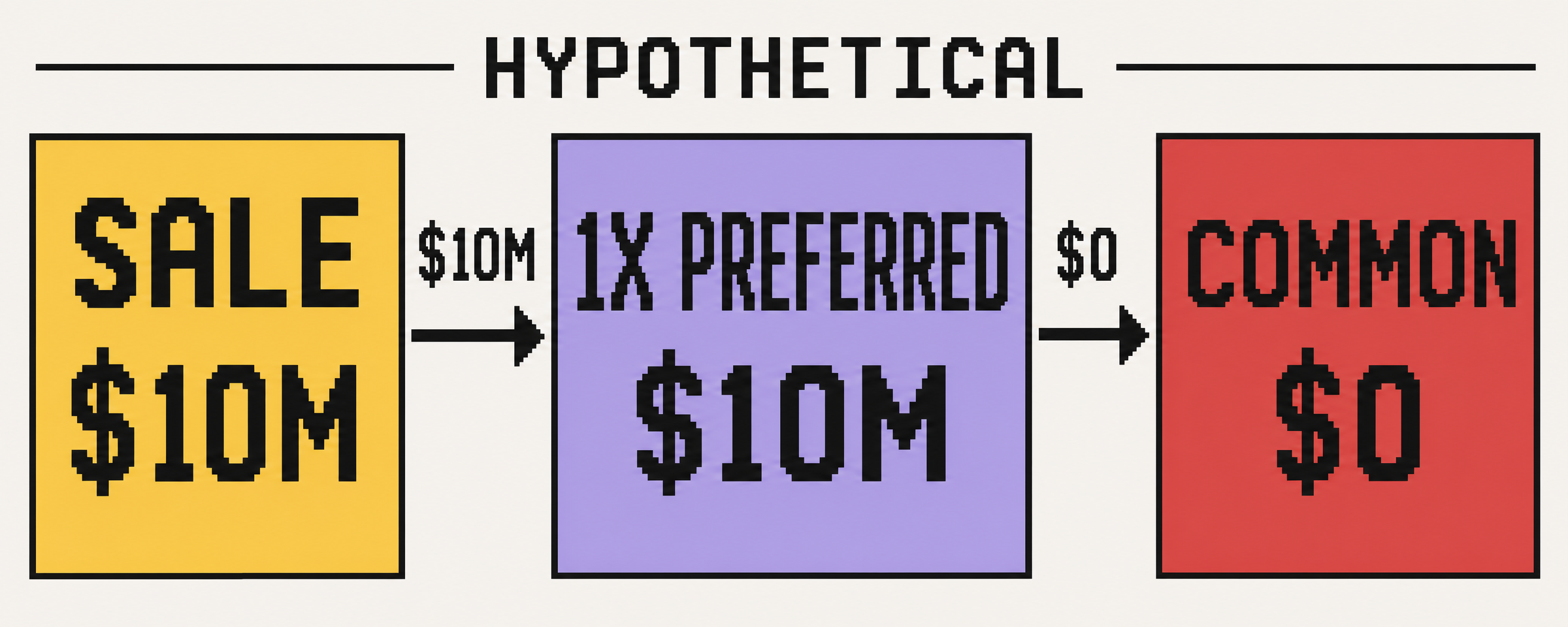
Liquidation preference can matter even when the headline exit sounds positive. Hypothetical, simplified deal-level exit example as of the sale date: gross and fully realized; $10 million of preferred capital; no follow-ons, fees, carry, taxes, debt, transaction costs, dividends, participation, seniority differences, option exercises, or later cap-table changes. If the company sells for $10 million and the preferred stock has a 1x non-participating liquidation preference senior to common, preferred holders collectively receive $10 million and common holders receive $0. Actual payouts follow the charter, security terms, and capitalization table.
Prevention: Trace the ownership chain and exit waterfall. Review the security, current cap table, prior SAFEs and notes, preference stack, option pool, information rights, pro rata rights, fees, carry, and transfer limits. Use our liquidation-preference guide for the full mechanics.
Mistake 10: Expecting fast feedback, then quitting during quiet years
Startup investing rarely gives clean, timely scorekeeping. A higher financing mark is not cash. A flat mark does not prove the company is dead. An exit may take years, never arrive, or arrive after long stretches of ordinary updates.
The quiet period is when new angels often stop reading, pause new decisions, and lose track of the portfolio. That breaks both learning and administration. It can also make a follow-on notice or material company change easy to miss.
Prevention: Judge your process on a schedule and your outcomes only when the evidence supports it. Keep reading updates, reviewing new deals at your planned pace, and recording changes without treating current marks as spendable wealth.
Mistake 11: Treating founder relationships as transactions
Angel investing is a repeated game. Founders and investors remember who responded, kept a confidence, made a thoughtful introduction, gave a quick no, and honored a commitment.
The reverse compounds too. Ghosting a founder after requesting materials, reneging without a real change in facts, making introductions without consent, or using confidential information damages trust. One small check does not buy the right to micromanage.
Prevention: Set expectations about response time, help, reporting, and decision authority. Say no clearly. Protect confidentiality. Make specific offers you can deliver, then follow through.
Mistake 12: Disappearing after the check
The work after investing is less glamorous than the pitch. Read updates, answer reasonable requests, make relevant introductions, and know when the most helpful move is staying out of the way.
Keep the administrative record too: investing entity, amount, date, instrument, material terms, fees and carry, ownership or vehicle units when known, rights, contacts, wire confirmation, countersigned documents, valuations and their policy, follow-on decisions, distributions, write-offs, and tax-document status.
Support and recordkeeping reinforce each other. An organized investor can respond faster, learn from the original thesis, and avoid missing a notice during the boring years.
Prevention: Create the portfolio record when you wire, update it whenever new documents arrive, and schedule a quarterly review. Our guide to supporting founders explains how to help without becoming overhead.
The concise angel investing mistake-prevention checklist
Before each check, answer yes to all 12:
- Is this capital truly surplus and able to remain illiquid?
- Does the check fit my written size and portfolio rules?
- Does it preserve my chosen follow-on strategy?
- Have I compared the deal with enough relevant opportunities?
- Would the evidence still interest me without the hype or co-investor names?
- Can I state my own thesis and the fact that would disprove it?
- Did diligence match the amount, stage, instrument, and risk?
- Did I model ownership, dilution, and exit sensitivity?
- Did I read the security, cap table, preference stack, rights, and vehicle costs?
- Can I hold through years without reliable liquidity or feedback?
- Have I set honest expectations with the founder?
- Can I support, monitor, and document this investment after close?
You do not need perfect foresight. You need rules that stop one exciting pitch from rewriting your budget, standards, or behavior. If you want to build those habits while reviewing real opportunities with experienced operators, apply to Angel Squad.













.png)