
How to Write Your First Angel Investment Check
Brian Nichols is the co-founder of Angel Squad, a community where you’ll learn how to angel invest and get a chance to invest as little as $1k into Hustle Fund’s top performing early-stage startups.
You have picked a startup and are ready to act. The hard part now is avoiding a rushed decision, signing something you do not understand, or wiring money without a clean paper trail. Your process runs from focused diligence through commitment, documents, funding, and close confirmation, with controls that prevent paperwork and transfer mistakes.
This is educational content, not investment, legal, tax, accounting, or valuation advice. Private placements are speculative, illiquid, long term, and can lose their entire value. Governing documents, fees, carry (the manager's share of investment profits), capitalization tables, tax positions, closing terms, and timing determine actual outcomes. Read the governing documents and use qualified independent legal and tax professionals for your circumstances.
What “writing a check” actually means
Nobody needs to find a paper checkbook. Writing an angel check is a chain of decisions and records: investigate the deal, decide, commit, sign, fund, confirm the close, and store the evidence.
For the broader model, start with what angel investing is. For eligibility, risk budgeting, deal flow, and portfolio preparation, use our comprehensive beginner guide. The workflow here begins after you have selected a specific opportunity.
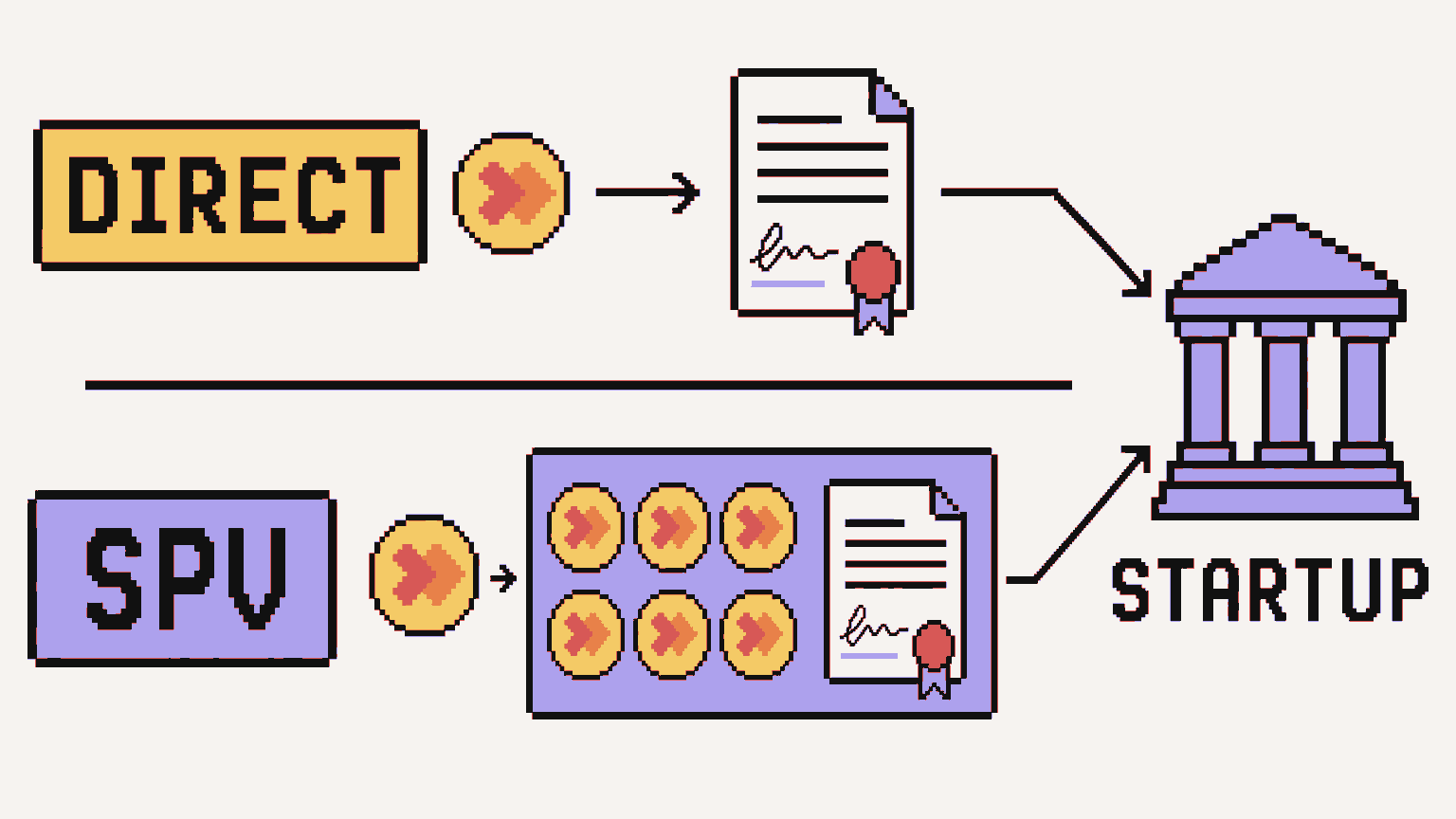
The party receiving your investment depends on the deal structure:
- In a direct investment, you invest in the startup. You may receive a Simple Agreement for Future Equity (SAFE), a convertible note, or shares issued in a priced equity round.
- In a special purpose vehicle (SPV), you buy an interest in a legal vehicle. The vehicle holds the startup security. When that security is shares, the vehicle rather than the underlying investors is the shareholder shown on the startup's capitalization table, or cap table. A syndicate manager or platform administers the vehicle.
That distinction controls which documents you sign, who receives your funds, which fees and rights apply, and where future updates and tax documents come from.
Our Angel Squad angel-investing community uses Hustle Fund-sourced opportunities, deal memos, and AngelList for commitments. The platform handles the legal paperwork, transfers, and tax documents. Joining the community does not require accredited-investor status; investing in relevant offerings does. Members still make their own investment decisions. Infrastructure reduces administrative work. It does not replace judgment.
1. Set your decision boundary before doing more diligence
Write down four facts before opening another deck:
- The most you will invest in this deal.
- The name of the person or entity that will make the investment.
- The commitment and funding deadlines.
- The findings that would make you pass.
The fourth item protects you from falling in love with the pitch and moving your standards afterward. Examples include a founder misrepresenting their history, customer claims that do not hold up, unresolved intellectual-property ownership, or financing terms you cannot explain in plain English.
This process assumes your first-check budget and portfolio plan already exist. If they do not, finish the pre-check readiness work before committing to a company.
2. Run diligence in proportion to the risk
A small check can still create legal, tax, reputational, and fraud exposure. “Spend two hours because the check is small” is a weak rule. Diligence depth should follow the size of the potential loss, the complexity of the business and financing, the reliability of available evidence, and your ability to understand the risks.
Work through four buckets.
Founders
Confirm claimed roles, employers, education, and prior companies against credible records. Speak with people who have worked with the founders when the relationship or amount justifies it. Ask what happens when a founder is wrong, under pressure, or late.
Look for evidence of learning and execution. A polished pitch only proves that the team can make a polished pitch. As our GP Eric Bahn writes, “great execution meets high velocity.”
For an early company, that can show up as a short product cycle, a specific customer insight that changed the roadmap, or disciplined movement in one meaningful metric. Speed without learning is activity. Learning without shipping is theory.
Product, customers, and traction
Use source evidence for the claims driving your decision. If retention matters, review cohort data. If revenue matters, understand what the company calls revenue and whether it is recurring, contracted, collected, or merely projected. If customer love matters, talk with customers or review unedited usage evidence.
Write down what you could not substantiate. An open question is manageable. A hidden one is dangerous.
Market and competition
Start with how customers solve the problem today. The strongest competitor may be a spreadsheet, an employee, or doing nothing.
Then ask why this team can enter now, which narrow customer group it can win first, and what has to become true for the opportunity to grow. A giant market-size slide cannot answer those questions.
Company and financing
Understand the legal entity, fundraising target, instrument, use of funds, expected runway, existing debt, outstanding SAFEs or notes, and option pool. Read the current cap table or the lead investor's cap-table analysis when access allows. Identify what converts ahead of or alongside your money and how another financing could dilute the position.
For a Regulation D offering, an SEC Form D can supplement this work. It is a notice, not an SEC endorsement of the investment. Under Rule 506(b), the notice is due after the first sale, and purchasers receive restricted securities. That timing also means a missing pre-close filing does not settle the diligence question by itself.
3. Write a one-page investment memo
Complete the memo before clicking “commit.” Keep it short enough that you will actually revisit it.
Include:
- Decision: Invest or pass, amount, date, and decision deadline.
- Thesis: The two or three reasons this company could create substantial value.
- Evidence: The facts supporting each reason.
- Risks: The strongest case against the investment.
- Unknowns: Questions that remain unanswered and why you accept them.
- Terms: Instrument, valuation cap or price, discount, special rights, and the investing entity.
- Sizing: Why this amount fits your preset limit.
- Learning markers: The milestones that would strengthen or weaken the thesis.
This document is a record of what you believed with the information available. It is not a prediction. Our GP Elizabeth Yin explains why the record matters: “The more disciplined you are in your thought process/rubric, the more you can improve over time.”
A memory rewritten after the outcome teaches very little. A dated memo exposes which assumptions were sound, which were lucky, and which you missed. Our tear sheet example gives you a compact format for keeping the evidence and decision together.
4. Make a clean go or no-go decision
You are ready to say yes when the material questions are answered, the remaining risks are explicit, the terms fit your limits, and you are comfortable losing the full amount.
You are ready to say no when a founder evades a material question, the story and source evidence conflict, the structure remains unclear, the deadline prevents adequate review, or the deal only works under optimistic assumptions.
A pass does not require proving that the company will fail. “I cannot underwrite this risk” is enough.
Before submitting an indication, understand what that button does. Depending on the platform and documents, it may be an expression of interest, a commitment subject to allocation, or a binding subscription. Record whether the amount can be reduced, whether you can withdraw, what happens if the round is oversubscribed, and how cancellation or refunds work if the deal does not close.
5. Understand the instrument and ownership path
The word “equity” hides several different outcomes.
- SAFE: You receive a contract for potential shares later. A SAFE is not stock before conversion. The standard YC post-money SAFE has no interest or maturity date, and rights such as pro rata participation may sit in a separate side letter. The current SAFE forms explain the cap, discount, most favored nation provision, conversion events, and optional side letter. Modified forms can behave differently.
- Convertible note: You hold debt that may convert into equity. Interest, maturity, conversion triggers, repayment priority, and amendments matter.
- Priced equity: You purchase shares at a stated price. The stock purchase agreement, charter, investor-rights documents, and cap table define the economics and rights.
- SPV interest: You own an interest in the vehicle. The vehicle owns the startup instrument or shares. Your economics also depend on the manager, fees, carry, expenses, allocation policy, distribution waterfall (the order in which cash is paid out), and vehicle documents.
Do not record “I own 0.1% of the startup” because a pitch slide or quick division produced that number. Other SAFEs, notes, option-pool changes, round mechanics, preferences, fees, and later dilution can change the result.
6. Review the documents as one connected package
Document names vary. Read the subscription agreement, SAFE or note, stock purchase papers, SPV operating agreement, private placement memorandum, and side letters that apply to your deal as one package.
Confirm these items across every document and screen:
- Your legal name or investing entity, contact details, and investment amount.
- The startup or SPV legal name and the security or vehicle interest being purchased.
- The valuation cap, discount, interest, maturity, share price, or other core economic terms.
- Information, pro rata, voting, transfer, and distribution rights, including where a right is absent.
- SPV fees, carry, expenses, manager powers, conflicts, and distribution waterfall.
- Closing conditions, allocation changes, cancellation terms, and return-of-funds process.
- Tax-document timing and which party administers it.
- Investor representations, including any accreditation and sanctions-related statements.
- Signature status and whether the counterparty must countersign or accept the subscription.
Standard-looking documents still deserve attention. A familiar template can be modified, and the economic terms often live in more than one place.
7. Transfer funds without creating a fraud opening
Use funding instructions inside the known administrator platform or through a contact channel established before the transfer request. Confirm that the beneficiary name matches the startup or SPV named in the documents.
If the account changes, stop the transfer. Confirm the change through a second channel using a phone number or platform contact you already know. The FBI's guidance on business email compromise recommends a secondary channel for account-information changes because legitimate email accounts can be compromised.
Initiate the transfer early enough for bank cutoffs, weekends, holidays, transfer limits, and administrator review. Save the transfer receipt and reference number. Send the administrator the date and amount, without emailing full banking credentials or sensitive account details.
8. Confirm the close and build the permanent record
A bank confirmation proves that money left your account. It does not prove that the investment closed.
Collect the records that establish the full chain:
- Written confirmation that the correct party received the funds.
- The final accepted or countersigned documents.
- The closing notice and final allocated amount.
- The SAFE, note, share record, or SPV-interest record that applies.
- Any side letter and final deal summary.
- Contact details for the founder, manager, and administrator.
- Your memo, diligence notes, transfer receipt, and relevant correspondence.
- The expected location and timing of investor updates and tax documents.
Store the files in one folder named with the company, investing entity, and close date. Put the company on your portfolio tracker only after the close status is clear. If the amount received differs from the signed amount, resolve the discrepancy in writing and keep that record with the deal.
A realistic first-check timeline follows milestones
Deal calendars vary. Rolling closes can move quickly. An SPV may wait for its own minimum, signatures, and funding. Direct investments can stall on diligence, allocation, bank timing, or company approvals.
Use milestone gates instead of promising yourself a seven-day or 30-day finish:
- Opportunity selected: Record the commitment deadline, closing model, and open questions.
- Before commitment: Complete material diligence and date the investment memo.
- After allocation: Read the final documents and reconcile every term with the memo.
- Before the funding cutoff: Confirm the beneficiary and transfer instructions independently, then fund early.
- At close: Obtain receipt, acceptance, the final amount, and the instrument or SPV record.
- After close: Archive the record and make one specific offer of help to the founder when appropriate.
A tight deadline can shorten elapsed time. It cannot erase an unresolved risk. Pass when the evidence or paperwork cannot be completed responsibly.
Your final first-check checklist
Before committing
- The deal fits your preset amount and risk limits.
- Founder, traction, market, company, and financing claims have source evidence.
- Material unknowns and pass conditions are written down.
- Your dated memo explains the thesis and strongest risks.
Before signing
- The investor, recipient, amount, and instrument match across the package.
- You understand the core economics, rights, restrictions, fees, carry, and tax administration.
- Allocation, cancellation, refund, and closing mechanics are clear.
Before funding
- The beneficiary matches the legal documents.
- New or changed instructions have been confirmed through an independent channel.
- The transfer is scheduled before the real cutoff.
After closing
- Receipt, executed documents, final allocation, and ownership record are stored together.
- Your portfolio tracker reflects the actual structure and amount.
- Update and tax-document channels are recorded.
The first transfer feels like the finish line. It is really the point where your written judgment meets an irreversible decision. Build a process you can repeat without rushing or hand-waving the paperwork.
If you want to review Hustle Fund-sourced deals, learn alongside active operators, and handle commitments through established infrastructure, apply to Angel Squad.







.png)