
AI agents market map: 6 layers for startup investors
Brian Nichols is the co-founder of Angel Squad, an angel investing community where aspiring and active angels learn from Hustle Fund’s approach, review curated deal flow, and connect with peers.
The AI agent label now covers products as different as coding tools, orchestration frameworks, browser infrastructure, and healthcare workflow systems. A crowded logo grid makes those companies look comparable when their customers, products, and risks are miles apart. For investors, the useful map is a functional one. It separates the enabling stack from applications, shows the controls that cut across every category, and turns category excitement into diligence questions.
What counts as an AI agent?
An AI agent is software that can receive a goal, choose or plan steps, use tools, observe the result, and adjust its next action with some degree of independence.
Autonomy sits on a spectrum:
- Assistants retrieve information or generate an output for a person. The human remains the operator.
- Agentic workflows complete bounded, multi-step work across tools, often with approval gates.
- Higher-autonomy agents pursue a goal, make more decisions during execution, and ask for help at defined limits.
A practical screen has five parts: a goal, state or memory, tool access, a feedback loop, and permission to act. A chatbot that drafts an email has one or two. A system that researches an account, updates the customer relationship management system, drafts outreach, and pauses for approval has all five.
This map also includes infrastructure built specifically to create, run, connect, evaluate, or secure agents. A tool can be essential to the agent market without being an end-user agent.
AI agents market map, September 19, 2026
This is a curated, non-exhaustive, non-ranked snapshot based on accessible first-party product evidence. Inclusion means a company documents either an agentic product or an enabling function built for agents. Placement reflects documented product function, not revenue mix, valuation, market share, or investment quality. Companies can span categories, and several do.
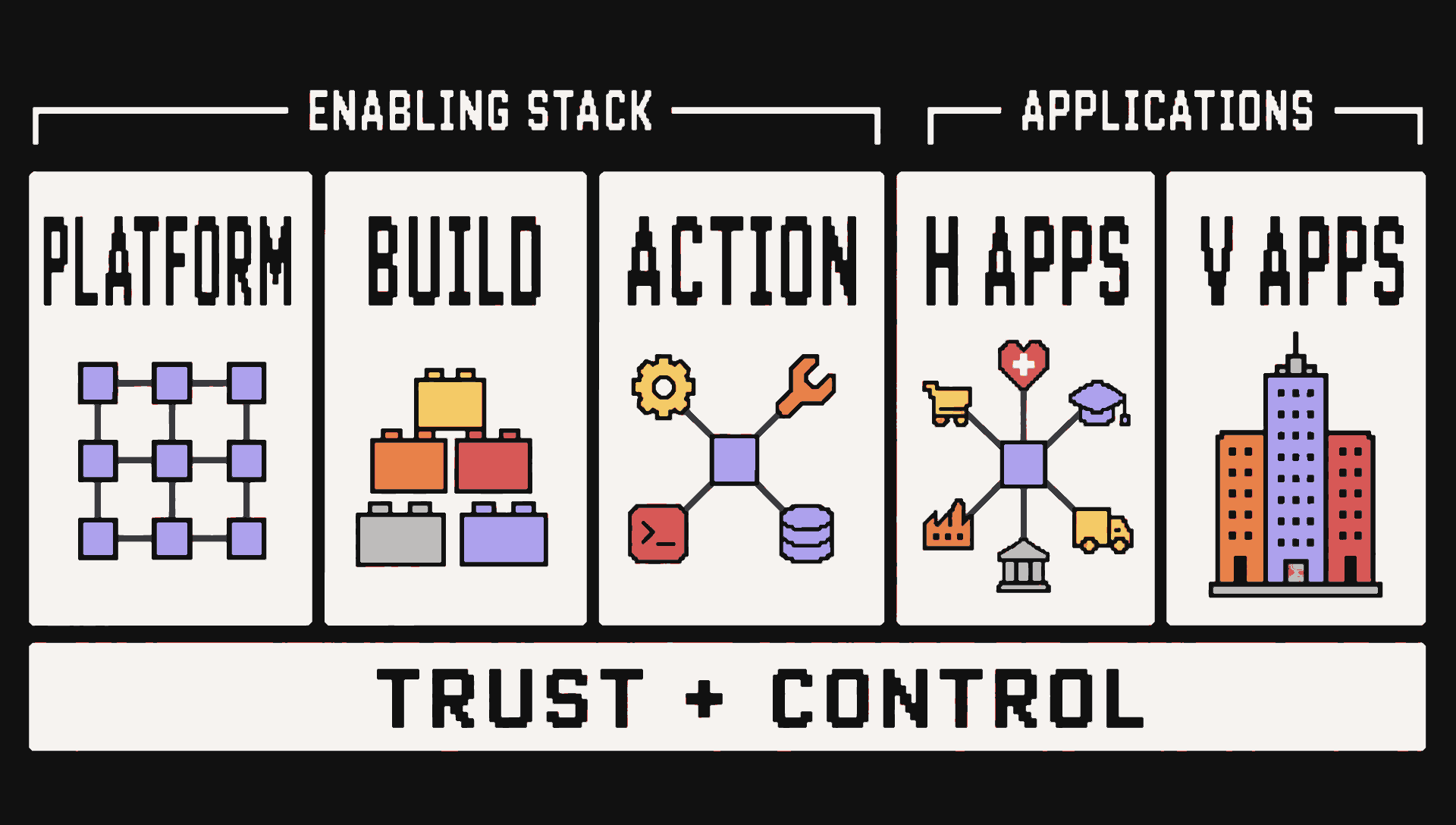
1. Agent platforms and control planes
Documented function: These products provide a managed environment for building, deploying, and governing agents. They bundle models, tools, runtime, workflow controls, and enterprise administration in different combinations.
Representative products come from Amazon Web Services (Bedrock Agents), Google Cloud (Gemini Enterprise Agent Platform), Microsoft (Copilot Studio), Salesforce (Agentforce), and Cloudflare (Agents).
Diligence hypothesis: Distribution, deployment, and governance may matter more here than one orchestration feature. An early-stage company needs a clear reason a customer will choose it over the model, cloud, or system-of-record vendor already in the account.
2. Agent building and orchestration
Documented function: Frameworks in this layer define agent steps, route work, manage state, coordinate specialized agents, and support human review. Representative projects include the Agents SDK from OpenAI, LangGraph from LangChain, CrewAI, and the agent-building stack from LlamaIndex.
The distinction from layer one is scope. A builder gives a developer composable parts. A platform offers more of the managed environment around those parts. Many companies do both, so the line is fuzzy by design.
Diligence hypothesis: Open-source adoption can create distribution while making direct monetization harder. The durable asset could be managed execution, evaluation data, enterprise governance, or a developer ecosystem. The pitch should identify which one.
3. Context, action, and runtime infrastructure
Documented function: This layer lets agents retrieve context and act. It includes browser infrastructure, tool connections, authorization, sandboxes, stateful execution, memory, and observability around actions.
Browserbase provides browser infrastructure for agents. Composio provides tool calls, delegated authorization, sandboxes, and execution across connected applications. Cloudflare also spans this layer with stateful runtime primitives.
Diligence hypothesis: Usage is weak evidence when calls fail or customers can switch easily. The better questions concern completed jobs, permissioning, recovery, and the cost of maintaining integrations when upstream systems change.
4. Trust and control, across every layer
Documented function: Evaluation, tracing, security, policy enforcement, and governance sit across the stack. They are a control rail, not the next sequential step after runtime.
Braintrust, Arize AI, Maxim AI, Langfuse, and Lakera represent different parts of this cross-cutting layer.
The 2025 AI Agent Index documented 30 prominent agents and found that 25 disclosed no internal safety results and 23 disclosed no third-party testing. The finding does not establish that those agents are unsafe. It establishes an information gap. Investors need the evaluation set, failure log, red-team results, escalation rules, and incident owner behind the security slide.
Diligence hypothesis: Control products gain value when they see behavior across models, tools, and applications. A point feature faces bundling risk. Cross-platform evidence, policy depth, or proprietary threat data could make the difference.
5. Horizontal applications
Documented function: Horizontal agents automate a job shared across industries. The large groups in this snapshot are enterprise knowledge and workflow, customer interaction, and software development or computer use.
- Enterprise knowledge and workflow: Glean, Writer, Relevance AI, Zapier, and HubSpot document agents that work across company knowledge, customer relationship management data, or connected applications.
- Customer interaction and voice: Sierra, Intercom, Zendesk, Decagon, and ElevenLabs document customer-facing or conversational agent products.
- Coding and computer use: Anthropic, Replit, Cursor, GitHub, Cognition, and Manus document products that edit code, run commands, create pull requests, publish applications, or execute broader computer tasks.
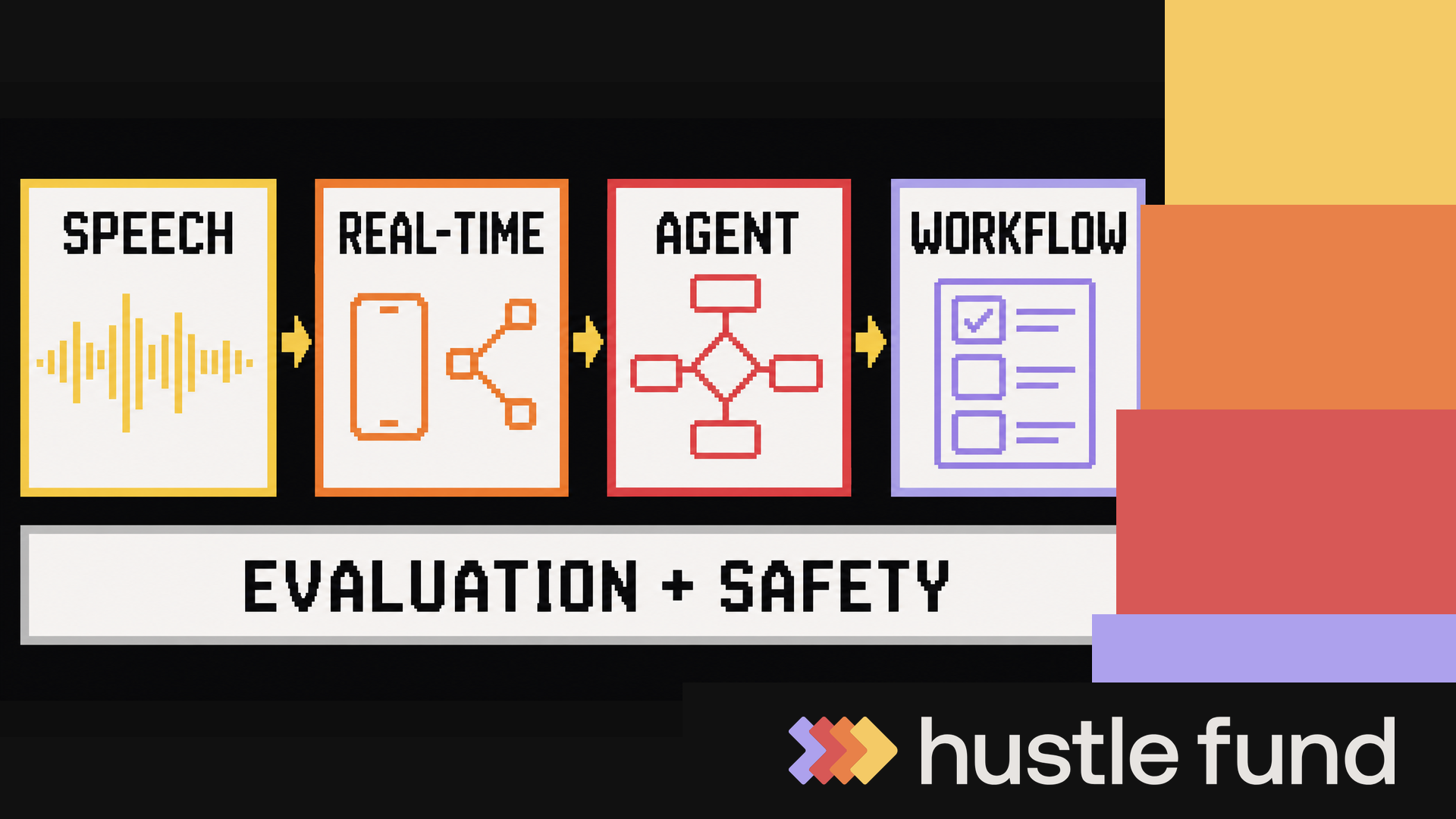
Voice agents also have a deeper market stack, from speech infrastructure to end applications.
Diligence hypothesis: A large horizontal market also attracts incumbents with data, distribution, and an existing workflow surface. A startup needs a narrow entry point where its output is measurable and meaningfully better for a specific buyer.
6. Vertical applications
Documented function: Vertical agents carry out industry-specific work that depends on domain context, systems, approval rules, or regulation.
- Healthcare: Hippocratic AI and Infinitus document agents for patient or administrative workflows.
- Legal: Harvey, Legora, and Eudia document agentic products for law firms or in-house legal work.
- Financial services and finance: Hebbia, Rogo, and Concourse document agents for investment, deal, close, forecast, or collections workflows.
- Insurance, real estate, and cybersecurity: Bevaya, EliseAI, Dropzone AI, and Simbian document agents for underwriting or claims, property operations, and security operations.
Diligence hypothesis: Domain data, integrations, evaluations, and buyer trust can support defensibility. They can also hide a services-heavy implementation. Deployment time, human labor per account, customer-specific code, and gross-margin progression test whether the product is becoming repeatable.
What this map suggests, and what it does not
The broader demand signal is real. Menlo Ventures estimated that enterprise generative AI spending reached $37 billion in 2025, with $19 billion going to applications. Its estimate covers generative AI, not AI agents alone. It supports the case that enterprise buyers are spending on AI while leaving the size of the agent market unresolved.
Three working hypotheses are worth carrying into deals:
- Owning completed work may be more durable than exposing generic capability. A customer can compare a resolved ticket, merged pull request, reviewed contract, or reconciled payment with the old process. A general builder still relies on the customer to design the value.
- Open standards expand distribution and pressure thin integration moats. The Linux Foundation hosts the Agent2Agent protocol and the Agentic AI Foundation, which stewards Model Context Protocol. The AI Agent Index found that 20 of its 30 agents already supported Model Context Protocol. Easier interoperability can grow the market while making a basic connector easier to replace.
- Reliability becomes part of the product as permission expands. An agent that can send money, modify production code, or change a customer record needs scoped credentials, traceability, rollback, and clear human escalation.
Hype can still help an early entrant by lowering customer acquisition cost (CAC). Our co-founder and general partner Elizabeth Yin puts it plainly: “If you’re early in the hype cycle, the CAC is low.” The diligence question is whether category curiosity becomes repeatable demand before competitors and incumbents crowd the channel.
Seven diligence questions for an AI agent startup
1. What work is the customer buying?
Name the exact trigger, steps, output, buyer, and budget. “Automate finance” is vague. “Reconcile incoming payments against invoices and route exceptions to a controller” is specific enough to evaluate.
2. What can the agent do without approval?
Map read permissions, write permissions, spending authority, escalation rules, and rollback. Then ask what changes as autonomy rises. A company should know its failure boundary before customers find it.
3. How is success evaluated?
Request task-completion rate, exception rate, human-review rate, latency, and cost on real customer work. Failed cases show where a single average hides rare errors that can break the business case.
4. What is the fully loaded cost per completed workflow?
Include model calls, retries, search, browser sessions, third-party tools, hosting, human review, onboarding, and support. Cost per token is an input. The hypothesis to test is whether gross profit per completed unit improves with volume.
5. What can this company dominate?
Our co-founder and general partner Shiyan Koh says, “The key is to identify the dimension they believe they can dominate.” For an agent startup, that dimension might be distribution, workflow data, evaluations, integration depth, deployment speed, or trust. The founder needs evidence for the chosen dimension.
6. What can an upstream platform bundle?
Run the threat from three directions: model provider, cloud or system of record, and well-funded direct competitor. Then identify the customer asset or distribution channel those players cannot copy quickly.
7. Can the team turn learning into repeatable software?
Separate product revenue from implementation and managed service work. Review time to launch, engineering hours per deployment, customer concentration, retention, and gross margin by cohort.
The founder response matters as much as the present architecture. Our co-founder and general partner Eric Bahn defines hustle as “great execution meets high velocity.” In a fast-changing market, learning speed only counts when the team converts it into a more repeatable product.
Use the map to build a thesis, then a portfolio
No investor needs to predict one permanent winner in each category. The boundaries will move as platforms add features, open standards spread, and application companies build more of their own stack.
Write down where you believe value can accrue, why that layer can stay defensible, what evidence would disprove the thesis, and how much exposure you want to one model provider or technical dependency. Then apply the same rubric across deals. A market map should organize questions. It should never substitute for company-level diligence or portfolio construction.
Want to practice this kind of market and deal analysis with other investors? Apply to Angel Squad to learn from our approach, review curated startup opportunities, and pressure-test your thinking with peers.
Disclaimer: This content is for educational and informational purposes only and is not investment, legal, tax, or accounting advice. Startup investments are speculative, illiquid, long-term, and may result in total loss. Company examples are illustrative and are not recommendations or endorsements. Conduct independent diligence and review governing documents with qualified advisers.





.png)







.png)