
Debt Capital vs. Equity Capital: Key Differences
Brian Nichols is the co-founder of Angel Squad, a community where you’ll learn how to angel invest and get a chance to invest as little as $1k into Hustle Fund’s top performing early-stage startups.
An investor evaluating a startup should ask whether its capital matches the job. Debt can turn predictable cash flow into growth or make a fragile runway worse. Equity absorbs uncertainty but changes ownership and rights. The same mechanics guide founders selecting a financing route. Here is how to compare the terms, diligence repayment assumptions, and spot a mismatch.
This material is for education only and is not investment, legal, tax, or accounting advice. Financing terms, rights, taxes, and outcomes depend on the governing documents, entity, jurisdiction, and facts. Private startup investments are speculative, illiquid, long term, and can result in total loss. Founders and investors should review the financing documents and consult qualified independent legal, tax, accounting, and investment advisers.
Debt capital vs. equity capital: the quick answer
Debt capital generally gives a lender a contractual claim to principal and often interest. Payment timing and form depend on the instrument. Payments might be fixed, revolving, linked to revenue, or due at maturity. Conventional equity exchanges cash for ownership and has no scheduled loan payment, although preferred terms can add dividends or redemption rights.
Debt usually fits a visible, time-bound payback. Equity usually fits uncertainty that could take years to resolve.
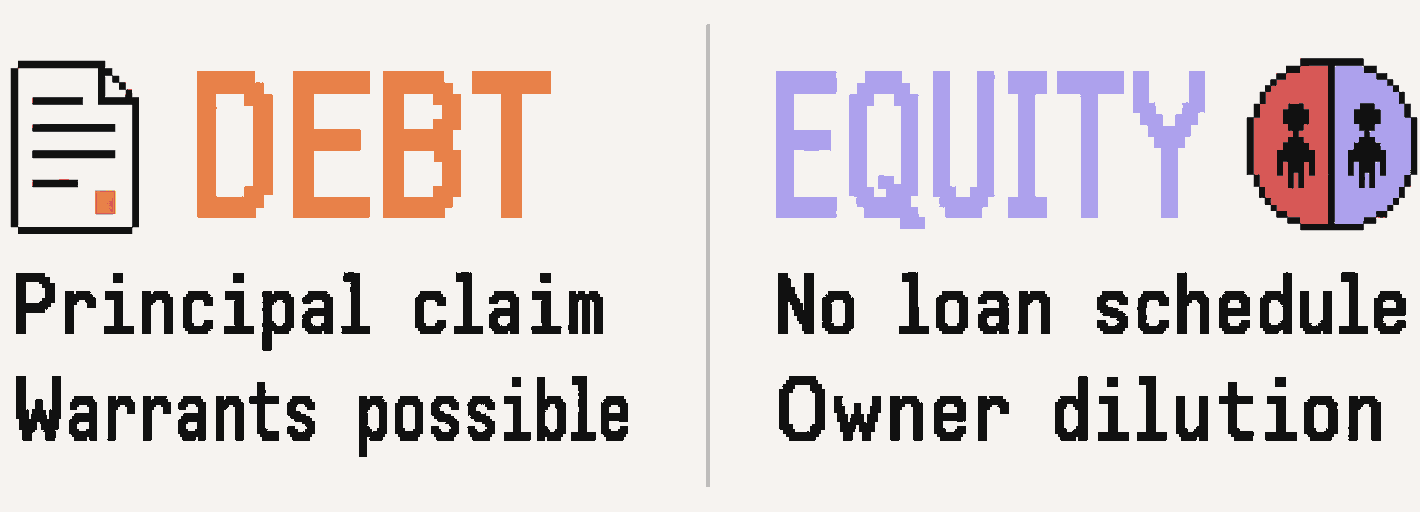
Compare the two across eight dimensions:
- Repayment: Debt generally creates a principal claim and often interest, but the schedule and payment form vary by instrument. Conventional equity has no scheduled loan payment, though preferred-stock terms can include dividends or redemption rights.
- Ownership and dilution: Straight debt leaves the cap table unchanged. Equity reduces the founders' percentage ownership. Warrants or conversion features can make debt dilutive too.
- Control: A lender rarely receives ordinary shareholder voting rights, but covenants can restrict spending, new borrowing, acquisitions, or minimum cash. Equity investors may receive voting, board, information, or veto rights. The documents determine the actual control and voting rights.
- Cost: Straight debt has visible costs such as interest, fees, and legal expenses. Warrants or conversion rights can add equity upside for the lender. Conventional equity has no interest bill, but the company gives investors a claim on future value.
- Cash flow: Many debt instruments pull cash from the business on a schedule, while others tie payments to revenue or defer principal. Conventional equity lets the company keep operating cash available for hiring, product work, and growth.
- Collateral and remedies: A loan may be secured by receivables, equipment, or other assets. It may also require a personal guarantee. Unsecured debt exists, but the lender still has contractual remedies after default. Conventional equity requires no collateral.
- Qualification: Lenders underwrite repayment capacity. Equity investors underwrite the chance of a large outcome. The SBA's 7(a) underwriting standards show the debt lens clearly: cash flow, credit, equity, and collateral may all matter, and the loan needs a reasonable assurance of repayment.
- Tax treatment: U.S. federal tax law can permit a deduction for business interest, although Section 163(j) rules and other provisions can limit or defer it. Equity does not create an equivalent interest deduction. Entity type, instrument terms, and use of proceeds can change the result.
Risk also lands differently. A company owes its debt even when growth stalls. An equity investor can lose the entire investment if the company fails. In a bankruptcy, creditors generally rank ahead of common shareholders, although liens, subordination, preferred terms, and applicable law determine the actual waterfall. The SEC's bankruptcy priority overview describes common stock as last in line.
What is debt capital?
Debt capital covers financing that creates a contractual principal claim and often interest. The payment timing and form depend on the instrument. For straight debt, the lender's return comes from interest and fees in addition to repayment of principal. Warrants or conversion rights can add equity upside. Once the company satisfies the debt obligation, that debt claim ends, though a separate warrant or converted equity position can survive.
Common forms include:
- Term loans: A lump sum repaid over a stated term.
- Lines of credit: A revolving facility the company draws and repays as working-capital needs change.
- Asset-based and accounts-receivable financing: Borrowing supported by inventory, equipment, or invoices.
- Venture debt: A loan designed for venture-backed companies, often with interest, fees, covenants, a lien, and warrants. Our deeper guide explains how venture debt works.
- Revenue-share and revenue-based financing: Structures vary. Payments may be calculated as a share of revenue, use a fixed schedule, or combine both. Some products are loans, while others are structured as receivables purchases. The legal form, payment formula, cap, term, and remedies all matter.
A convertible note starts as debt and is usually designed to convert into equity if a specified financing or event occurs. If conversion does not occur, its maturity and repayment terms govern. It belongs in the overlap between the two categories rather than a clean debt-only bucket.
Advantages of debt capital
- Founders usually keep their ownership percentage.
- The cost and repayment endpoint of straight debt can often be modeled before signing.
- Debt can bridge a timing gap between spending cash and collecting known revenue.
- The debt claim ends at payoff. A separate warrant or converted equity position can survive.
Disadvantages of debt capital
- Principal, interest, and fees reduce operating cash when due.
- Under fixed-payment debt, a revenue miss does not automatically pause repayment.
- Collateral, guarantees, liens, and covenants can narrow the founder's choices.
- Default can trigger penalties, accelerated repayment, enforcement against collateral, or an insolvency proceeding.
- Venture debt warrants and convertible features can still create founder dilution.
Debt is dangerous when a founder treats hope as repayment capacity. A signed invoice, proven renewal pattern, or contracted backlog is stronger evidence than a pipeline, waitlist, or optimistic forecast.
What is equity capital?
Equity capital comes from selling an ownership interest. Startup fundraising also uses contracts that convert or may convert into equity later. On a balance sheet, equity can include earnings retained in the company. Here, equity capital means outside financing from investors. Those investors accept the risk that the company may fail, and they seek a return through distributions, a sale, an initial public offering, or another liquidity event.
Common forms include:
- Common stock: The basic ownership security, often held by founders and employees.
- Preferred stock: Shares issued in many priced venture rounds with negotiated economic and control rights.
- Simple Agreements for Future Equity (SAFEs): A SAFE is a contractual right to future equity if its trigger and conversion terms are met. Terms are not standardized, a SAFE is not current stock, and conversion may never occur. The SEC's SAFE investor bulletin explains why investors need to read the actual agreement.
Regulation Crowdfunding is an offering exemption, not a type of equity. It can be used to sell equity, debt, or other securities. The offering must run through an SEC-registered broker-dealer or funding portal, with applicable disclosure, offering, investor, and resale rules. The SEC's Regulation Crowdfunding overview explains those requirements.
Advantages of equity capital
- No scheduled principal or interest payment drains cash.
- The investor shares the risk of an uncertain outcome.
- The company does not pledge collateral for the equity investment.
- A well-matched investor can add recruiting, customer, fundraising, or operating help.
Disadvantages of equity capital
- Founders and existing investors own a smaller percentage after issuance or conversion.
- Investors may negotiate board seats, vetoes, information rights, and liquidation preferences.
- The economic cost can become large if the company's value grows sharply.
- Priced rounds can take significant diligence, negotiation, legal work, and founder time.
Unlike term debt, equity does not end on a scheduled payoff date. The position can end or change through a transfer, company repurchase, contractual redemption, acquisition, liquidation, or other exit. The percentage sold matters, and so do the rights and restrictions attached to it.
When debt makes sense, and when equity fits better
Our co-founder Elizabeth Yin writes that “equity financing is the least risky for you as the entrepreneur” at the uncertain earliest stage. Her point is about the obligation, not the odds of success. Equity has no loan payment while a founder is still searching for a working product and business model.
As Elizabeth explains, debt can enter the picture “once you start to get some certainty around your revenues.” That gives founders a useful rule: match fixed claims with visible cash generation, and fund open-ended learning with risk-sharing capital.
These simplified hypothetical examples make the distinction concrete.
The Costco invoice
A bakery sells $1 million of apple pies to Costco. Costco will pay the invoice in 90 days, but the bakery needs cash now for ingredients, bakers, and packaging.
Accounts-receivable financing or a working-capital line could bridge the timing gap. The founder can point to a creditworthy customer, a fixed receivable, and a clear repayment source. Equity would sell part of the company to solve a 90-day cash problem.
The founder still needs room for delayed payment, rejected goods, lower margins, and financing fees. A purchase order is not cash in the bank.
The proven SaaS sales motion
A software-as-a-service company has operated for two years, produces $20,000 in monthly recurring revenue, has 2% monthly customer churn, and has a repeatable sales process. The founder wants to hire more sales development representatives.
Debt may fit if retained gross profit from new customers arrives soon enough to cover hiring costs and loan payments. The underwriting should test churn, collection timing, customer concentration, payback period, and downside cash flow. Recurring revenue helps. It does not make repayment automatic.
The motorbike backlog
An electric motorbike company has a long waitlist and has collected $1,000 deposits, but it needs more cash to build the bikes.
Inventory or purchase-order financing may bridge production when deposits, firm orders, unit margins, supplier lead times, and delivery capacity support the loan. A nonbinding waitlist is weak underwriting evidence, not collateral. Customers can cancel, parts can arrive late, and manufacturing costs can move.
The uncertain hardware system and unproven SaaS product
Now change the facts. One founder is building a new hardware system and does not know whether the technology will work. Another is building a SaaS product without a repeatable way to acquire or retain customers.
Both companies are spending money to discover whether a business exists. There is no visible cash event tied to repayment. Equity can carry that uncertainty without adding fixed monthly debt service. A lender may decline, charge more, or seek collateral or guarantees that put company or personal assets at risk. Those terms merit independent legal and financial advice.
A practical decision framework
Investors can use these questions to test whether a startup's financing choice matches its operating reality. Founders can use the same sequence before comparing term sheets.
- Ask what job the capital will do. Funding an invoice, inventory batch, or installed equipment can point toward debt. Funding technical discovery, product-market fit, or an unproven go-to-market motion can point toward equity. An investor should ask why this instrument matches that use.
- Verify the repayment source. Request a weekly or monthly cash schedule showing which receipts will cover principal, interest, and fees. Separate contracted revenue from pipeline and forecasts.
- Stress the timing. Delay the expected cash and reduce it. If one slow customer or missed launch creates a default, the financing is brittle. Investors should compare management's downside case with historical collections and churn.
- Calculate the full cost. Include interest, origination and unused-line fees, legal costs, prepayment terms, warrants, and covenant burden. For equity, model the ownership sold, expected dilution from outstanding convertibles and SAFEs, and negotiated investor rights.
- Map every claim on the company. For debt, identify collateral, guarantees, liens, covenants, default triggers, seniority, and any equity kicker. For equity, identify liquidation preference, board composition, voting thresholds, pro rata rights, and protective provisions.
- Match the term to the cash cycle. Short-lived working-capital needs should not create an obligation that outlasts the asset or cash event it finances. Investors should question a maturity date that arrives before the expected cash.
- Judge the downside. Confirm the startup can keep operating after debt service. A loan that extends runway in the base case can shorten it fast when revenue slips. The investor's question is whether debt improves the probability of reaching the next milestone or merely delays a financing problem.
Three especially useful numbers are the peak cash gap before revenue arrives, the lowest cash balance after each payment, and the date the financed activity is expected to return cash. If those numbers depend on several unproven assumptions, the company is trying to borrow against uncertainty.
When a mix of debt and equity can work
Debt and equity can fund different jobs inside the same company. Equity can finance the uncertain foundation, while debt finances a later, measurable cash cycle. The company's capital structure should reflect both jobs rather than treating one source as universally cheaper.
In one deal our Angel Squad community reviewed, the startup had already raised enough equity for nearly two years of operations and then signed a large contract. Using debt for the contract's near-term overhead could help the company deploy faster, collect revenue sooner, and avoid spending equity-funded reserves on a short cash cycle.
That mix only works if the contract economics, collection schedule, debt payments, and downside case line up. Otherwise, the new facility can start draining runway before the customer pays.
Frequently asked questions
Is debt capital better than equity capital?
Neither is automatically better. Debt is a stronger fit when a company can identify and stress-test the cash that will repay it. Equity is a stronger fit when the company needs time to resolve product, market, or timing uncertainty.
Why is debt capital often cheaper than equity capital?
Straight debt usually gives the lender a defined return from interest and fees, while warrants or conversion rights can add equity upside. The debt claim generally ranks ahead of common equity. An equity investor accepts more downside risk in exchange for uncapped upside. Interest may also receive favorable tax treatment, subject to limits. Debt is cheaper only if the company can repay it without creating a larger failure cost.
Does debt capital always require collateral?
No. Debt can be secured or unsecured, and collateral rules vary by lender, product, amount, and borrower. Even unsecured debt creates a repayment obligation and default rights. A personal guarantee can also expose a founder beyond the company's assets.
Can a startup use debt before raising equity?
Yes. Revenue-producing companies may qualify for bank loans, equipment financing, invoice financing, or other facilities without a venture round. Venture debt lenders often prefer companies with institutional backing, but venture debt is only one part of the debt market.
Choosing capital is easier after you separate a measurable cash gap from an uncertain bet. If you want to practice assessing those tradeoffs alongside experienced operators and investors, apply to Angel Squad.







.png)