Startup Investor Meeting Questions for Your Follow-Up Call
Brian Nichols is the co-founder of Angel Squad, an angel investing community where aspiring and active angels learn from Hustle Fund’s approach, review curated deal flow, and connect with peers.
A follow-up call shows that an investor has enough interest to keep digging. It is not an investment commitment. They still have questions about the evidence, risk, or fit, and the second call gives both sides room to resolve them.
Good preparation turns every claim from your first meeting into something you can support. You should also leave with a clear view of the investor’s process and what happens next.
Start with the investor’s open questions
Review your notes from the first call before building another presentation. Mark every topic the investor returned to, every answer that felt thin, and every item you promised to send. Those are the likely starting points for your investor follow up meeting.
Ask whether the investor has a preferred agenda and who will attend. If a new partner joins, prepare to give a crisp two-minute company overview. Bring the current deck, but do not force the group through the same pitch unless they ask.
The questions investors ask startups in a second meeting usually track what remained uncertain after the first. Questions investors ask founders also reveal how well they understand the business, especially when the data is early or messy.
Questions investors may ask in a follow-up call
Problem and product evidence
An investor wants to know that the problem is painful, frequent, and specific enough to support a business. Expect questions such as:
- Who has this problem, and what do they do about it today?
- How did you learn that the problem matters?
- What behavior changed after people tried the product?
- Which product claim has the strongest evidence behind it?
- What did users dislike, ignore, or misunderstand?
Bring evidence that matches your stage. That might be five customer interviews with the same complaint, product usage from a small beta, signed pilots, repeat usage, or paid invoices. A long feature list does less work than one clear example of a customer changing behavior.
Market and customer proof
Market slides can look tidy while hiding a fuzzy buyer. Investors will test whether you know who buys first, why they buy, and how budget moves.
Prepare to answer:
- Which customer segment are you pursuing first?
- Who uses the product, who pays, and who can block the purchase?
- What event makes the customer search for a solution now?
- How long has the sales process taken so far?
- What evidence supports the price?
Separate market size from customer proof. A large category does not prove that your first segment has urgency. Name the first narrow segment, the buyer’s current workaround, and the result of your latest pricing or sales test.
Traction, acquisition, and business economics
Know the numbers even when the numbers are small. Customer acquisition cost (CAC) is the amount spent to win one customer. Unit economics are the revenue and direct costs tied to one customer, subscription, order, or transaction.
Expect questions about revenue, active users, conversion, retention, churn (customers who stop paying or using the product), gross margin, sales cycle, and results by acquisition channel. Our guides to unit economics and investor meeting metrics can help you organize the calculation.
Show actuals separately from estimates. If 20 early customers came from your personal network and two came from paid search, say so. Then explain what you learned, which channel you will test next, and what result would earn more spending.
Competition and differentiation
“We have no competitors” usually means the comparison set is too narrow. Customers already spend money, time, or attention on another option, including spreadsheets and manual work.
Prepare for these questions:
- What does the customer use today?
- Why would they switch?
- Where is your product better, and where is it worse?
- What could an incumbent copy within six months?
- What advantage gets stronger as you grow?
Keep the answer grounded in customer behavior. Faster onboarding, better data, a cheaper workflow, or access to an ignored customer segment is more useful than calling the product unique.
Team and ability to learn
At an early stage, investors are assessing how your team handles missing information. Relevant experience helps, but your learning speed shows up in how you run tests and change your mind.
Expect questions about founder roles, gaps in the team, customer insight, past disagreements, and the hardest lesson from the last few months. Bring one example in which new evidence changed a product, pricing, or go-to-market decision. State what you believed, what you learned, and what changed.
How to prepare for an investor meeting: a second-call checklist
Build your preparation around five compact packets. Each packet should fit on one page or one clean section of your notes.
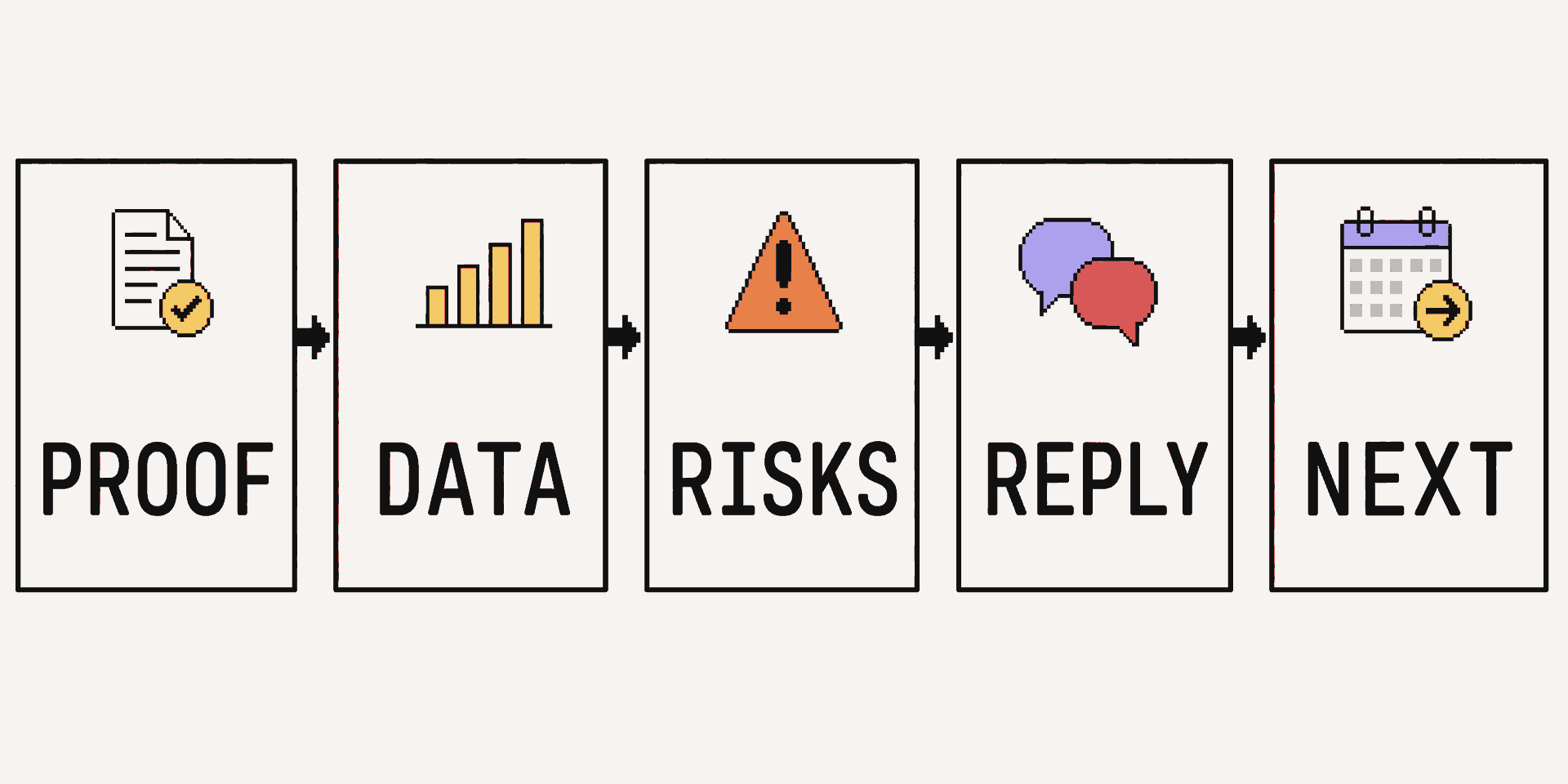
- Evidence: customer quotes, usage, pilots, contracts, and product proof that support the main claims.
- Metrics: current numbers, prior-period comparisons, definitions, and the source of each figure.
- Risks: the three ways the plan is most likely to break, plus the test or action that reduces each risk.
- Pushback: short answers to the hardest objections from the first call, including what remains unknown.
- Next step: the decision process, requested materials, responsible person, and date for the next contact.
Check that every number in the deck matches your working model. Open the product demo before the call. Put supporting files in one folder. Decide who will answer each topic if multiple founders attend.
Discipline is part of the signal. As our co-founder Elizabeth Yin wrote, “The more disciplined you are in your thought process/rubric, the more you can improve over time.” (Elizabeth Yin, Democratizing Knowledge)
Name the three biggest risks and mitigation for each
Choose risks that could change the investment decision. “We may grow more slowly than planned” is vague. “Our paid channel has not produced repeat customers” gives you something to test.
Three common early-stage risks show how specific the plan should be:
- Customer demand risk. Customers express interest but do not adopt or pay. Mitigate it with a defined test, such as 10 paid pilots in one segment by a set date. Track the owner, conversion target, and reason for each loss.
- Acquisition and economic risk. A channel can bring users, but CAC or payback makes growth unattractive. Mitigate it by testing a lower-cost channel, improving conversion or retention, and setting the threshold required before spending more.
- Execution risk. A key product, sales, regulatory, or hiring milestone depends on capacity the team does not have. Mitigate it with a named owner, a near-term milestone, and a backup plan if the dependency slips.
Your actual list may differ. A technical startup may have reliability risk. A marketplace may have supply density risk. A regulated company may face an approval path. Name the risk, explain its impact, show the leading indicator, and give the next mitigation milestone.
Respond constructively to pushback
Pushback is useful when it exposes the investor’s real concern. Treat it as a question to understand before you answer.
Use this sequence:
- Clarify the concern. Ask which assumption feels weakest and why.
- Answer with evidence. Give the shortest fact that addresses it.
- Acknowledge the gap. Say what you do not know yet without filling the space with a guess.
- Name the test. Explain how and when you will get a better answer.
Suppose an investor says the market looks crowded. A defensive answer lists features. A constructive answer identifies the comparison they have in mind, explains why a defined customer segment switches, shares the evidence, and names the next customer test.
You do not have to accept every suggestion. Show that you can examine it. Our pitch interview prep gives you another way to practice direct answers under pressure.
Questions founders should ask the investor
The investor is also asking you to consider a long working relationship. Elizabeth’s line is blunt: “At the end of the day, money is a commodity.” (Elizabeth Yin, Democratizing Knowledge) Your questions should uncover what comes with the money and whether the relationship fits.
Ask:
- What open question could stop you from investing?
- Who else participates in the decision, and what is the process?
- What is a realistic decision timeline?
- How do you work with founders when performance misses the plan?
- Which portfolio founders can speak to your support style?
- What ownership, check size, and follow-on expectations shape your decision?
- Do you see any portfolio conflicts with this company?
- What would you want us to accomplish before another conversation?
Listen for concrete answers. “We help with hiring” is broad. A clear example, a founder reference, or an operating process tells you more.
How to follow up with investors after the call
Send a short recap within 24 hours. Keep your startup investor follow up limited to what the conversation created:
- Restate the main open questions and any decisions made.
- Attach or link only the materials you promised.
- Name the owner for each outstanding item.
- Give the delivery date for anything still in progress.
- Confirm the agreed follow-up date or the condition that will trigger it.
Do not bury the investor in a new data room or restart the pitch by email. If a number changed during the call, correct it plainly. If the investor promised an introduction or internal discussion, include that item in the recap so both sides leave with the same record.
Open your notes now and write the three questions your first meeting left unresolved.