Commoditization of technology: an investor’s moat test
Brian Nichols is the co-founder of Angel Squad, an angel investing community where aspiring and active angels learn from Hustle Fund’s approach, review curated deal flow, and connect with peers.
Two startups can use the same artificial intelligence (AI) model and nearly identical code. One earns repeat customers. The other competes on price.
If you’re evaluating early-stage companies, that difference matters. Understanding technology commoditization helps you separate an impressive demo from a business with reasons for customers to choose it and stay.
What is the commoditization of technology?
The commoditization of technology is the process through which a technical capability becomes widely available and sufficiently interchangeable that buyers increasingly choose suppliers on price, convenience, or reliability. Access to that capability stops being much of a competitive advantage.
A technology can remain valuable after it becomes a commodity. Electricity is essential to a business, even though having an electricity connection rarely explains why customers choose that business.
The same distinction applies to software. A startup can depend on a widely available database, cloud server, or AI model while offering something customers have trouble finding elsewhere.
Commoditization is also different from broader access. A tool becoming affordable lets more people use it. It becomes commoditized when buyers see competing options as adequate substitutes. Falling prices alone don't establish that every supplier or every product built on the technology is interchangeable.
Several forces can push a capability in that direction:
- Shared standards. Compatible formats and interfaces make it easier to use competing components.
- Reusable tools. Open-source code lets developers inspect, modify, and share software under its license. Alongside off-the-shelf services, it reduces how much a new entrant needs to build from scratch.
- More capable suppliers. Competition and improvements in production can make similar performance available at lower prices.
- Sufficient performance. Once several options meet a buyer’s needs, another technical improvement may add little value to that buyer.
The speed varies by market. Specialized performance, scarce expertise, and difficult operating requirements can preserve differences between suppliers.
Examples of technology commoditization
Cloud computing, open-source software, and AI show how a common ingredient can change competition without making every business the same.
Cloud computing makes infrastructure accessible
Startups can rent computing resources instead of building and operating their own physical infrastructure. The National Institute of Standards and Technology’s cloud computing definition describes on-demand access to a shared pool of configurable resources.
That shared access lowers a barrier to building software. A pitch that rests on having servers is weak when competitors can rent servers too. Security, reliability, specialized infrastructure, and the work of moving between providers can still differ substantially.
Open-source software spreads building blocks
An open-source database or web framework gives many teams access to the same underlying code. Using that code provides little exclusivity by itself.
A company can still create value through deployment, support, integration, or a product designed around a particular customer’s work. The investment question is which of those capabilities the customer pays for and why the startup can deliver it better.
AI makes some capabilities much cheaper
Stanford’s 2025 AI Index reported that the cost of querying a model at roughly GPT-3.5-level performance on a language-understanding benchmark fell from $20 per million tokens in November 2022 to $0.07 by October 2024. Tokens are the small pieces of text a model processes.
That finding shows how sharply the cost of a specified level of performance can fall. It doesn't establish that models are equally useful for every task. Accuracy on a customer’s work, response speed, privacy requirements, and operating costs still matter.
Our investment lens is to separate the shared model from the customer value built around it. Access to a capable model is a starting ingredient. A dependable product needs much more.
Lower costs help startups and their competitors
Cheaper technology lets a small team attempt something that once required a large budget. It can spend more effort understanding customers and less effort rebuilding basic infrastructure.
It also gives rivals the same opportunity. More teams can enter the market, copy visible features, and offer similar results. Customers may demand lower prices as those alternatives improve.
The cost savings don't all flow to the startup. Competitors can pass savings to customers. Sales, implementation, support, and human review can remain expensive even when computing gets cheaper. A growing company can sell more while earning less on each sale.
For an investor, the useful questions are specific: which costs are falling, which costs remain, and how much pricing power survives?
Separate the technology from the product
Consider two hypothetical startups using the same AI model to help customer-support teams.
The first writes suggested replies. An agent pastes a ticket into a box and copies the answer back into the support system. A rival can reproduce much of that visible experience with the same model.
The second serves a narrow customer group, such as merchants handling delivery problems. It brings together order history, shipping events, merchant policies, and prior conversations. It routes exceptions to a person, records approved actions, and helps the team complete the case inside its existing support system.
That second product has more work behind it. Integrations, operating knowledge, and customer trust could make it harder to replace. Those are hypotheses until customers adopt it, use it repeatedly, and get results worth paying for.
Neither company needs to invent a model to be useful. Neither earns a durable advantage merely by connecting a model to another system. The evidence comes from the customer’s experience of the complete product.
A moat is an advantage that makes it harder for competitors to take a company’s customers or profits. At pre-seed, you’re often evaluating a plausible path to a moat rather than an established one.
Use three tests for a startup’s edge
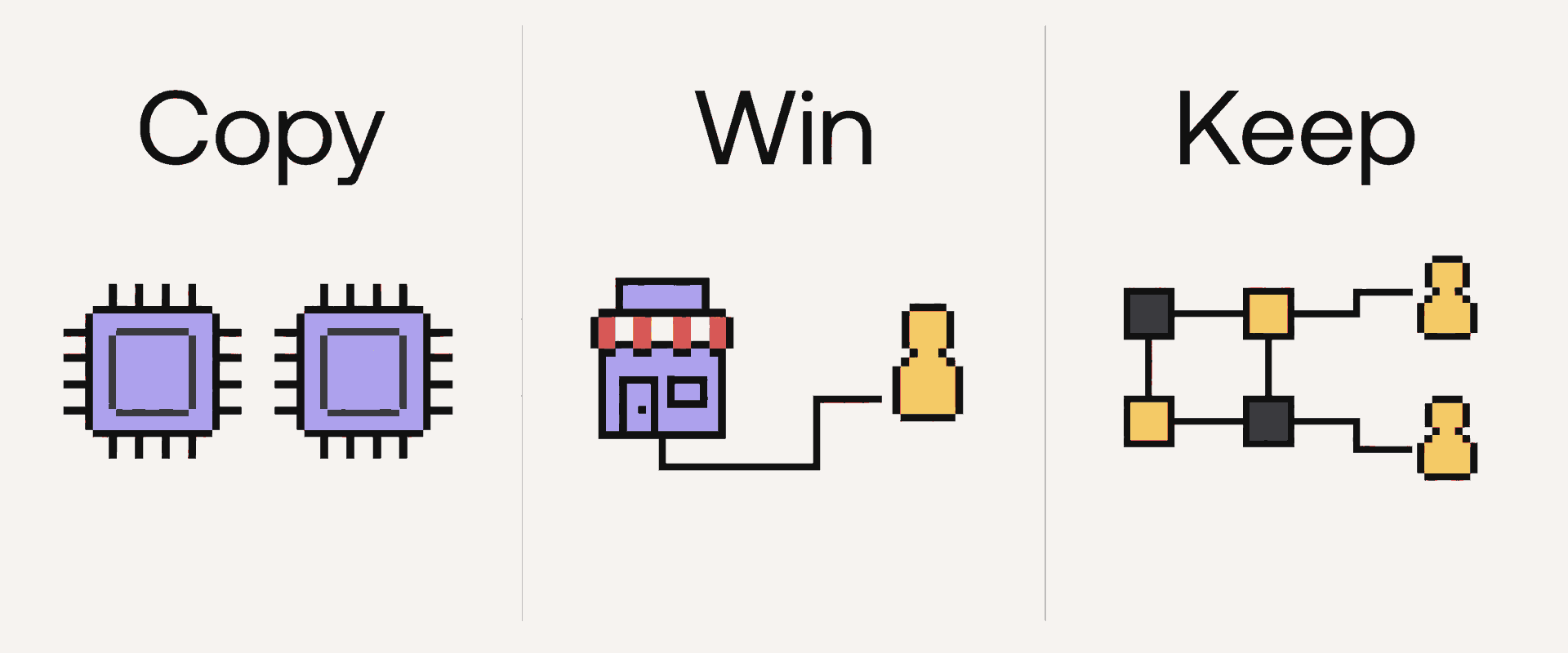
Assess three separate challenges: how easily rivals can copy the result, how the startup wins buyers, and what keeps those buyers after competitors catch up.
1. How easily can a competitor copy the useful result?
Look beyond the interface. Separate the technology available to everyone from the work the startup has done itself.
Useful evidence includes:
- Customer-specific performance. Results on the tasks customers face, including mistakes and the work needed to correct them.
- Workflow depth. The steps the product completes, the systems it connects, and the exceptions it handles.
- Learning from use. A clear explanation of how feedback improves the product and what access the company has to that feedback.
A large pile of data is weak evidence if the company can't use it, customers can supply it to any rival, or it doesn't improve the result. A long feature list is weak evidence if most features are easy to reproduce.
A team’s speed matters when it helps solve the customer’s problem. Our co-founder and general partner Elizabeth Yin cautions, “The caveat is that this speed has to be done on the important things.” A founder who can explain a customer’s awkward edge cases gives you more to work with than a founder who can only explain the model.
2. Why will this company win the customer?
Distribution is how a company reaches buyers and turns interest into purchases. A technically similar product can win through a trusted recommendation, a well-matched sales channel, or a stronger understanding of a particular buyer.
Evidence includes customers arriving through repeatable channels, referrals that become paying accounts, and a sales process that works beyond the founder’s personal relationships. Compare the cost of winning customers with the revenue and service costs those customers create.
A founder’s professional network can help a startup get started. The next question is whether the company can reach customers outside that network without spending more than the business can support.
We apply this customer-first lens in our startup evaluation framework, alongside team, market, traction, and financing considerations.
3. Why will customers stay after a rival catches up?
Retention means customers keep using or paying for a product. It is stronger evidence when customers have credible alternatives and still choose to stay.
Useful signals include renewals, continuing use by the people doing the work, and expansion into additional teams or tasks. Customer accounts from the same start period help reveal whether early enthusiasm lasts.
Understand what a switch would require. Replacing a button is easy. Rebuilding working integrations, retraining a team, and moving accumulated operating knowledge can take more effort.
Those costs can protect a business, but they can also slow its initial sale. A difficult installation may create friction before it creates loyalty. Assess the value the customer receives alongside the burden of adopting the product.
Brand and community need evidence too
Our co-founder Elizabeth has emphasized brand and community as ways to stand out when knowledge and tools become widely available. For investors, both need to connect to customer behavior.
A brand is the expectation people associate with a company. A reputation for solving a particular problem reliably can reduce a buyer’s uncertainty. A recognizable logo or a large follower count gives you much less evidence about whether anyone will pay.
A community creates value through relationships among its members. For a software company, that might mean customers sharing useful practices, helping each other solve problems, or introducing new users. A mailing list whose members only receive promotional messages has a different role.
You can assess those claims through concrete behavior:
- Acquisition. Customers name the company’s reputation or a member referral as a reason they bought.
- Participation. Members help one another without the company arranging every interaction.
- Retention. Customers describe an ongoing benefit from the relationships or shared knowledge.
Community membership can be copied on paper. Useful relationships take time to build. They can also weaken if the company loses trust or stops serving members well.
For investors, peer relationships can improve judgment by adding operating experience you don't have. In Angel Squad, curated deal reviews and peer learning give you opportunities to compare reasoning with other investors. You still make your own investment decisions.
Your check needs a reason to be chosen
Commoditization also applies to the value you offer founders. Two checks of the same size can pay the same bills, while the investors behind them can behave very differently.
In a Sacra interview, Elizabeth said that “money is now a commodity.” She explained that our educational content helps demonstrate value beyond capital by making startup knowledge more transparent.
As an angel, your contribution can be smaller and specific. An operator who understands enterprise sales might help a founder prepare for a buyer meeting. Someone who knows a customer segment might make a relevant introduction, with both sides’ permission.
Offer specific, bounded help you can deliver, follow through, and respect the founder’s decisions and time. A reputation for useful, reliable behavior gives founders a reason to welcome you beyond the dollars in your check.
None of these advantages guarantees an investment outcome. Startup investing is risky, and most of your bets could fail. A promising moat can disappear, and thoughtful investors can disagree about how much evidence is enough.
If you want to practice evaluating those tradeoffs through curated deal reviews and peer learning, apply to Angel Squad.
This material is for educational purposes only. It is not investment advice or a recommendation to buy or sell any security. Startup investments are speculative, illiquid, and long-term, and you could lose your entire investment.