
Capital Calls: How They Work for Fund Investors
A capital call is a formal request from a fund's general partner asking its limited partners to send part of the money they committed. A commitment to a venture fund is rarely a one-time wire: you agree to invest a total amount, then the fund asks for portions of it over time.
That structure gives a fund cash when it needs to make investments or pay approved expenses. It also gives you time to manage the part of your commitment that has not been called. But the commitment is still binding, so the timing deserves a real plan.
This guide explains how capital calls work, what to check in a notice, how to prepare for them, and what can happen if a limited partner cannot pay.
Capital call terminology
The process moves money from an investor's unfunded commitment into paid-in capital. A fund manager is the general partner (GP), and the fund's investors are limited partners (LPs).
Four terms make the rest of the process easier to understand:
- Committed capital: The total amount you agreed to invest over the life of the fund.
- Paid-in capital: The amount you have already contributed.
- Uncalled capital: The part of your commitment the fund has not requested yet. It is also called your unfunded commitment.
- Distribution: Cash or other value the fund returns to an LP. A distribution moves value back to the investor; a capital call moves money into the fund.
If you commit $100,000 and have contributed $30,000, your uncalled capital is $70,000. A later 20% call based on your original commitment would require another $20,000, reducing the uncalled balance to $50,000.
Our Angel Squad guide to limited partnership agreements explains the contract in plain language. In your own fund, the limited partnership agreement (LPA), subscription documents, and any applicable side letter control when the GP can call capital, how quickly you must pay, and what happens after a missed payment. The capital call notice applies those terms to one request.
How capital calls work
The exact process varies by fund, but the core sequence is consistent:
- You make a commitment. You sign the fund documents and agree to contribute up to a fixed amount under the LPA's terms.
- The fund takes an initial drawdown. Some funds request part of the commitment when you subscribe or when the fund begins investing.
- The GP issues a capital call notice. The notice states the amount due, the due date, payment instructions, and how the call changes your unfunded commitment.
- You verify and send the money. You reconcile the notice against your records, confirm the instructions through the fund's approved process, and wire the amount by the deadline.
- The fund updates your account. Your paid-in capital increases and your uncalled capital decreases. The fund then uses the proceeds for purposes permitted by its governing documents.
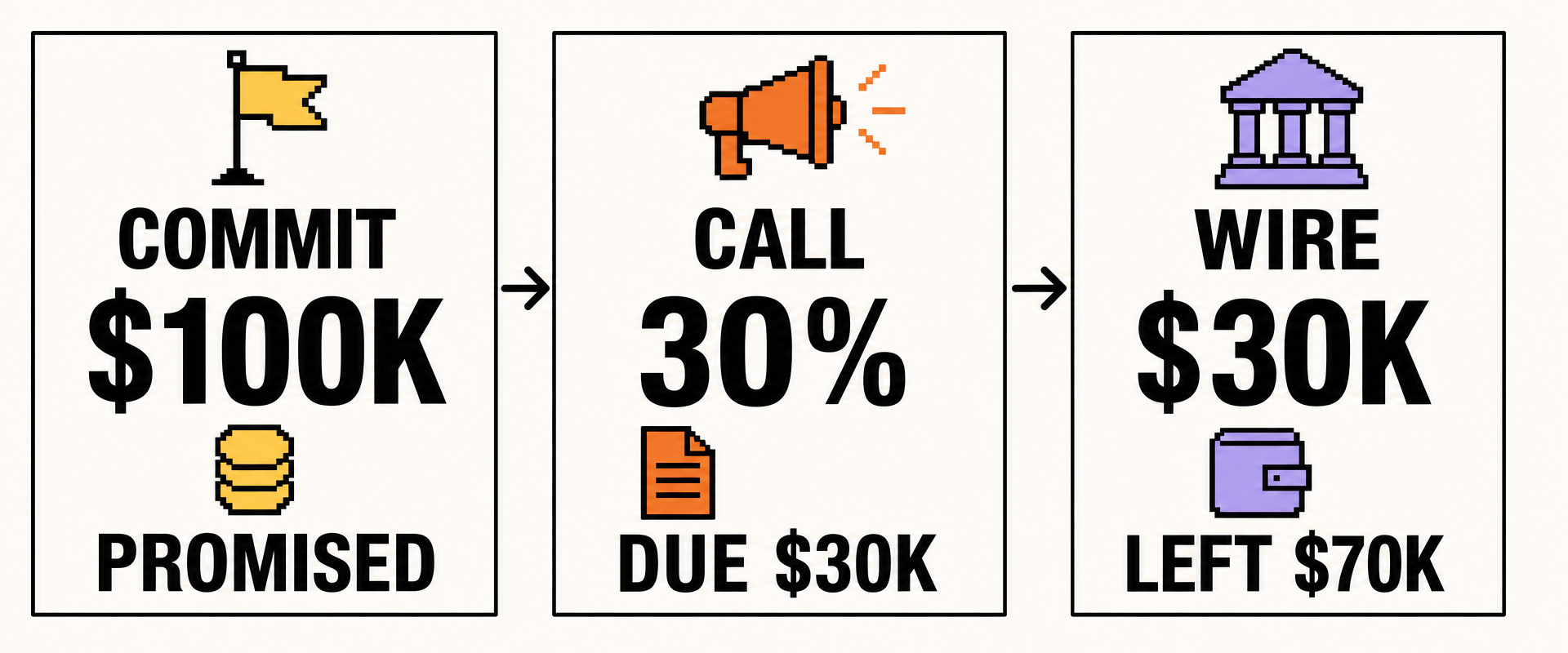
A $100,000 capital call example
Suppose you commit $100,000 to a venture fund.
- At the first close, the fund calls 30%, so you wire $30,000. Your uncalled capital is $70,000.
- Six months later, the fund calls 20% of your original commitment, so you wire $20,000. Your uncalled capital is $50,000.
- The fund later calls 25%, so you contribute $25,000. Your uncalled capital is now $25,000.
- A final 25% call brings your total paid-in capital to $100,000.
Real schedules are rarely this neat. A fund may vary the size and timing of calls as its investment pace, expenses, follow-on needs, and governing documents allow. Plan around the full commitment rather than treating a sample schedule as a promise.
What triggers a capital call?
A GP can issue a call only for purposes the fund documents permit. Common triggers include:
- a new portfolio investment;
- a follow-on investment in an existing portfolio company;
- management fees, fund expenses, or other approved obligations; and
- repayment of short-term borrowing that bridged an investment or expense.
The notice should tell you why the money is being requested. If the purpose is vague or does not appear to match the LPA, ask the GP or fund administrator to explain it before you wire.
Why funds do not collect every dollar upfront
When Brian Nichols joined our team while we were raising Fund II, he assumed a successful close meant tens of millions of dollars would land in our bank account. He soon learned that the fund's committed capital was not cash already sitting there.
The fund size usually describes capital that LPs have committed, not cash already sitting in the fund's account. Our co-founder and general partner Elizabeth Yin makes the distinction plain:
"VCs actually have very little cash on hand."
Elizabeth Yin, Hustle Fund co-founder and general partner, in Democratizing Knowledge
That arrangement can help both sides.
For the fund
- Cash arrives closer to when it will be used. A GP can call capital for new investments, follow-on investments, fees, or expenses allowed by the LPA.
- Less idle cash reduces cash drag. A fund's internal rate of return is sensitive to the timing of LP cash flows. Calling money long before it is invested can reduce the fund's reported IRR.
- The GP can match funding to its investment pace. A high-volume seed fund may need a different rhythm from a concentrated fund making a few larger investments.
For the LP
- The cash stays outside the fund until it is called. That gives you more flexibility, but the committed amount must remain available under your liquidity plan.
- You can plan around an expected range of calls. A clear forecast helps you manage liquidity across several fund commitments.
- Earlier distributions may offset some later cash needs. That only helps if the timing works; a distribution is not a reason to assume future calls will take care of themselves.
The tradeoff is simple: you keep the cash for longer, but you must be able to produce it when a valid notice arrives.
How capital call timing can vary
Scheduled and deal-by-deal calls are two common approaches. Funds can also use milestone-based calls, catch-up calls, or a hybrid that changes with the investment pace and governing documents.
Scheduled calls
The fund calls capital on a regular cadence, such as several times a year. The amount can still change, but LPs get a more predictable planning rhythm.
Scheduled calls often suit funds that make many investments. Calling capital for every small deal would create more wires, notices, and reconciliation work for everyone.
Deal-by-deal calls
The fund calls capital when a specific investment is ready to close. This can keep cash from arriving too early, but it gives LPs less predictable timing and may be difficult when a fund makes frequent investments.
Catch-up calls for later investors
If an LP joins at a later close, the fund may require a catch-up contribution so the new LP reaches the same paid-in percentage as earlier investors. The LPA should explain how the catch-up amount, any equalization payment, and the LP's remaining unfunded commitment are calculated.
How much notice do LPs receive?
There is no universal payment window or call frequency. A valid notice supplies the due date under the LPA, subscription documents, and any applicable side letter. Some funds share a forecast or regular cadence, but investment timing can change. Treat a forecast as planning help, not permission to make the remaining commitment illiquid.
What should be in a capital call notice?
A useful notice should let you understand the request without reverse-engineering the fund's math. Look for:
- the fund's legal name and the LP account or entity receiving the notice;
- the issue date, due date, currency, and amount you must contribute;
- the total amount being called across the fund and your share of that amount;
- the purpose of the call, such as an investment, management fee, fund expense, or repayment of short-term borrowing;
- your commitment, previous paid-in capital, and unfunded balance before and after the call;
- complete payment instructions and a contact for questions; and
- any calculations needed to explain a catch-up, fee, credit, or adjustment.
The Institutional Limited Partners Association's 2025 capital call and distribution template is a useful benchmark for transparent reporting. Not every fund uses that exact format, but a notice should still follow any reporting requirements in the fund documents and reconcile the amount due with the effect on your remaining commitment.
How LPs can prepare for capital calls
Capital-call planning starts before you sign the subscription documents.
Before committing
- Read the LPA's call terms and default provisions. Focus on the investment period, notice mechanics, any limits on calls, permitted uses, and remedies after a default.
- Ask for the expected call pace. A forecast is not a guarantee, but it helps you understand whether the GP expects scheduled, deal-by-deal, or front-loaded calls.
- Map the full commitment. Add this fund to a calendar that includes your other private-fund obligations. Several reasonable commitments can still create a liquidity problem when their calls overlap.
- Choose a liquidity plan that can survive bad timing. Do not assume you can sell a volatile asset at a favorable price just before the deadline.
- Confirm the fund's wire-verification procedure. Capital calls are large, time-sensitive transactions. Know whom to contact through a trusted channel if instructions change.
Yin's advice is blunt:
"As an LP, you need to plan across a few years"
Elizabeth Yin, Hustle Fund co-founder and general partner, in Democratizing Knowledge
If you are still learning how private-market documents fit together, Angel Squad pairs startup-investing education with peer learning, helping you build a better question list before you speak with a fund manager or adviser.
That planning is part of deciding how to invest in venture capital, not an administrative detail to solve later.
When a notice arrives
- Match the fund name and LP entity to your records.
- Reperform the calculations shown in the notice and reconcile them to the governing documents and your prior balance. Catch-ups, equalization, fees, offsets, exclusions, and other adjustments can make the amount more complex than a single percentage.
- Reconcile the opening and closing unfunded balances.
- Check that the stated purpose is permitted by the LPA.
- Confirm the due date and initiate internal approvals early.
- Verify new or changed wire instructions with a known fund contact, not by replying to an unfamiliar email.
- Save the notice and payment confirmation with your fund records.
If something does not reconcile, ask the GP or fund administrator before sending the wire. Silence is a poor strategy when the deadline is approaching.
What happens if an LP misses a capital call?
A missed capital call can be a default under the LPA. The consequences are fund-specific and can be severe.
Possible remedies may include penalty interest, suspension of voting or participation rights, reduced distributions, dilution or forfeiture of part of the LP's interest, a forced sale, or claims for losses caused by the default. Some agreements allow a cure period; others give the GP broad discretion.
Do not rely on a generic list to predict the outcome. Read the documents you signed and get legal advice for your situation. If you expect a problem, contact the GP before the due date. Early communication may give the fund more options than a surprise shortfall on closing day.
Are capital calls mandatory?
In a traditional closed-end venture or private equity fund, a valid call made under the documents you signed is generally a contractual obligation up to your remaining commitment. A deal-level limited liability company or real estate partnership may handle additional capital differently, but declining to contribute can still cause dilution, loss of rights, or other consequences. The governing agreement, not the label "capital call," determines your obligation.
Capital call lines can bridge a timing gap
A capital call line, also called a subscription line, is short-term borrowing secured primarily by the fund's right to call committed capital from LPs. A GP may use one to close an investment before an upcoming call is funded, reduce the number of small calls, or manage a brief timing mismatch.
The tool solves one timing problem but creates costs and reporting questions:
- the fund pays interest and fees;
- borrowing can delay the date of an LP's cash outflow and affect reported IRR;
- the LPA may limit the amount, duration, or purpose of the facility; and
- LPs need clear disclosure to understand their exposure and the effect on performance.
ILPA's guidance on subscription lines and alignment of interests calls for clear terms and consistent disclosure. Investors should ask how a fund uses the line, how long balances typically remain outstanding, and whether performance is also shown without the facility's timing effect.
For a concrete operating example, our guide to capital call gaps explains how a fund might compare a small credit draw with another call.
Why capital call operations matter to founders and GPs
For founders
A signed term sheet does not always mean the investor's cash is already in the bank. A venture fund may need to issue a call, draw on a credit line, or wait for an already scheduled call before it can wire the startup. Founders can ask whether the fund has completed its first close, whether the money for this investment is available, and what closing timeline both sides should plan around.
For GPs
Good calls are accurate, clearly explained, and as predictable as the deal schedule allows. Give LPs a reasonable forecast, reconcile each notice, allow time for approvals and transfers, follow the LPA consistently, and understand the costs and disclosures attached to any credit facility. Clear expectations protect the relationship when markets, liquidity, or deal pace change.
The bottom line
A capital call converts part of an LP's unfunded commitment into paid-in capital. The GP gets cash closer to when the fund needs it, while the LP keeps the rest for longer. In return, the LP must maintain enough liquidity to meet valid notices throughout the commitment period.
Capital calls mainly apply when you invest as an LP in a fund. A direct angel check or deal-specific special purpose vehicle usually has a different funding schedule. If you want to learn how startup investments work and practice evaluating opportunities with other investors, Angel Squad is our angel-investing community for education and peer learning. You do not need accredited-investor status to join, but investing in relevant offerings requires it; every investment is optional, and membership does not guarantee access or allocation. Apply when you are ready to get closer to early-stage investing.







.png)