
How to become an accredited investor
“How do I apply?” is usually the first question people ask about accredited investor status. The process is less obvious than the name suggests. There is no SEC application, official certificate, or permanent membership card.
You need to understand which legal test you meet, calculate it correctly, and be ready to prove it when an issuer asks. That last part matters because the evidence required can change with the type of private offering.
What becoming an accredited investor actually means
An accredited investor is a person or entity that meets one of the standards in Rule 501(a) of Regulation D. The designation matters because many startups, venture funds, syndicates, and special purpose vehicles (SPVs) sell securities through exemptions that limit who may invest.
You become accredited as soon as you satisfy a qualifying test. The SEC does not approve you first. The startup, fund, SPV, platform, or a verification provider confirms your eligibility when you invest.
Accreditation is a regulatory eligibility screen. It does not prove that someone understands startup investing, and it does not make a private investment safe. Our co-founder Elizabeth Yin has long argued that insight comes from a wider range of lived experience:
“Investors use their life perspective to assess. For this reason, we need more funders with more varied life perspectives.”
Elizabeth Yin, Democratizing Knowledge, our co-founder and general partner
The current SEC qualification rules give individuals four practical paths. You only need one.
This is educational information, not legal or tax advice. Securities rules, asset ownership, income treatment, and adviser registration can depend on your facts and state. Seek independent review from qualified securities counsel and tax professionals before relying on a qualification route or investing.
Four ways an individual can qualify
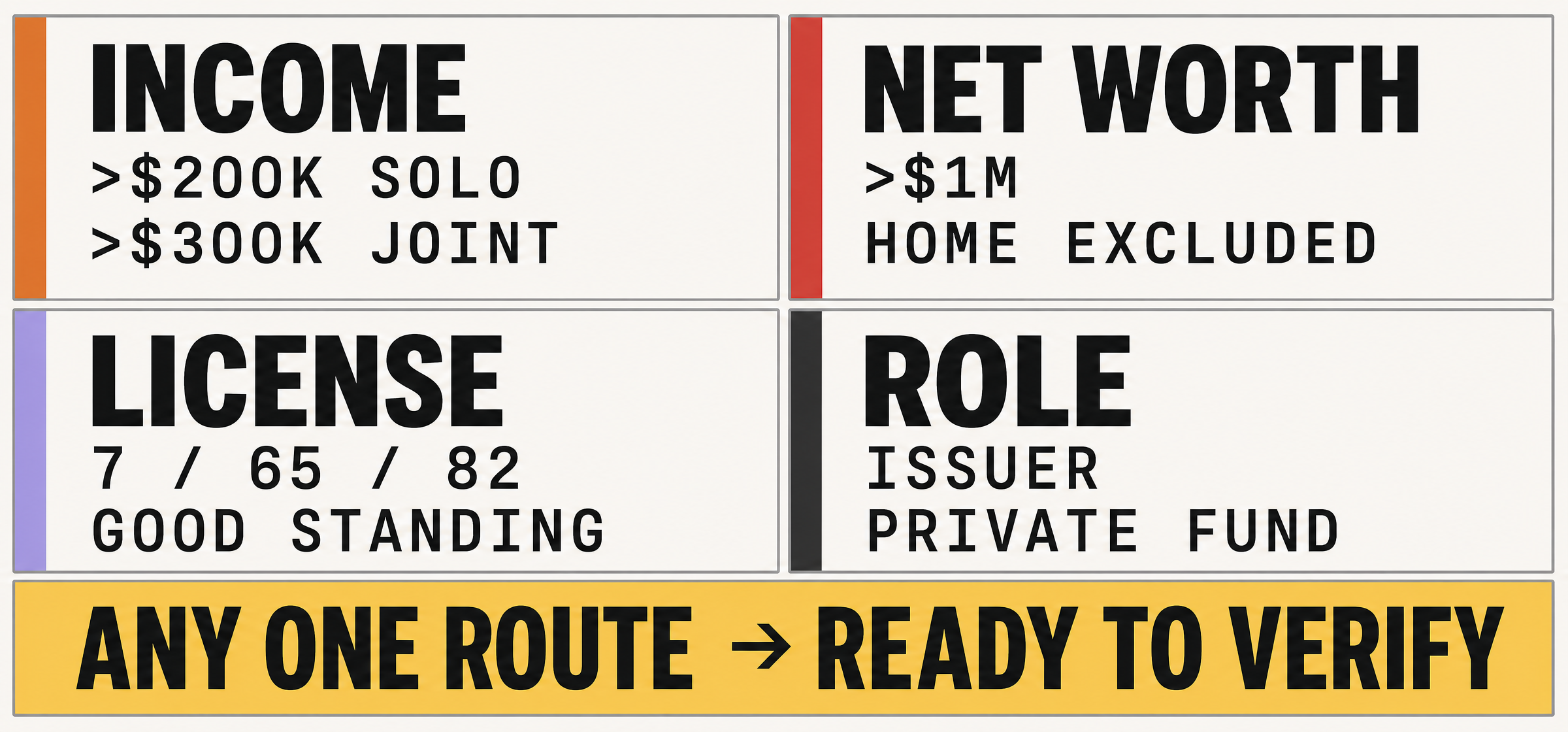
The four routes are:
- Income above the individual or joint threshold
- Net worth above $1 million, excluding a primary residence
- A designated financial credential held in good standing
- A qualifying role with the issuer or a private fund
1. Qualify through income
You qualify through income if you had either:
- Individual income exceeding $200,000 in each of the two most recent years, with a reasonable expectation of reaching the same level in the current year
- Joint income with a spouse or spousal equivalent exceeding $300,000 in each of those years, with the same expectation for the current year
“Exceeding” matters. Income of exactly $200,000 does not clear the individual test.
Past income alone is also insufficient. If you earned above the threshold for two years and then left your job with no reasonable expectation of reaching it this year, the income route does not fit.
For proof, keep the relevant tax returns and income forms for both prior years. A Rule 506(c) issuer may also ask for a written statement about your expected current-year income.
2. Qualify through net worth
You qualify if your individual net worth, or your joint net worth with a spouse or spousal equivalent, exceeds $1 million. Your primary residence is left out of the calculation.
Start with this formula:
Qualifying net worth = included assets minus included liabilities
Included assets can include cash, brokerage accounts, retirement accounts, and equity in property other than your primary home. Use supportable current values. Subtract liabilities such as credit card balances, student loans, personal loans, and debt tied to included assets.
Your home needs special treatment:
- Do not count the value of your primary residence as an asset.
- Do not count mortgage debt up to the home’s fair market value as a liability.
- Count any mortgage balance above the home’s fair market value as a liability.
- Debt secured by the home that you take on during the 60 days before buying the securities generally counts as a liability, unless it resulted from acquiring the home.
Here is a simplified example. An investor has $150,000 in cash, $450,000 in a brokerage account, $350,000 in retirement accounts, and $240,000 of net equity in a rental property. Those assets total $1.19 million. After subtracting $140,000 in student, auto, and credit card debt, qualifying net worth is $1.05 million. The investor’s primary home and a mortgage below the home’s value stay outside the calculation.
That investor clears the test by $50,000. A market drop or new liability could change the result, so a stale calculation is a poor basis for a new investment.
3. Qualify through a professional credential
The SEC currently recognizes three credentials:
- Series 7, the General Securities Representative qualification
- Series 65, the Uniform Investment Adviser Law Examination
- Series 82, the Private Securities Offerings Representative qualification
The credential must be held in good standing. Series 7 and Series 82 normally require association with a sponsoring firm. You can enroll for the Series 65 exam without a firm sponsor, which makes it the route most independent aspiring angels notice.
Passing Series 65 alone does not finish the job. The exam is a step toward the professional credential. You must also complete the registration or licensing needed to hold it in good standing. For a Series 65 holder, that generally means registration as an investment adviser representative under applicable state rules, usually through an investment adviser firm.
That registration is a real regulated role. It can involve filings, disclosures, fees, recordkeeping, compliance policies, continuing education, and regulator examinations. Requirements differ by jurisdiction, as the state registration resources show. Creating an adviser firm solely to gain accredited status can add far more work and expense than the exam itself.
Accreditation is not required to join Angel Squad, our angel-investing community. Members who decide the Series 65 path genuinely fits can use study support, learn alongside peers who have taken the exam, and receive reimbursement for the exam cost after passing.

4. Qualify through an issuer or private-fund role
Some people qualify because of their relationship to the securities being offered. These routes include:
- A director, executive officer, or general partner of the company selling the securities, or of that company’s general partner
- A “knowledgeable employee” of a qualifying private fund, as that term is defined under the Investment Company Act
- A qualifying family client of a family office that is itself an accredited investor
These are role-specific routes. Being a startup employee, adviser, mentor, or fund employee does not automatically qualify you. A knowledgeable employee test looks at duties, participation in investment activities, and experience. It applies only to offerings by that private fund and other private funds managed by the employer, not to unrelated startup deals. The issuer and its counsel need to apply the rule to the actual role and offering.
How accredited investor verification works
Once you qualify, there is still no universal certificate to request. What the issuer must do to establish your status depends heavily on the exemption used for the offering.
Rule 506(b): reasonable belief, often supported by a questionnaire
A Rule 506(b) offering cannot use general solicitation. It may sell to an unlimited number of accredited investors and up to 35 non-accredited investors who meet a financial sophistication standard.
The issuer must reasonably believe you are accredited at the time of the sale. Rule 506(b) does not impose Rule 506(c)’s separate requirement to take reasonable verification steps. In practice, the process often starts with an investor questionnaire in which you identify the test you meet. That response can support the issuer’s belief. Whether it provides a reasonable basis depends on all the facts and circumstances, including contrary information the issuer knows.
Rule 506(c): reasonable verification steps are mandatory
A Rule 506(c) offering may advertise publicly, but every purchaser must be accredited. The issuer must take reasonable steps to verify that status. A bare checkbox will not carry that burden.
The SEC’s current assessment guidance provides non-exclusive verification methods. An issuer can use other reasonable evidence, but these methods offer a clear path:
- Income: Review Internal Revenue Service forms reporting income for the two most recent years and obtain a written representation that the investor reasonably expects to reach the required income in the current year.
- Net worth: Review recent asset records, obtain a consumer report from a nationwide agency for liabilities, and collect a written representation that all liabilities needed for the calculation have been disclosed. The records must be dated within the prior three months for this method.
- Third-party confirmation: Obtain a written confirmation from a registered broker-dealer, an SEC-registered investment adviser, a licensed attorney, or a certified public accountant stating that, within the prior three months, they took reasonable steps and determined that the investor was accredited.
- Prior verification: An issuer can rely on its earlier reasonable verification for up to five years if it obtains a fresh written representation at the time of sale and knows of no information to the contrary.
Professional-credential and role-based investors may be confirmed through registration records, employment records, fund documents, or other evidence appropriate to the route.
Build a proof file before a deal arrives
Private rounds can move quickly. Assemble the evidence for your route before you need it:
- Income route: Two years of tax returns or relevant IRS income forms, plus current-year income support
- Net-worth route: Recent bank, brokerage, and retirement statements; support for other asset values; and a complete list of liabilities
- Credential route: Current registration records showing a designated credential in good standing
- Role route: Employment, governance, or fund records that establish the qualifying position
Keep sensitive records in a secure system. Many issuers use a lawyer or specialist verification provider so the issuer does not need to receive an investor’s full financial file. The issuer still remains responsible for satisfying its exemption.
What to do if you do not qualify yet
Do not claim accredited status before you meet a test. A false representation can hurt both you and the issuer, whose exemption may depend on selling to eligible investors.
You still have legitimate ways to invest and learn:
- Regulation Crowdfunding: Eligible offerings allow non-accredited investors to participate, subject to investment limits and platform rules. The SEC explains those limits in its crowdfunding guidance.
- Regulation A offerings: Some offerings accept non-accredited investors, with investment limits applying to certain Tier 2 purchases.
- A limited Rule 506(b) place: The rule permits up to 35 sophisticated non-accredited investors, although many startups and funds choose not to accept them because extra disclosure obligations apply.
- Education and founder support: You can learn diligence, develop a thesis, advise founders within your expertise, and observe deals without wiring money.
Forming an LLC does not turn a non-accredited person into an accredited investor. An entity can qualify through separate tests, including routes based on its assets, investments, or accredited equity owners, but creating it solely to buy a particular security can disqualify some entity routes.
Accreditation opens the gate; you still need an investment plan
Qualifying answers “may I participate?” It leaves the harder questions untouched: Should you invest in this company? Do you understand the security? Can you afford a total loss and years without liquidity? Does the check fit a diversified portfolio?
Elizabeth describes the mental adjustment plainly:
“Investing in risky/uncertain things (such as startups) is a total mindwarp.”
Elizabeth Yin, Democratizing Knowledge, our co-founder and general partner
Set a startup-investing budget before deal excitement takes over. Read the documents, understand fees and conflicts, and perform real due diligence. An accredited investor can still lose the full check.
In Angel Squad, we help new and active angels build that investing process through education, peer learning, and curated deal flow from our Hustle Fund team. Membership does not require accredited status. Investing in an applicable private offering does.
Once you can document a qualification route and have a risk plan you can follow, you are ready to evaluate opportunities as an investor rather than chase accreditation as a badge.
If you want to learn the craft alongside other operators and investors, apply to join us.













.png)