
Angel Investing for Tech Employees: 90-Day Plan
Working in tech gives you a close view of how products get built, bought, and scaled. It can also give you startup equity, an industry network, and enough disposable income to consider angel investing.
Those advantages need a process. Before your first check, you need to separate insight from enthusiasm, protect your job, set a loss budget, and learn how private-company deals work. Here is the plan we would use.
Your operator experience is an investing edge
Most first-time angels worry that they do not know enough finance. Tech employees should start with a different question: what has your work trained you to notice before a generalist would?
An engineering leader may spot a brittle architecture or an unrealistic hiring plan. A product manager can test whether the roadmap follows a real user problem. A salesperson may recognize a fake pipeline, a painful procurement cycle, or a buyer with no budget. A people leader can probe whether the founders know how to recruit the team their plan requires.
That operator lens has real value. Research covering 13 angel groups across 21 countries found that angel funding had a positive impact on startup growth, performance, survival, and follow-on fundraising. Capital is part of the contribution. Judgment, connections, and help after the check can matter too.
Our co-founder and general partner Elizabeth Yin puts the case for operator-angels plainly:
“Investors use their life perspective to assess. For this reason, we need more funders with more varied life perspectives.”
Elizabeth Yin, our co-founder and general partner
Expertise has boundaries. A developer tools engineer may judge architecture and user workflow quickly. That same person can still miss a weak capitalization table, an aggressive valuation, founder conflict, or poor distribution. Write down where you have an edge and where you need another investor, customer, lawyer, or technical specialist to fill a gap.
Clear four gates before you invest
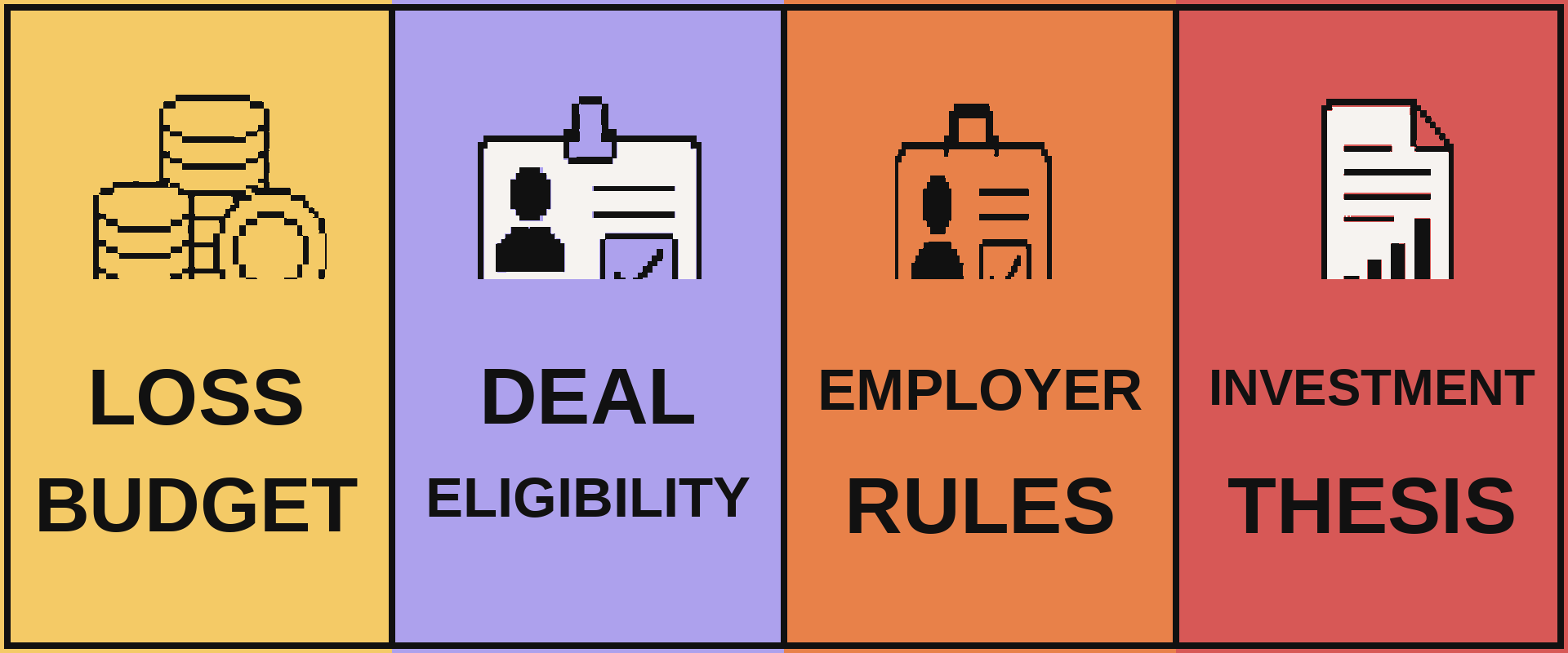
The first deal can wait. Four decisions come first: your loss budget, investment eligibility, employer rules, and investment thesis.
This material is educational and does not constitute legal, tax, or investment advice. Have qualified legal and tax professionals independently review your circumstances, an offering's documents, and its tax treatment.
1. Set your loss budget
Startup capital should be money you can lose completely and leave untouched for years. The SEC's private-placement guidance warns that these securities can result in a total loss, may be highly illiquid, and may provide less disclosure than registered public securities.
Tech employees face an extra concentration problem. Your salary, career prospects, unvested equity, vested company stock, and angel portfolio can all depend on the same sector. FINRA specifically identifies employer stock, correlated assets, and illiquid investments as sources of concentration risk.
Set two limits:
- A total startup allocation: the most you can lose across the entire portfolio without changing your housing, emergency savings, retirement contributions, or other major plans.
- An annual deployment pace: the amount you can commit each year without depending on a future bonus, unsold restricted stock units, or a hoped-for secondary sale.
Then work backward from the portfolio you can sustain. A hypothetical $18,000 budget over three years might reserve $12,000 for twelve $1,000 initial checks and hold $6,000 for fees or selected follow-ons. That is a planning example, not a recommended allocation. Your real numbers may support fewer investments, a slower pace, or no startup allocation at all.
2. Confirm which deals you may enter
Many US private offerings are limited to accredited investors. Under the SEC's current accredited investor criteria, an individual can qualify through one of several routes, including:
- net worth above $1 million, alone or with a spouse or partner, excluding the primary residence;
- income above $200,000 individually or $300,000 with a spouse or partner in each of the prior two years, plus a reasonable expectation of the same in the current year; or
- a Series 7, Series 65, or Series 82 credential held in good standing.
Other entity and insider routes also exist. Accreditation makes you eligible for certain offerings. It says nothing about whether a deal is sound or a loss is affordable.
Non-accredited investors can access some startup securities through Regulation Crowdfunding, subject to offering rules and individual investment limits. You do not need accredited status to join Angel Squad, our angel-investing community, while investing in the relevant private offerings does require it.
3. Protect your job and confidential information
Angel investing can overlap with an employer's competitors, customers, vendors, intellectual property, and confidential roadmap. Resolve that overlap before money or advisory work changes hands.
Read the outside-activity, conflicts, confidentiality, intellectual property, and code-of-conduct terms that apply to you. When approval is required, get it in writing. Keep the investment on personal time, devices, email, and accounts.
Decline a deal when participating would require employer information you cannot share or create divided loyalty you cannot manage. Never use internal customer data, code, pricing, product plans, or an introduction obtained through a confidential work process. Disclose relevant portfolio conflicts to founders early, especially when you invest in adjacent companies.
4. Turn your experience into a narrow thesis
An investment thesis tells founders and other investors what you understand, what you seek, and why you might help. Start narrower than “B2B software” or “AI.”
Use this one-sentence template:
I invest in [stage] startups serving [specific customer] because I understand [problem or distribution channel], and I can help with [two concrete actions].
A security engineering leader might focus on pre-seed tools sold to chief information security officers and help with design-partner introductions and technical hiring. A marketplace operator might focus on software for local service businesses and help founders model supply activation and retention.
Add a check range, geography if relevant, conflicts you will avoid, and two automatic pass criteria. The constraints keep an interesting pitch from rewriting your strategy in real time.
Build deal flow without exploiting your workplace
Good deal flow grows through trust. Tech employees often have useful starting points:
- Former colleagues who became founders. You have direct evidence of how they work under pressure.
- Customers and specialists one degree away. They can surface problems and founders in a domain you understand.
- Founder and operator communities. Repeated participation gives other people a reason to learn your thesis and send relevant companies.
- Angel groups and syndicates. These can add a lead investor, shared diligence, administration, and opportunities beyond your immediate circle.
Separate sourcing from access to confidential information. A former colleague can make an introduction because they know your background. A current employer's private acquisition list, partner pipeline, or unreleased product strategy stays out of your investing process.
In Angel Squad, our angel-investing community, members learn with other operators, review opportunities sourced by Hustle Fund, and choose independently whether a shared deal fits. That structure is useful when your expertise is strong but your personal founder network is still small.
Reputation compounds. Give founders a quick no, make introductions only when the fit is real, and never claim more influence or capital than you have. Founders remember the investor who was clear and useful before they remember a fancy title.
Use your expertise inside a complete diligence process
Technical or market knowledge can shorten part of diligence. It cannot replace the rest. Before investing, understand the company, the financing instrument, the vehicle, and the people responsible for both.
Ask five groups of questions.
Founder and problem
- What did the founders learn firsthand that outsiders miss?
- How quickly have they turned evidence into a product or sales change?
- What do former colleagues, customers, or co-founders say about their judgment and integrity?
Customer and distribution
- Who feels the pain, who uses the product, and who controls the budget?
- What evidence shows urgency beyond compliments and pilot conversations?
- Which acquisition channel could work repeatedly, and what could make it too expensive?
Product and execution
- What must the team build in the next 12 to 18 months?
- Which technical, regulatory, hiring, or operational assumption is most likely to break?
- Does the product create a durable advantage, or can a better-funded team copy the important part?
Round and security
- How much is the company raising, what milestone should that capital reach, and how long might it last?
- Are you buying shares, signing a Simple Agreement for Future Equity (SAFE), or investing through a special purpose vehicle (SPV)?
- What do the valuation cap, discount, conversion terms, fees, carried interest, information rights, transfer limits, and follow-on rights mean for your position?
Our guide to SAFE agreements explains the instrument's core mechanics. If the deal uses an SPV, read both the startup terms and the vehicle documents. The SPV manager, fees, control rights, reporting, tax documents, and treatment of follow-ons affect your economics.
Conflicts and disconfirming evidence
- Does this company compete with your employer or an existing portfolio company?
- Are you relying on information that the founder did not provide and that you cannot lawfully use?
- What fact would make you pass immediately? What evidence would reverse your current excitement?
The best use of operator expertise is asking sharper questions. The worst use is falling in love with a product because you could imagine building it.
Write the decision before you wire
A short investment memo forces a feeling into claims someone else could challenge. It also gives you a record to learn from when the outcome arrives years later.
Capture eight items on one page:
- the company and security;
- your thesis in two sentences;
- the strongest evidence;
- the largest unresolved risk;
- why you have an edge in evaluating or helping;
- terms, fees, and expected ownership if knowable;
- employer and portfolio conflicts; and
- the next milestone that would strengthen or break the thesis.
A concise investment tear sheet keeps this record consistent across deals. Add a pass reason when you decline. In six months, “interesting, too early” teaches you very little. “No repeatable path from security engineers to the budget owner” gives you a claim to revisit.
Construct a portfolio your finances and calendar can support
One startup can make you feel like an investor. It cannot show whether your process works across different founders and outcomes.
Elizabeth's advice is blunt:
“Don't try to pick a co. Select a portfolio.”
Elizabeth Yin, our co-founder and general partner
Portfolio construction begins with the loss budget, then divides it into checks small enough to make multiple independent decisions. Account for platform or SPV fees before setting the check size. Decide whether follow-ons belong in the plan instead of improvising when a founder asks for more money.
Diversifying across twelve software startups still leaves you concentrated in private technology. Consider the angel portfolio alongside employer stock, index funds, cash needs, real estate, and every other asset and liability. Startup count alone does not create a diversified financial life.
Track each company's sector, customer, stage, security, check size, source, co-investors, conflicts, and next expected update. Treat a financing valuation as a paper mark. Cash returns require an acquisition, public listing, approved secondary sale, distribution, or another liquidity event.
Help founders without taking a second job
Your check may be small. Your help should be specific.
Send each founder a simple menu after investing:
- the customer profiles for which you can make a warm introduction;
- the roles or candidate types you can help recruit;
- one product, technical, or go-to-market question you can discuss well; and
- how quickly you can respond to an update or targeted request.
Set a monthly time budget for the portfolio. A founder benefits more from one relevant customer introduction than from ten vague offers to “help with anything.” Boundaries also reduce the temptation to advise two competing companies with information that belongs to one.
Your first 90 days
You do not need to force a first investment into the calendar. Use 90 days to build the process that will govern it.
Days 1 to 30: set the gates
- Write the total allocation, annual pace, initial check range, and follow-on policy.
- Confirm your accreditation route or choose a compliant non-accredited path.
- Resolve employer approval and conflict requirements.
- Draft a one-sentence thesis and two automatic pass rules.
Days 31 to 60: practice without wiring
- Review at least ten deals from your network, public demo events, or an investing community.
- Write two practice memos, including one for a company you like and still decide to pass on.
- Compare your judgment with operators from finance, sales, product, legal, and other functions.
- Refine the thesis when the same unanswered question appears repeatedly.
Days 61 to 90: make one complete decision
- Choose a deal that fits the thesis, budget, eligibility, and employer rules.
- Complete references and document review proportional to the risk and information available.
- Write the memo before committing.
- Record the investment, send the founder your help menu, and schedule the next portfolio review.
If no deal clears every gate, the correct first decision is a pass. A decade-long practice does not need a quarterly target.
If you want experienced investors, structured education, and curated opportunities around that practice, apply to Angel Squad. Bring your operator edge. We will help you turn it into a repeatable investing process.







.png)