
Post-Investment Support: How to Help Founders After You Invest
A check changes the relationship between an investor and a founder. It creates a chance to help, but it can also create noise, pressure, and blurred authority. Angels and small VC funds need a support system that makes them useful without turning them into shadow operators. That starts with a clear role, a simple way to handle requests, and the judgment to know when to act, refer, or step back.
Haley Bryant originally wrote this guide. Brian Nichols contributed our firsthand material on founder wellbeing, crisis response, and the human side of portfolio firefighting.
What post-investment support means
Post-investment support is the help an investor provides after funding a company to remove obstacles, improve a decision, or connect the founder with a useful person or resource. It can include customer introductions, recruiting, fundraising preparation, go-to-market guidance, reporting, coaching, and help during a crisis.
VCs often call this portfolio support or portfolio company support. In this context, those terms mean help for the companies a fund has backed. Portfolio support for VCs can sit with an investment partner, an operator, or a dedicated platform team. It does not mean investment-portfolio software or general customer support.
Portfolio monitoring is adjacent, but different. Monitoring helps an investor understand company performance and risk. Support helps the founder make progress. A monthly update can serve both purposes, but an investor should be honest about which need a request serves.
This is the practical side of venture capital value add. A survey of 885 institutional VCs found that investors viewed post-investment value-add, deal sourcing, and deal selection as contributors to value creation. The useful question for an angel or small fund is narrower: what can we do that this founder actually needs?
“Money has always been a commodity.”
Elizabeth Yin, Hustle Fund co-founder and general partner
Capital matters. After it lands, an investor earns trust through relevant help, good judgment, and follow-through. None of those actions guarantees a company's outcome.
Useful support can turn into interference
Support is useful when it is specific, wanted, timely, and within the investor's competence. Interference starts when the investor creates work, asserts authority they do not have, or treats personal preference as operating truth.
A simple test is to ask four questions:
- Did the founder ask for this, or agree that it would help?
- Does it solve a current priority?
- Are we qualified to help?
- Will the founder still own the decision?
If one answer is no, pause. An unsolicited deck rewrite before a customer deadline, a standing meeting with no purpose, or an introduction made without permission can all become extra work. Sometimes the highest-value move is to leave the team alone.
Judy Abad brings that restraint to her work as an operator-investor. She and her husband, Pablo, built Abad Capital as a family-run venture firm. Before becoming an investor, Judy held leadership roles at Facebook, Instagram, Slack, and WhatsApp. That operator experience informs her advice, but it also reminds her who is doing the work.
“It is so important for investors to always remember to keep their egos in check. You’re ultimately here to serve and support the founders you’ve backed.”
Judy Abad, Abad Capital
.png)
The founder and team deserve the credit for company progress. The investor's job is to improve the conditions around their work, then get out of the way.
Decide who owns support at an angel group or VC fund
Every portfolio company should know who to contact. Shared responsibility without a named owner usually becomes no responsibility.
How VCs support portfolio companies depends on the firm's size and skills, but the founder should always see one clear front door.
- Individual angels should own their commitments and introductions. If you offer recruiting help, the founder should not have to chase three times.
- Small VC funds can assign one partner or operator to triage requests, even when several people contribute.
- Funds with platform teams can route hiring, go-to-market, community, and reporting questions to specialists while keeping the investment partner informed.
- Co-investors should coordinate on large asks so the founder does not repeat the same context or receive conflicting advice.
The support owner does not become the company's operating owner. Their job is to receive the request, find the right response, and close the loop.
Solo angels also need a bench. In Angel Squad, our angel-investing community, members learn from other investors and can draw on a wider range of operator perspectives when a founder's request sits outside their lane.
Set expectations during diligence and onboarding
The support relationship starts before the wire. During angel due diligence, ask founders what they want from investors and explain what you can realistically provide. That conversation exposes mismatched expectations before they become resentment.
After the investment, send a short support profile that covers:
- the topics where you can contribute firsthand experience
- the requests you can route through your network
- the areas where you will bring in an expert
- your preferred request channel and usual response pattern
- what counts as urgent and how to reach you
- how you handle confidential information and portfolio conflicts
- the update cadence that works for both sides
Do not promise constant access if you cannot provide it. A clear boundary is more useful than an open-ended “let me know how I can help.”
Honest feedback also needs permission and context. Our co-founder Eric Bahn opens difficult conversations by setting a social contract:
“I’m going to be brutally honest with my feedback but I want you to know that it’s coming from a good place.”
Eric Bahn, Hustle Fund co-founder and general partner
That framing does not give an investor permission to be careless. It makes the shared intent explicit before a candid conversation begins.
Use one request and triage loop
Founders should not need to guess whether to text a partner, email an associate, or complete a form that nobody reads. Pick one default channel and make the urgent route explicit. A support inbox, a shared email alias, or a structured field in the company's regular update can all work.
Run every request through the same four-step loop:
- Ask. Capture the desired outcome, why it matters now, the deadline, and what a good match looks like.
- Qualify. Check priority, expertise, consent, confidentiality, and conflicts. Decide whether the request needs direct help, a referral, or no action.
- Act. Name one owner and next step. Make the introduction, schedule the working session, find the expert, or explain why stepping back is better.
- Close the loop. Ask what happened, record the outcome, and agree on any next step. This protects relationships and improves future support.
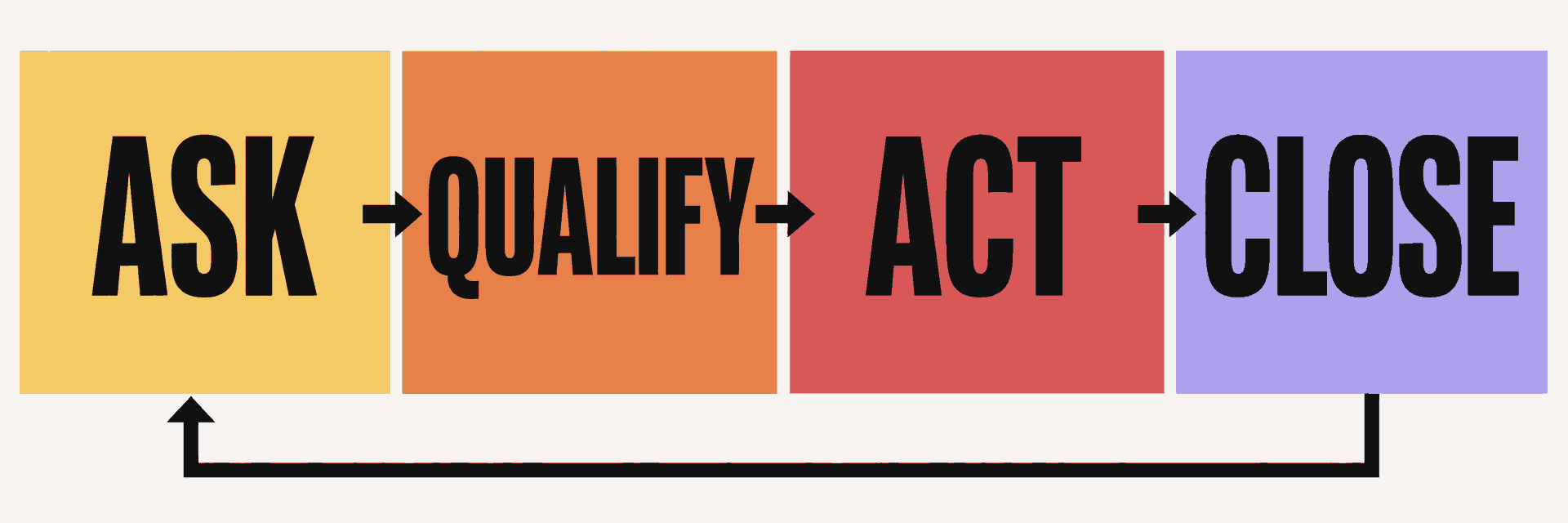
Triage by consequence and deadline, not by who sends the loudest message. A payroll issue, co-founder rupture, expiring offer, or time-sensitive financing request may need a fast response. A broad brand brainstorm can wait. A health, legal, immigration, employment, or tax matter should reach a qualified professional rather than an investor improvising outside their expertise.
What useful post-investment support looks like
Customer and partner introductions
Start with the target, the reason to meet, and the desired next step. Ask the founder for a short forwardable note, confirm that your contact is open to the introduction, and give both sides enough context to decide. Then step out of the sales process.
The same pattern works for distribution, integration, and channel partners. Define the mutual value before asking either side for time.
Avoid mass forwarding, vague “you two should meet” emails, and pressure on a contact to buy. Our customer introduction guide goes deeper on protecting both relationships and learning from the result.
Hiring
Useful hiring support starts before candidate sourcing. Help the founder define the problem the role will own, the stage-appropriate profile, and the evidence that would show a strong fit. Then make targeted introductions to people who are open to the conversation.
Judy used this approach with Lang.ai. She helped source candidates and interviewed alongside the founders as they hired their first product manager. Our separate portfolio hiring playbook covers role definition, warm candidate outreach, and network stewardship in more detail.
Fundraising
An investor can review the narrative, identify gaps in the data, help build a relevant investor list, rehearse difficult questions, and make warm introductions when the company is ready. The founder still owns the raise.
If you think the timing is wrong, explain why and name the evidence that could change your view. Vague reluctance wastes runway and trust. Our fundraising support guide shows how to give a candid answer without pretending it is a command.
Operations and go-to-market
Operator-investors can be especially useful in a bounded working session. Define one decision, share the relevant pattern, pressure-test the options, and leave the founder with a next step. Avoid taking over the function or turning one company's playbook into a universal rule.
Judy advised Yalo on marketing and positioning, drawing on her go-to-market and business-operations experience. Within Abad Capital, Pablo contributed product, fundraising, and CEO-coaching experience. For companies reaching a more complex operating stage, our session on working smarter as you scale is a useful companion.
Key performance indicators and reporting
Reporting should help the founder run the business first. Agree on a small set of key performance indicators (KPIs) tied to the company's model, plus cash position, major risks, and the asks where investors can help. Do not force an early-stage founder to produce several versions of the same update for different investors.
Use the update to spot patterns and ask better questions. A missed target may call for context, a customer introduction, a hiring change, or no intervention at all. Monitoring the number is not the same as diagnosing the problem.
Founder wellbeing and peer community
Startup pressure compounds. Product uncertainty, hiring gaps, team departures, cash constraints, and family responsibilities can hit at the same time. Add a co-founder or relationship conflict, a visa issue, cap-table disagreement, serious illness, or death, and the immediate problem may be human before it is strategic.
Brian Nichols contributed these patterns from the portfolio calls investors rarely discuss. The work can include listening, helping a founder regain perspective, reframing one setback, restoring morale, taking an urgent call, or introducing a trusted peer or coach. It can also mean having a candid conversation about a pivot or shutdown when continuing under the current plan is causing more harm.
Investors should not diagnose or treat a mental health condition. Health crises belong with qualified clinicians, legal and visa issues belong with qualified counsel, and investor coaching should never be presented as a substitute. The useful role is to listen without judgment, preserve the founder's agency, and help them reach the right support.
Peer community reduces the pressure on one investor to have every answer. A portfolio founder circle can connect people facing similar stages without exposing sensitive company information. Inside Angel Squad, investors also learn from peers who have handled hard portfolio situations and can help identify the right kind of expert.
Respect autonomy, conflicts, and the limits of your expertise
An investor can hold a strong view without taking control. State the observation, the reason it concerns you, and the outcome you want to protect. Ask how the founder sees it. If you still disagree, document the disagreement and separate advice from any formal board or contractual authority.
Our guide to hard portfolio conversations shows how to put the problem at the center and keep the founder on your side of the table.
Conflicts need the same clarity. Disclose when you have invested in adjacent companies, when a follow-on decision affects your advice, or when you cannot share information from another portfolio company. Never use one founder's confidential data to help another.
Bring in an expert when the problem requires deeper pattern recognition or professional expertise you do not have. Judy once connected Dive Chat, a Hustle Fund portfolio company, with a former Instagram consumer-product leader to discuss social messaging. She did not pretend her own network made her the expert. She found the person with the right experience and let the founder decide what to use.
Ask permission before making the referral, explain the person's relevant experience, clarify any cost or commercial relationship, and step back if the fit is wrong. A referral transfers the conversation, not responsibility for the founder's decision.
Choose a sustainable cadence and boundaries
A workable default for many angels and small funds is:
- an asynchronous company update on an agreed cadence
- a focused check-in when there is a real decision or request
- a periodic relationship conversation that is not only about metrics
- a defined route for genuinely urgent situations
Respond to every request, even when the answer is no, later, or “I know someone better.” Silence makes founders spend more time following up and teaches them not to ask again.
Your portfolio size, role, and expertise determine how much you can offer. Keep detailed hour ranges and capacity planning separate from the operating guide. Our guide to the time investment of angel investing helps you choose a sustainable engagement model.
Scale support without burdening founders
A small fund does not need a large platform team to build a dependable system. It needs a visible front door, an accountable owner, and a useful record.
Start with six pieces:
- One intake channel for ordinary requests and one urgent route.
- An expertise directory of team members, investors, operators, and qualified specialists.
- A request log with the founder's goal, owner, deadline, consent, and status.
- Short playbooks for recurring asks such as customer introductions, hiring, and fundraising.
- A regular needs scan that asks founders where help would matter now.
- A feedback loop that records whether the help was timely and relevant.
Measure the support system, not your proximity to company decisions. Useful operating signals include response time, open requests, introductions accepted, referrals completed, repeated needs across the portfolio, and founder feedback. Restrict sensitive notes to the people who need them, and do not turn the support log into a surveillance file.
As the portfolio grows, group common needs. A recruiting office hour, peer session, or expert workshop may answer several requests at once. Keep an individual route open for confidential or company-specific issues.
Post-investment support checklist
- [ ] Align on the founder's expectations during diligence.
- [ ] Send a short support profile after investing.
- [ ] Name the person who owns support requests.
- [ ] Define the default channel and urgent route.
- [ ] Ask for the desired outcome, context, deadline, and ideal match.
- [ ] Check expertise, consent, confidentiality, and conflicts before acting.
- [ ] Use double opt-in introductions and give both sides context.
- [ ] Let the founder own operating decisions and company credit.
- [ ] Bring in qualified experts when the need is outside your lane.
- [ ] Close the loop and record what happened.
- [ ] Maintain a cadence you can sustain across the portfolio.
- [ ] Offer listening, perspective, and peer connection during hard periods.
- [ ] Review recurring needs and build a shared resource only when it saves founders time.
Good post-investment support is responsive, humble, and specific. If you want to practice that craft with investors who share playbooks, operator experience, and early-stage perspective, apply to join Angel Squad.







.png)