
Accredited angel investor: what the status actually changes
“Accredited” sounds like a credential you earn before becoming an angel investor. In practice, it is one regulatory gate in a much longer investing process. Clearing it can expand the private startup deals you may enter, but it says nothing about whether a deal is good, a check is affordable, or the terms are fair.
Before writing your first startup check, you need to know where accreditation applies, how verification works, and what belongs on your side of the decision.
“Accredited angel investor” combines two different labels
An angel investor uses personal capital to invest in a startup, usually at an early stage. An accredited investor is a person or entity that meets a standard in Rule 501(a) of Regulation D.
There is no separate legal designation called an “accredited angel investor.” The phrase simply describes an angel who also qualifies as accredited.
That distinction matters. Accreditation governs eligibility for certain securities offerings. It is not an investing license, an SEC endorsement, or proof that you can evaluate a startup. You do not apply to the SEC, and the SEC does not issue a certificate.
For an individual, the main SEC qualification routes are:
- Income: More than $200,000 in individual income, or more than $300,000 jointly with a spouse or spousal equivalent, in each of the two prior years, with a reasonable expectation of reaching the same level in the current year
- Net worth: More than $1 million individually or jointly with a spouse or spousal equivalent, excluding the value of the primary residence
- Professional credential: A Series 7, Series 65, or Series 82 license held in good standing
- Qualifying role: Certain directors, executive officers, and general partners of the issuer, plus knowledgeable employees investing in the private fund for which they qualify
You only need one route. The thresholds are strict: income of exactly $200,000 does not exceed the individual threshold. Status can also change. A market decline can move a net-worth calculation below $1 million, and a career change can affect the required current-year income expectation.
Our guide to becoming an accredited investor explains each route, the primary-residence calculation, and the limits of using a Series 65 credential.
This is educational information, not legal, investment, or tax advice. Eligibility, asset treatment, offering terms, and tax consequences depend on the facts. Seek independent review from qualified securities counsel and tax professionals before relying on a qualification route or committing capital.
Do angel investors have to be accredited?
Many private startup rounds accept only accredited investors. Angel investors do not have to be accredited for every possible startup investment.
The deciding factor is the securities-law exemption used for the offering. A startup might raise through a Simple Agreement for Future Equity (SAFE), convertible note, or preferred stock. A special purpose vehicle (SPV) may pool investors and buy one of those securities. Each can be offered under different exemptions, so the instrument alone does not answer who may buy it.
Rule 506(b) can include a limited number of non-accredited investors
A Rule 506(b) offering cannot use general solicitation. It may accept an unlimited number of accredited investors and up to 35 non-accredited investors who have enough financial and business knowledge to evaluate the investment, either alone or with a purchaser representative.
Accepting non-accredited investors brings prescribed disclosure requirements and more work for the issuer. Many startups, funds, and SPVs therefore limit their 506(b) offerings to accredited investors even though the rule does not require that choice.
Rule 506(c) requires every purchaser to be accredited
A Rule 506(c) offering may be advertised publicly. Every purchaser must be accredited, and the issuer must take reasonable steps to verify that status.
This tradeoff explains why a deal promoted online may demand more evidence than a private round shared through an existing relationship.
Other exemptions can admit non-accredited investors
Regulation Crowdfunding offerings can accept non-accredited investors through a registered intermediary, subject to investor limits and other rules. Some Regulation A offerings also admit non-accredited investors. These routes give people a way to invest in private companies without claiming a status they do not meet.
So, accreditation expands access. It does not define who is allowed to care about startups, learn the craft, or participate in every form of startup investing.
What accredited status opens, and what it does not
Accredited status can make you eligible for more opportunities, including many direct startup rounds, SPVs, syndicates, and venture funds. It does not grant automatic access to any specific allocation. A founder, lead investor, or fund manager can still decide whom to accept.
It also does not provide:
- A quality screen. The SEC does not approve a private placement merely because accredited investors can buy it.
- Public-company disclosure. Private issuers may provide far less standardized information than a public company.
- Liquidity. There may be no market for the security, and transfer restrictions can prevent a sale even if you find a buyer.
- Downside protection. The startup can fail, later financing can dilute you, and an exit can leave common holders or SAFE investors with little or nothing.
- Fair pricing. Accreditation says nothing about valuation, a SAFE cap, fees, carried interest, or the rights attached to your security.
- Qualified-purchaser status. Some private funds use a separate, higher eligibility standard.
The SEC's private-placement bulletin warns that investors may receive limited information and can lose their entire investment. Treat the designation as permission to consider a deal, never as evidence that the deal deserves your money.
How accredited investor verification works in an angel deal
Qualification and verification are separate events. You qualify when you meet a Rule 501(a) test. The issuer must establish a reasonable basis for treating you as accredited when it sells the security.
Verification in a Rule 506(b) offering
In a 506(b) round, the issuer must reasonably believe that you are accredited at the time of sale. The process often starts with an investor questionnaire and representations in the subscription agreement. The issuer may ask for more support when the circumstances create doubt.
There is no rule that makes one unchecked questionnaire sufficient in every case. The issuer and its counsel assess the full set of facts they know.
Verification in a Rule 506(c) offering
In a 506(c) round, reasonable verification steps are mandatory. A self-certification box by itself is insufficient.
The SEC provides several non-exclusive methods in its verification guidance:
- Income route: Review Internal Revenue Service forms reporting income for the two most recent years and obtain a written statement that the investor reasonably expects to reach the threshold in the current year.
- Net-worth route: Review recent asset records, obtain a consumer report covering liabilities, and collect a written statement that the investor disclosed all relevant liabilities. The prescribed records must be dated within the prior three months.
- Third-party confirmation: Obtain a written confirmation from a registered broker-dealer, SEC-registered investment adviser, licensed attorney, or certified public accountant that took reasonable steps and determined the investor was accredited within the prior three months.
- Prior verification: Rely on reasonable verification completed within the previous five years, paired with a new written representation and no known information to the contrary.
Other evidence may also be reasonable. The right method depends on the route, the investor, and the offering.
Imagine that Priya qualifies through income and wants to invest $5,000 through a publicly promoted SPV. The SPV uses Rule 506(c). Priya is already accredited, but the SPV still needs to verify her before accepting the investment. She can provide the required income records and current-year representation, or use an eligible professional to deliver a confirmation. Once verified, she still has to review the SPV's economics and the startup security it will buy.
A verification letter is not a permanent investor passport. Another issuer can run its own process, and any time-limited evidence can go stale.
Before you wire: build the investing process
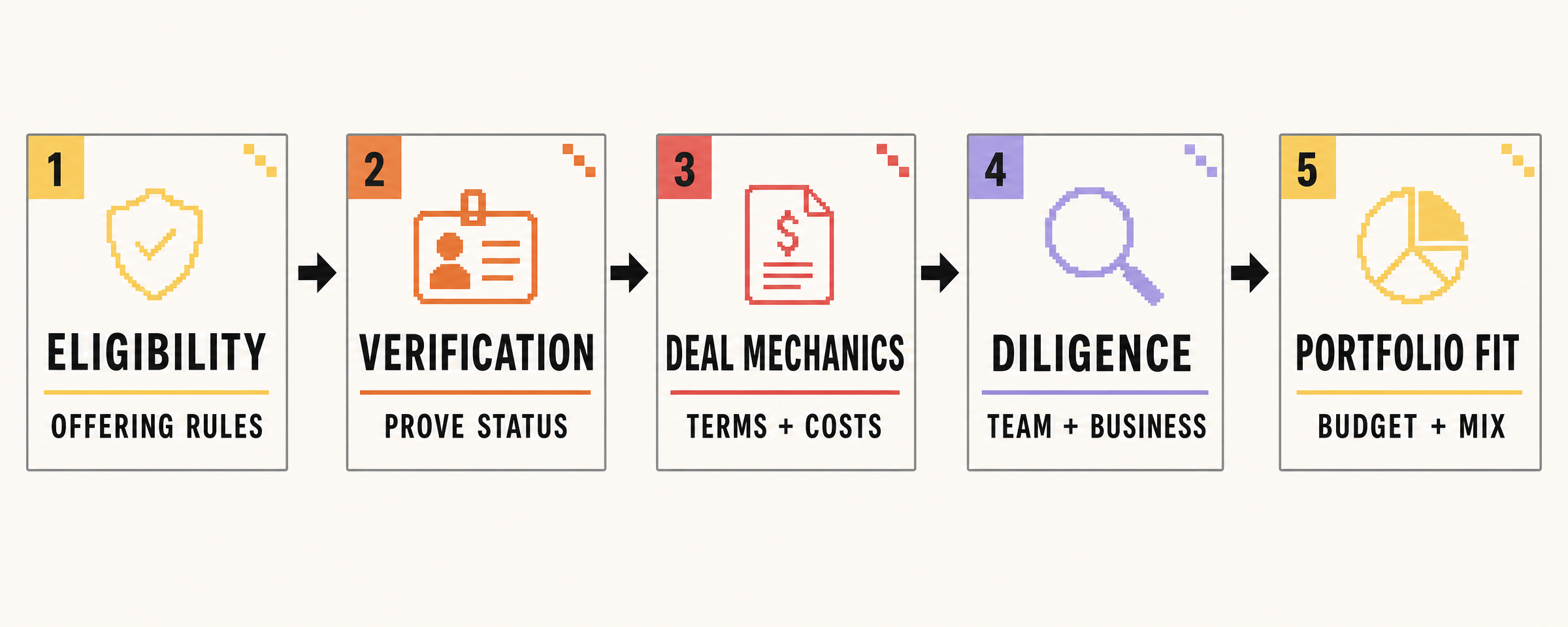
Accreditation answers one narrow question: are you eligible for this offering? Once eligibility and verification are handled, we use five practical questions before and after the wire.
1. Set a loss and liquidity budget
Assume the check can go to zero and remain inaccessible for years. Set an annual startup-investing budget that does not compete with near-term expenses, emergency savings, debt obligations, or other financial goals.
Then choose a default initial check size. A $25,000 allocation split into five $5,000 checks creates a different risk profile from one $25,000 bet. Neither structure guarantees a better result. The point is to choose deliberately before a persuasive pitch creates urgency.
2. Know what you will own
For a direct investment, identify whether you are buying stock, a SAFE, or a convertible note. For an SPV, you usually buy an interest in the vehicle, and the vehicle buys the startup security. That extra layer can affect fees, carried interest, information flow, voting, transfers, follow-on rights, tax documents, and timing.
Read both levels of documents. Our walkthrough of investing through an SPV explains where the money and ownership sit.
3. Separate access from diligence
A trusted introduction is useful. It does not replace an investment decision. Review the founder team, customer evidence, market, cap table, intellectual-property ownership, runway, use of funds, valuation, security terms, and material conflicts.
Our co-founder Eric Bahn looks for founders who pair speed with learning and measurement:
“Great execution meets high velocity.”
Eric Bahn, our co-founder and general partner
Velocity without evidence can be noise. Evidence without the ability to adapt can become stale. The useful question is whether the team learns quickly enough to turn scarce capital into real progress.
In Angel Squad, we share curated deal flow from our Hustle Fund team, investment memos, live pitches, and a community of operators who can compare what they see. The lead's work is an input. Each member decides independently whether to invest.

4. Make the decision fit a portfolio
Startup returns are highly uneven. A 2007 study of 1,137 exits reported by angel-group members found that 52% returned less than the capital invested. Just 7% returned more than 10 times invested capital, accounting for 75% of total dollars returned in the sample. The authors cautioned that the data described angels connected to groups, so it should not be treated as a forecast for every investor. The return distribution still shows why one exciting company is a fragile strategy.
Elizabeth puts our view more bluntly:
“Don't try to pick a co. Select a portfolio.”
Elizabeth Yin, our co-founder and general partner
Write down how many initial checks your budget can support, whether you will reserve capital for follow-on rounds, and which concentrations you will accept by sector, geography, stage, or founder network. Diversification cannot remove startup risk. It can reduce the chance that one loss ends the entire experiment.
5. Decide what you can contribute after the check
Angels can help with customer introductions, hiring, product feedback, industry context, and future fundraising. Promise only what you can deliver. Founders remember investors who are responsive and specific. They also remember investors who create work, leak confidential information, or disappear.
Your value can improve access to future founders, but access is earned over time. A thoughtful “no,” a useful introduction, and a kept promise all contribute to that reputation.
A practical accredited-angel checklist
Before committing, the deal file should answer each of these questions:
- Offering: Which exemption is the issuer using, and must every purchaser be accredited?
- Verification: Who handles verification, which route supports your status, and when will the evidence expire?
- Vehicle: Are you investing directly or through an SPV, and who appears on the startup's cap table?
- Security: What are the valuation, cap, discount, interest, maturity, liquidation, conversion, and dilution mechanics that apply?
- Costs: What management fees, administrative expenses, carried interest, or platform costs reduce your proceeds?
- Rights: Do information, voting, pro rata, transfer, or follow-on rights reach you directly or remain with a lead or vehicle?
- Conflicts: Does the lead, platform, or manager receive compensation from another party or hold a different security?
- Risk fit: Can this check go to zero without changing your financial plan, and does it fit your target portfolio?
- Decision: What specific evidence supports the investment thesis, and what evidence would make you pass?
A completed accreditation questionnaire answers only the first two. The rest determine whether you are acting like an investor rather than an eligible buyer.
Accredited angel investor FAQs
Does forming an LLC make me an accredited investor?
No. An entity must satisfy its own Rule 501(a) test, such as qualifying based on assets, investments, or accredited equity owners. Forming an LLC solely to buy one deal does not convert a non-accredited owner into an accredited investor, and some entity routes exclude entities formed for the specific purpose of buying the offered security.
Is accredited investor status permanent?
No permanent certificate exists. The applicable test is assessed at the time of the sale, and verification records have their own recency rules. An investor who qualified for one deal may need updated evidence for the next.
Is an accredited investor also a qualified purchaser?
Not automatically. “Qualified purchaser” is a separate Investment Company Act standard used by some private funds. An individual generally needs at least $5 million in investments to qualify, which is different from the accredited-investor income, net-worth, credential, and role tests.
Build the process before chasing the deal
Accreditation gets you through one door. Your advantage comes from a repeatable process, independent judgment, and thoughtful people around you.
If you want to learn from our investing experience, review curated startup opportunities, and compare notes with fellow operators, apply to Angel Squad. Membership does not require accredited status. Investing in an offering that does will.







.png)