Insurtech market map for early-stage startup investors
An insurance app, a pricing model, and a claims platform can all be called insurtech. They have different buyers, revenue models, and exposure to losses. Comparing them as one business can hide the reason each succeeds or fails.
Our insurtech market map connects startup categories with the economics and dependencies behind them. In Angel Squad, our angel-investing community, we combine investing education and peer learning to help aspiring and active angels evaluate businesses.
Where insurtech fits within fintech
Insurtech is the part of financial technology that helps people and businesses buy insurance, price and transfer risk, administer policies, or handle claims. It includes insurance businesses and the software suppliers that serve them.
Our broader fintech market map puts insurance beside payments, banking, lending, and other financial services. Within insurance, the first distinction is who bears the contractual obligation to pay covered claims.
A carrier is the insurer on the policy. A broker or agent arranges coverage. A managing general agent (MGA) has authority from an insurer to perform functions such as underwriting, within agreed limits.
A software provider supplies tools. A claims administrator handles claims on another party's behalf. One company group can contain several of these businesses.
That entity boundary matters more than the interface. A technology parent, its insurance subsidiary, and a partner carrier can have different revenue, capital requirements, and exposure to losses. Reinsurance, insurance purchased by insurers, can transfer some of that exposure again.
The November 2026 insurtech market map
Map edition: November 4, 2026. The examples span U.S. and international businesses, with an emphasis on property and casualty insurance, which covers risks such as property damage and liability. This is a selective startup and scaleup landscape, rather than a complete inventory of insurance or life and health technology.
The categories follow the customer job. Distribution brings in the buyer. Underwriting assesses, selects, and prices risk. Claims handles the loss after an insured event. Carriers provide the insurance promise, while infrastructure supports the operating system. Specialty describes the risk or coverage design and can overlap every other category.
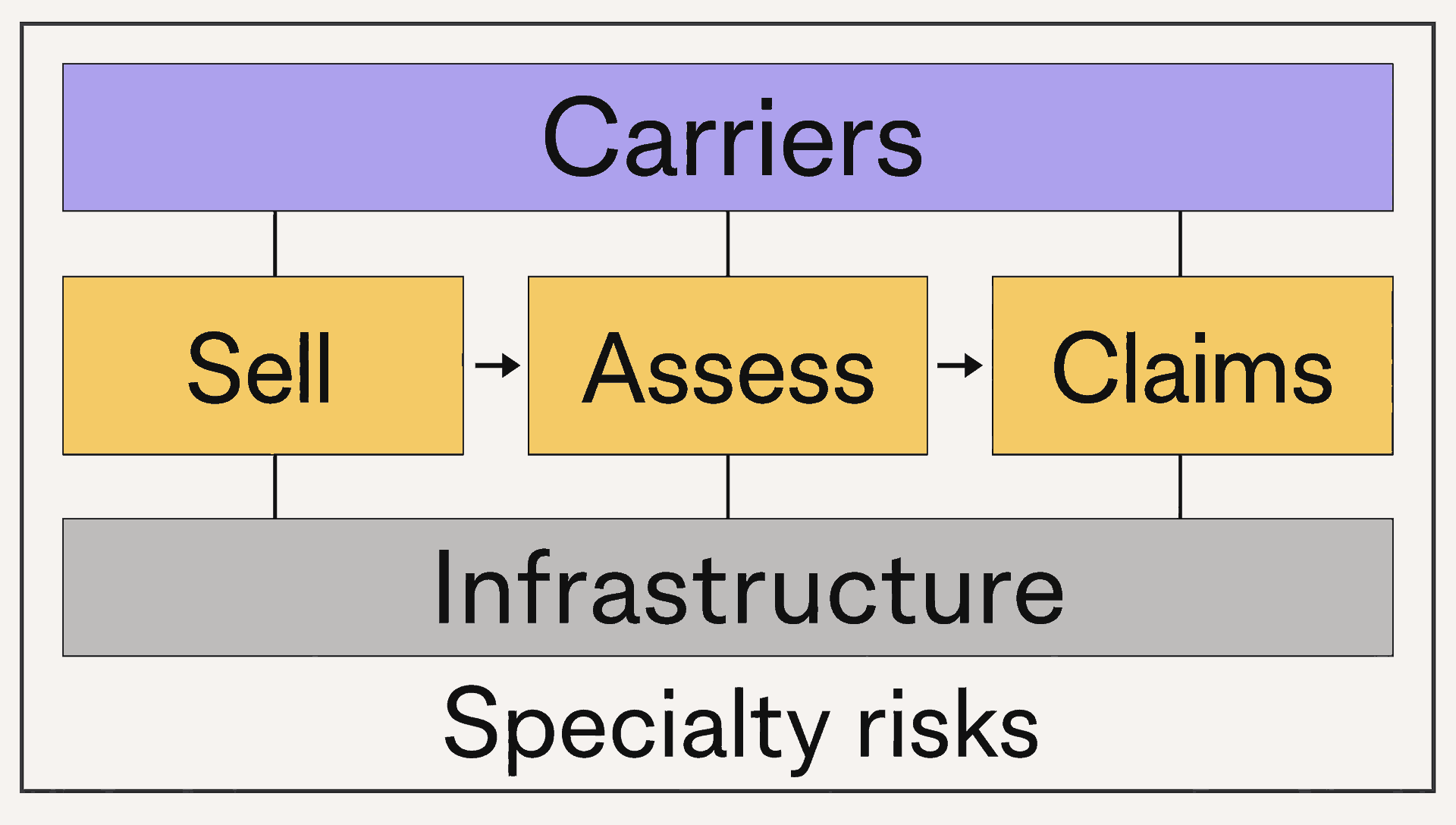
We apply four inclusion rules:
- Insurance is central to the product. Generic automation, cybersecurity, or payments software doesn't qualify merely because an insurer buys it.
- The product and role have public support. Each example has a company source beside it. Dates identify the supporting announcement; an undated page is labeled as such. A launch announcement establishes what was announced, not independent proof of customer results.
- Each company has one main placement. Material overlaps stay visible. Group-level labels don't mean every subsidiary or policy has the same structure.
- Inclusion has no price or rank. There are no paid placements. Examples are alphabetical within each category, with no score, endorsement, or implication that shares are available.
1. Carriers and carrier-building platforms
These businesses build insurance products around a risk-bearing insurer. The buyer is the policyholder, reached directly or through distribution partners. A carrier's economics involve premiums, claims, expenses, reserves for future claim payments, and reinsurance. A platform managing insurers may instead earn management or service fees alongside other revenue.
- Corgi. Its August 26, 2026 carrier launch announcement introduced Corgi Insurance Company, Inc. The group also includes MGAs and other insurance structures. That announcement doesn't make every Corgi policy a policy of the new carrier.
- Kin. Its June 30, 2026 reinsurance program announcement covers three reciprocal insurers it manages. These policyholder-owned insurers are distinct from the technology and management business.
The investor question is which entity earns the revenue and which entity absorbs losses. Useful evidence separates parent-company results from insurer results, shows claims experience as it develops, and identifies reliance on reinsurance renewals. Premium growth alone leaves those questions unanswered.
2. Distribution and embedded insurance
Distribution helps customers find, compare, buy, or renew coverage. Embedded insurance places that purchase inside another journey, such as buying equipment or using a business platform. Insurers supply coverage; distributors may earn commissions, fees, or platform revenue under their particular contracts.
- bolttech. Its June 4, 2025 distribution platform announcement describes an insurance distribution platform and an embedded-insurance venture with Sumitomo. Its technology has infrastructure overlap; distribution is the main placement here.
- Insurify. Its company overview describes an insurance-comparison marketplace and licensed agency. The page has no stated publication date. Carrier partners underwrite its Insurify Car program; the comparison service itself isn't the carrier.
The constraint is repeatable access to buyers and suitable carrier products. Ask how much business comes from one partner or paid channel, who controls renewal communication, and what happens when a carrier changes the risks it will cover or its commission terms. Quote requests, policies sold, premium volume, and revenue measure different things.
3. Underwriting, pricing, and risk selection
Underwriting tools help insurers and MGAs decide which risks to accept, on what terms, and at what price. Users include underwriters, actuaries who model insurance risk and pricing, and portfolio managers overseeing the mix of policies. Software revenue is different from the premium associated with decisions made through the software.
- Akur8. Its September 29, 2026 actuarial agents announcement describes artificial intelligence (AI) agents for pricing workflows, with actuaries retaining review and final decisions. It belongs in pricing software, rather than the carrier category.
- Federato. Its September 29, 2026 rating content announcement announces a licensing agreement for Verisk rating content in underwriting workflows. Federato also covers policy administration, billing, and claims, so its scope overlaps infrastructure.
Faster submissions are useful, but they don't establish better risk selection. Ask for evidence of adoption within the underwriter's workflow, traceable decision records, and results that distinguish model performance from changes in customer mix. Integration with policy systems and access to usable loss data can control deployment speed.
4. Claims management and assessment
Claims tools support the work from reporting a loss through assessment, investigation, handling, and resolution. The buyers include insurers, MGAs, and claims administrators. Some products manage the workflow; others handle a specific task such as estimating vehicle damage.
- Five Sigma. Its March 3, 2026 workflow automation announcement describes automation embedded in its claims-management platform. Selling to claims administrators doesn't make Five Sigma an administrator or insurer.
- Tractable. Its May 6, 2026 Foyer partnership announcement describes image-based assessment for minor motor claims. Damage assessment is a narrower job than deciding coverage or paying every claim autonomously.
The buyer needs operational improvement without worse claim outcomes. Ask about total handling cost, time to resolution, reopened cases, errors, and the work still done by people. A fast model output can leave the overall process slow if adjusters must re-enter data or repair its mistakes.
5. Insurance infrastructure and core systems
Infrastructure supports policy creation, administration, billing, data exchange, and the connections between insurance partners. Some companies sell subscription software. Others combine technology with licensed authority and access to carriers or reinsurance. Those models need different comparisons.
- Boost. Its May 26, 2026 Atlas launch announcement describes a portal partners can offer under their own brands, backed by MGA authority, carrier relationships, reinsurance capacity, and policy-administration technology. Atlas is explicitly not a standalone software subscription.
- Socotra. Its September 23, 2026 configuration assistant launch describes reviewable product configurations built on its insurance core platform. This is operating infrastructure, with underwriting overlap.
For software, useful evidence includes implementation time, migration burden, retention, reliability, and gross margin after support. For a program platform, add carrier and reinsurance dependencies. Ask which component the startup owns and which depends on a renewable third-party agreement. Insurance capacity is the backing available to write policies; startup funding pays to build and grow the business.
6. Specialty risks and coverage designs
Specialty is a second lens across the value chain. Cyber, flood, climate, and other focused risks can support carriers, MGAs, brokers, analytics businesses, or software suppliers. Parametric insurance is a coverage design that pays according to a specified event trigger, such as a measured weather event.
- Coalition. Its May 6, 2026 Allianz partnership announcement describes cyber insurance alongside security capabilities. The group includes insurance-selling affiliates and an insurance company. The issuer and structure vary by product and jurisdiction; the announced partnership expansion also had conditions.
- Descartes Underwriting. Its January 22, 2026 data center announcement describes parametric protection for construction and operating exposures. The wider group also includes a distinct licensed insurer, so the company name alone doesn't establish the structure of a policy.
Specialization changes the failure modes. One cyber event can affect many insured businesses. With parametric coverage, a customer can suffer a loss without the trigger producing a matching payout. The National Association of Insurance Commissioners explains this basis risk in its December 21, 2023 overview. Ask how triggers, exclusions, event concentration, and available insurance capacity affect the product.
Compare the dependency behind the business
Two startups in different categories can share the same weak point. A distributor and a program platform might rely on the same carrier. Several specialty insurers might depend on the same reinsurance market. Multiple software vendors might sell into the same small group of insurance buyers.
Consider a hypothetical embedded-insurance startup with growing premium volume. The commercial picture changes depending on whether it owns the renewal relationship, earns a commission, performs underwriting under delegated authority, or must fund an insurer. Its position on the map sets the questions; the answers determine the business case.
AI adds another dependency rather than removing these boundaries. The NAIC's December 4, 2023 AI model bulletin addresses governance, documentation, and consumer outcomes. It is a model bulletin, not a nationwide law. For an investor, audit trails, human escalation, data rights, and responsibility for errors belong beside the claimed time savings.
Build an insurtech diligence memo
A useful memo starts with a specific buyer and workflow. “Claims software for regional motor insurers” gives you a clearer comparison set than “AI for insurance.” Our startup investment criteria provide the broader team, customer, and business framework.
Add five insurance-specific questions:
- Who uses, buys, and approves it? A claims handler may use the product while operations owns the budget and security controls deployment.
- What creates revenue? Separate premiums, commissions, management fees, recurring software fees, and implementation services.
- Who owns the obligation? Name the insurer, distributor, administrator, technology provider, and relevant reinsurers. Separate the startup from its partners and subsidiaries.
- What proves customer value? Match the evidence to the job: retained policies, underwriting adoption, claims outcomes, or a completed core-system migration. Include the baseline and remaining manual work.
- What could stop growth? Identify carrier concentration, insurance capacity, data access, implementation cost, long sales cycles, or an unresolved product limitation.
Our co-founder and general partner Eric Bahn describes hustle as “great execution meets high velocity.” In insurance, useful execution can mean a completed production deployment or a workable carrier relationship. A quick demonstration proves less about either.
Keep the original reasoning and the evidence that would change it. Our co-founder and general partner Elizabeth Yin writes in Democratizing Knowledge (2021, p. 131), “The more disciplined you are in your thought process/rubric, the more you can improve over time.” A consistent memo makes later learning possible without pretending early-stage outcomes are predictable.
To practice evaluating business models with experienced investors and fellow operators, apply to Angel Squad.
This map is research, not an investment recommendation, endorsement, offer, or statement that an investment is available. It provides general education, not investment, legal, or tax advice. Startup investments are speculative, illiquid, and long-term; most bets may fail, and any investment can lose its entire value. Seek independent guidance from qualified financial, legal, and tax professionals for your own circumstances.