HR tech market map: products, buyers and diligence
Human resources (HR) technology covers the software employers use to hire, pay, schedule and support people at work. Products in the same suite can serve different buyers and depend on different budgets.
Our HR tech market map is a selective product snapshot dated November 17, 2026. It connects employer workflows with the commercial questions an angel investor needs to understand. Our Angel Squad angel-investing community brings aspiring and active angels together for investing education and peer learning.
Four groups in the HR tech market
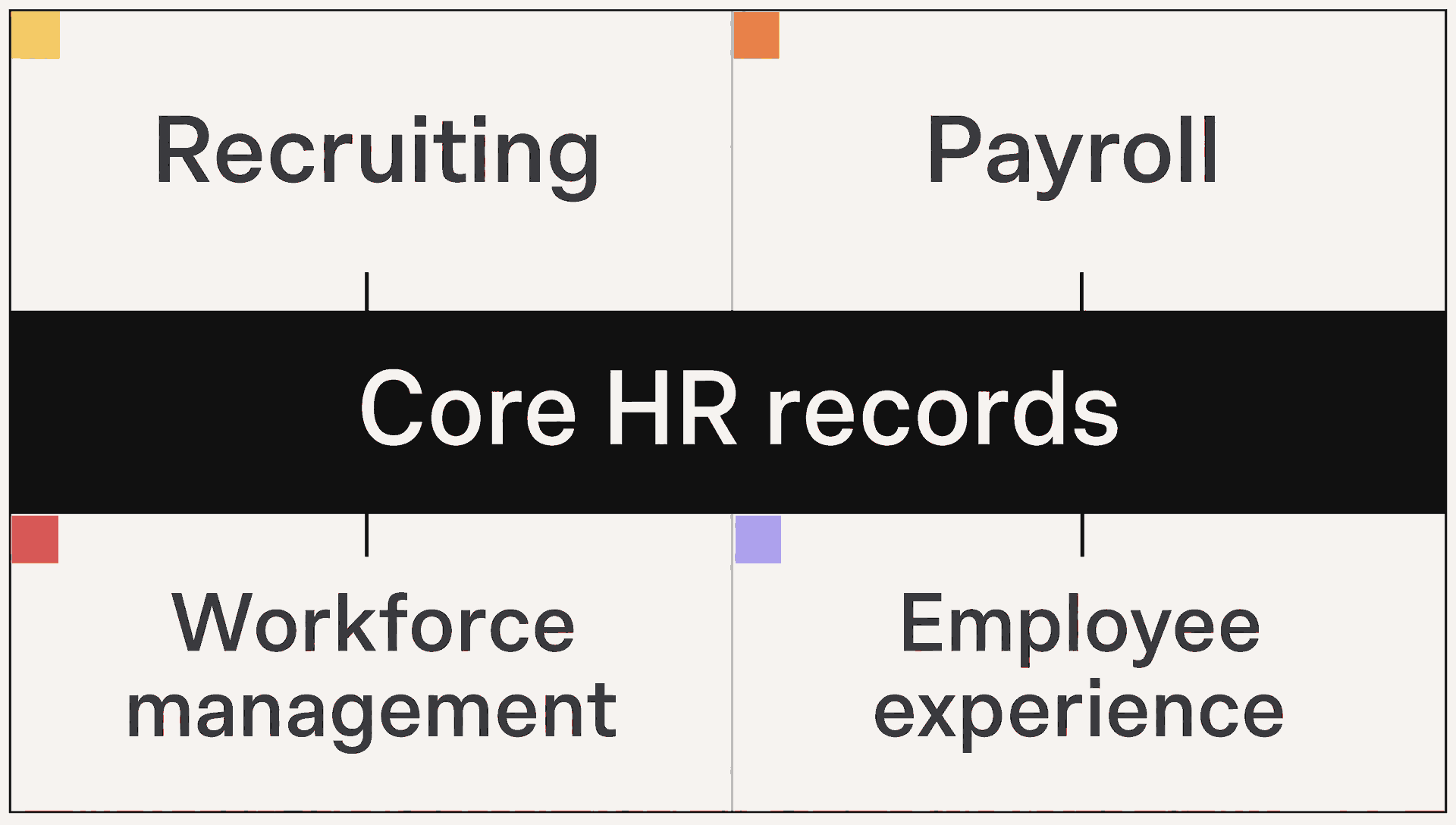
We group products by their primary job: recruiting, payroll, workforce management and employee experience. Core HR software holds shared employee records, such as a person's team, manager and employment status. Those records connect the groups.
The groups overlap. Approved hours from workforce management can feed payroll. An accepted offer can start onboarding, payroll setup and new-hire training. Employee feedback and learning continue throughout employment. These are connected workflows, rather than four steps every employer follows in order.
How products enter the map
The roster contains 12 illustrative products, with three in each group. We selected examples that show different jobs within a category and have a current first-party page describing those capabilities.
- Evidence date. This is a product snapshot dated November 17, 2026. It is not a live directory. Each linked product name leads to the first-party capability evidence used for its placement. These pages support product descriptions, not funding, ownership, financial performance or investment merit.
- One primary placement. Each example appears once, under the product job named here. We call out meaningful overlap instead of counting a broad suite several times. Names are alphabetical within each group; order has no investment meaning.
- Selective coverage. This is an employer-facing software map, not a complete vendor directory. Job boards, staffing agencies, public-stock analysis and standalone employment-services comparisons are outside its scope. Inclusion does not imply that a company is independent, early-stage, raising money or available to angel investors.
- No paid placement. Payment does not determine inclusion or order.
Buyer roles and commercial questions below are our research hypotheses. They describe what to investigate in a specific business, rather than verified procurement or pricing claims about every product listed.
Recruiting
Recruiting software supports candidate sourcing, relationships, applications, interviews and hiring decisions. An applicant tracking system (ATS) organizes applications and hiring stages. Other products can work alongside an ATS or include one themselves.
- Ashby ATS supports job setup, interview plans, application review, scheduling and recruiting analytics.
- Gem recruiting software combines sourcing and candidate relationship management with scheduling, analytics and an integrated ATS.
- Metaview interview notes captures interview notes, connects notes and scorecards to an ATS, and provides reporting across hiring conversations.
The starting buyer hypothesis is the talent acquisition team, the function responsible for recruiting. Separate the recruiter who uses the software, the hiring manager who contributes feedback and the person who approves the budget.
For commercial diligence, identify whether the contract depends on recruiter seats, hiring activity or a broader platform commitment. Then consider a hiring freeze. Which workflows would customers still use, and which paid seats or modules could they remove?
The category-specific question is whether the product solves a problem customers will fund separately when their existing ATS adds a similar feature. Customer evidence should explain the reason for buying and renewing.
Payroll
Payroll covers calculating pay, deductions and withholding, processing payroll, and delivering payments. Benefits administration, time tracking and broader employment services can sit beside it. A vendor's payroll product and its employment-services products need separate analysis.
- Deel Payroll supports multi-country payroll through self-serve or managed processing and global payments.
- Gusto payroll supports employee and contractor pay, multiple pay schedules, and payroll tax calculation and filing for U.S. businesses. Its broader suite also includes HR and benefits tools.
- Remote Global Payroll supports payroll for workers employed through the customer's own legal entities. Remote's separate employment-services offerings are outside this product's placement.
The buyer hypothesis includes payroll or HR staff and finance. Follow the approval chain from whoever prepares a pay run to whoever authorizes payment and signs the software or service contract.
For commercial diligence, separate subscription revenue, service fees and any payments-related revenue. Money moving through a payroll system is not automatically the provider's revenue. Investigate the people, partners and support needed to deliver each service, especially when adding countries.
The category-specific question is what happens when a pay run is wrong. Understand how the provider detects an error, resolves it, supports the customer and bears the resulting costs. A product feature list cannot establish those operating economics.
Workforce management
Workforce management covers scheduling, availability, time and attendance, shift administration and labor planning. A scheduling product's connection to payroll does not mean it calculates and processes payroll itself.
- 7shifts restaurant scheduling supports restaurant schedules, employee availability, time clocking and labor budgets. Its broader product offering also includes payroll.
- Deputy workforce management includes scheduling, time tracking, workplace communication and integrations with payroll, point-of-sale and HR software.
- Homebase team tools include scheduling, time clocks, payroll, HR and messaging for small businesses. We place its scheduling and time workflows here, with payroll as an adjacent product.
The buyer hypothesis starts with operations and location managers. HR and finance may also influence approval. Understand whether adoption happens location by location or through a central purchase, and who makes managers and employees use the system.
For commercial diligence, distinguish employee-based, location-based and bundled contracts. A customer opening another site, reducing staff or closing a location can affect those models differently. Include setup, training and ongoing support in the cost of serving the account.
The category-specific question is whether approved hours reach payroll accurately without repeated manual repair. Follow an edited time entry through manager approval and the payroll handoff. Identify who fixes an exception and how much work remains outside the software.
Employee experience
Employee experience is the broadest group here. It includes employee listening, engagement, feedback, performance and development. Learning is a distinct job within this group: delivering and tracking training differs from collecting survey responses or running a performance review.
- 360Learning learning management includes learner and manager dashboards, course and skills-development analytics, and integrations with HR systems.
- Culture Amp platform covers employee engagement surveys, performance, development, feedback and people insights.
- Lattice performance supports reviews, talent reviews, succession planning, one-to-ones, goals and feedback. This placement describes its performance product, rather than its entire suite.
The buyer hypothesis includes people or HR leaders and learning-and-development teams, with managers and employees as users. Identify the budget owner and the recurring decision the product helps that person make.
For commercial diligence, distinguish contracted employees, active learners and separately purchased modules. Participation in a survey or completion of a course is evidence of activity. A claim about improved retention or performance needs evidence that connects the product to that outcome.
The category-specific question is what changes after the software produces a result. Follow one survey finding, review or skills gap to a manager's action. Then identify what the customer measures before renewing.
The connections matter as much as the categories
Onboarding connects the hiring decision with employee records, payroll setup, benefits enrollment and training. Benefits can create payroll deductions. Analytics can draw from several systems. We keep these connections visible without turning every feature into a separate market.
For an illustrative employer, follow a new hourly employee from accepted offer to first paycheck. The employer needs a consistent employee record, scheduled shifts, approved hours and correct pay inputs. A new-hire course may run alongside that process. A missing or mismatched record can create work across several teams.
Use that handoff to investigate a product's place in the stack:
- Record ownership. Which system holds the authoritative employee record, and which systems copy it?
- Integration work. Who builds and maintains the connection, and who resolves conflicting or missing data?
- Access and accountability. Who can view sensitive information, change a record or approve an action? What history remains after a change?
A long integration list doesn't answer these questions. The useful evidence is how the connection works for a real customer, including exceptions.
Read the revenue behind the workflow
A hiring freeze can reduce recruiting activity while an employer continues paying and scheduling existing staff. The revenue impact depends on contract terms, headcount, usage and renewal decisions. Category placement alone cannot establish recurring revenue quality.
Our co-founder and general partner Elizabeth Yin writes in Democratizing Knowledge, “The more disciplined you are in your thought process/rubric, the more you can improve over time.” Apply the same commercial questions to each business:
- What does the customer pay for? Name the unit: user, employee, location, transaction, usage allowance or platform contract. Separate recurring software revenue from implementation and services.
- What does adoption cost? Include data migration, configuration, integrations, training and customer support. Establish who does that work and whether the customer pays for it.
- What keeps the budget? Compare groups of customers acquired in the same period through renewals, headcount changes and expansion. Separate more customers from higher prices or additional modules sold to existing customers.
- What can replace the product? Include spreadsheets, manual work, an incumbent suite's included module and doing nothing. Then investigate how customers discover, approve and buy the product.
Security, privacy, procurement and technical integration can involve people beyond the day-to-day user. Your buyer hypothesis should account for those approval roles. Avoid treating a successful pilot as proof of a repeatable sales process.
Turn one workflow into an investment research brief
Choose a workflow you understand well enough to question. In Democratizing Knowledge, Elizabeth Yin notes, “Investors use their life perspective to assess.” Your operating experience can help you spot a weak handoff or an implausible buyer assumption. It also has limits: experience with a large enterprise may not explain a restaurant group's purchase.
Write a short research brief with the customer, painful task, current workaround, buyer, pricing unit, required integrations and evidence that would change your view. Keep documented facts separate from assumptions. Our angel investing diligence checklist extends that work to the company and proposed investment.
If you want to practice evaluating startup claims with other operators and investors, apply to Angel Squad. Our investing education and peer learning give you a place to compare questions and challenge your reasoning.
This map is educational research, not an investment recommendation. Product inclusion is not an endorsement or an offer to invest. Startup investing is risky. Most early-stage bets may fail, and you can lose your entire investment.