Govtech market map 2026: software, buyers and barriers
A permit application, a bus arrival prediction and a police dispatch system serve very different jobs. Putting them all under “govtech” can hide the details an angel investor needs to understand.
At Angel Squad, our angel-investing community, we help aspiring and active angels build their judgment through education and peer learning. This U.S. market map connects illustrative software categories with the agencies that use them, the people involved in buying them and the constraints behind a sale.
What belongs in a govtech market map
Govtech is technology built for government operations and public-service delivery. The focus here is repeatable software for U.S. civil-government workflows across federal, state and local agencies, public safety and transit.
A city permitting platform belongs here. A custom consulting engagement, a defense-only system or a bid-search tool sold mainly to businesses pursuing government contracts falls outside this scope. A general-purpose business app doesn't become a distinct govtech category because a government happens to use it.
These nine functions overlap. A broad operating suite can include payments, permitting and procurement; a resident-service platform can connect several departments. The ten companies are illustrative examples, not a complete directory or a ranking. A product category doesn't establish a company's age, ownership, financing stage or availability for angel investment.
Evidence and refresh method
The evidence cutoff for all ten company descriptions, agency examples and policy references is November 9, 2026. Company descriptions use first-party product and company pages for capabilities and intended users. Named agency relationships rely on government service pages or procurement records, with proposals distinguished from adopted authorizations.
These sources don't independently demonstrate company performance or investment quality. Our market-map method keeps sourced observations separate from investor judgment.
Our refresh standard is an annual full-source pass, with earlier corrections for superseded records, material product changes or relevant policy changes. Advancing the cutoff requires revisiting every cited source, then correcting or removing unsupported claims.
Nine govtech software categories
The categories follow the work an agency needs to do. Each pairs a product example with its public-sector buyer or operating team and a practical business question.
Government operations, finance and procurement
OpenGov provides a broad state and local government operations platform spanning financial management, budgeting, procurement, payroll, grants, permitting, asset management and resident services.
The relevant agency teams depend on the product: finance staff preparing budgets, procurement teams managing purchases or public-works staff maintaining assets. A suite competes across several functions, so the useful unit of comparison is the module and workflow an agency is buying. An initial department sale and an organization-wide replacement have different implementation demands.
Permitting and community development
GovWell and Clariti provide software for local-government permitting and community development. GovWell's permitting software covers permit applications, plan review, inspections, licensing, planning and zoning, and code enforcement. Clariti provides permitting products for different sizes of local government and plan review assisted by artificial intelligence (AI).
Planning departments, building officials, inspectors and permit-center staff use these systems. Residents, contractors and architects may use the public portal. Berkeley's permitting procurement report shows how many departments can be involved: Planning, Public Works, Fire and Information Technology participated in evaluating proposals.
Local rules, existing records and connections to other systems are part of the product's delivery burden.
Government payments and resident transactions
PayIt provides payment processing software and customer-experience tools for state and local agencies. Workflows include property taxes, utilities, courts, driver and vehicle services, and licensing.
The North Carolina Division of Motor Vehicles identifies PayIt as the operator of its myNCDMV payment service. Drivers use the service, while the agency relationship determines which government transactions it supports.
The agency customer and the person paying a software-related fee can be different. For an investor, payment volume, fee allocation and the cost of supporting each transaction are separate from the face value of taxes or registration fees collected.
Grants management
AmpliFund provides grant-lifecycle software for state and local government, including award administration, reporting and compliance workflows.
Government grantmaking and grants-administration teams are the relevant agency users. Applicants and recipients may interact through a portal, but they have different responsibilities from the office administering the funds.
The underlying grant program determines eligibility, award conditions and reporting obligations. Software manages those workflows; the amount of grant funding passing through a system doesn't establish the software provider's revenue.
Public-sector workforce and hiring
NEOGOV provides public-sector human resources (HR) software covering recruiting, applicant tracking, onboarding, employee documents, performance and learning.
Agency HR teams and hiring managers use the internal tools. Job applicants interact with the hiring process from outside the organization. Public safety and education are also part of NEOGOV's customer focus.
A recruiting product, a training system and a broader employee-records replacement solve different problems. Their connections to payroll, identity systems and existing personnel records affect how much work a new deployment requires.
Public engagement and consultation
PublicInput provides government engagement software with surveys, public-meeting tools, interactive mapping, resident contact management, communications and machine-assisted comment analysis.
Local-government and transportation-agency staff use these tools to collect and organize public participation. Residents supply comments and responses; agency staff remain responsible for how that input enters a planning or policy process.
Participation volume is different from evidence that a sample represents the whole community. The business question includes how the product fits the agency's outreach, documentation and public-meeting workflow.
Public safety and emergency-response operations
Mark43 provides public-safety operations software covering computer-aided dispatch, records management, mobile tools and analytics. Computer-aided dispatch helps staff manage incidents and assign responders; records management supports the information recorded around police work.
Police, fire and emergency-response organizations are distinct operating teams, even when a city buys a shared platform. Dispatchers, responders, records staff and technology teams may all be involved.
Reliability, migration of existing records and connections between systems deserve their own discussion. A public-safety product's failure has different consequences from a missed notification in a routine administrative workflow.
Transit operations and rider information
Swiftly provides transit data software for agency operations, service planning and passenger information.
Stanislaus Regional Transit Authority's Swiftly renewal report describes its use of the software for real-time analysis, schedule adherence and planning. Its report connects the product to historical run times, vehicle speeds and on-time performance.
The transit authority is the customer. Planners and operations staff use the data, while riders may benefit from information built on it. Agency fleet coverage, data connections and staff workflows help define the scope of a deployment.
Resident-service intake and AI assistance
Polimorphic provides government service-delivery tools for voice, chat, search and workflows. These connect resident questions and requests with agency information and staff workflows.
Passaic County's adopted purchasing resolution authorizes a contract with SHI International for Polimorphic voice-answering services for its Roads Department. That example has three separate parties: the public agency, the software provider and the contracting reseller.
Answering a routine question, routing a service request and making a decision about someone's eligibility for a public service have different risks. “AI for government” is too broad to describe the buying requirements on its own.
The user, buyer and approvers can be different
A resident can use a service without choosing the vendor. An agency employee can want a product without controlling its budget. Procurement, security, accessibility and legal reviewers can affect whether and how a purchase proceeds. Several roles may sit with the same person in a small agency.
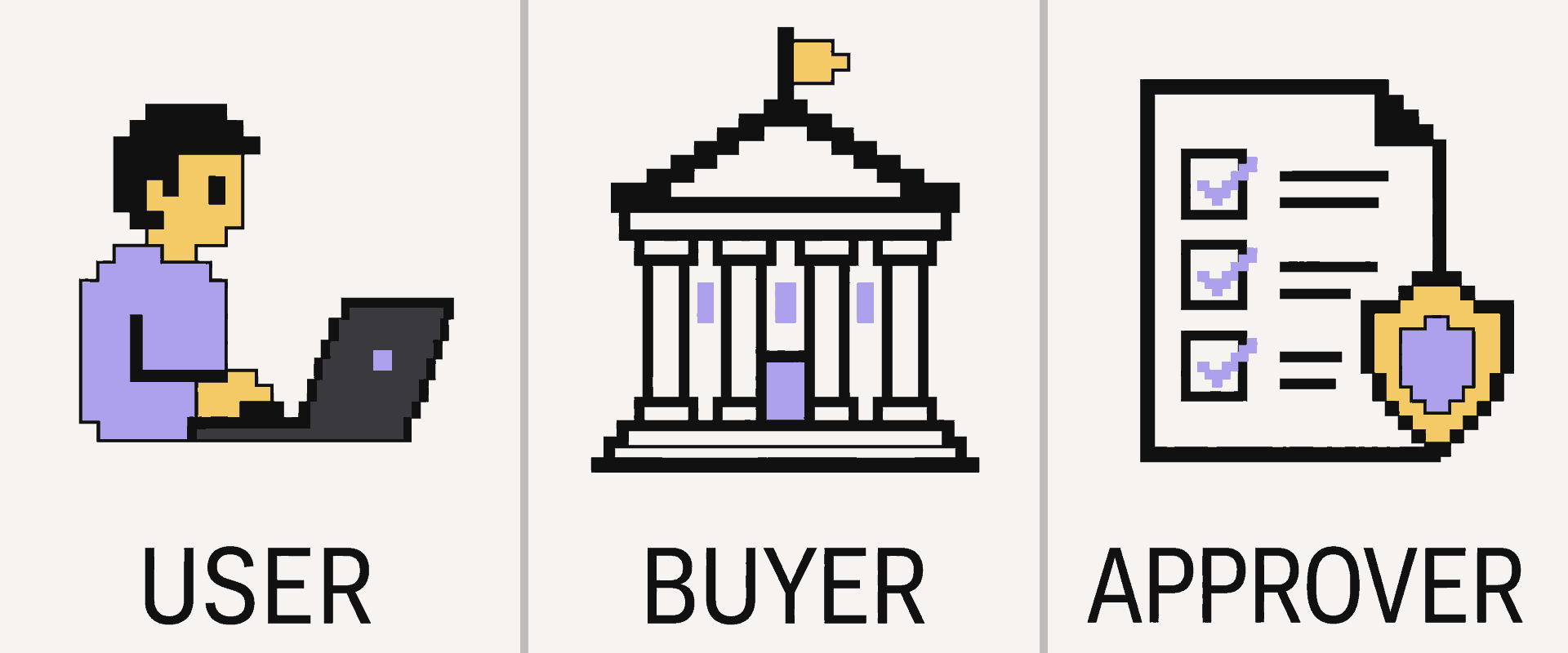
Berkeley's permitting procurement makes the distinction concrete. Permit applicants use the public-facing service. Multiple departments evaluate its fit. The city manager is the proposed contracting authority, subject to council authorization.
These roles explain why an enthusiastic user is only one piece of a commercial opportunity. Our approach to startup investment criteria separates the customer problem from distribution, implementation and evidence of demand. Government software needs the same separation at the department level.
How government purchases shape the business
A software subscription, a transaction-funded service and a sale through a reseller produce different economics. Contract totals also need context: they can include work beyond access to the software.
Berkeley's January 2026 report proposed a Clariti contract with a ceiling of $5,359,128, covering licensing, implementation, integrations, data migration, training, hosting and support. The proposed term extended through September 2032. That ceiling is for a multi-year project with several components; it isn't annual recurring software revenue or a typical govtech price.
North Carolina's PayIt contract guidance describes agency-paid, transaction-fee-funded and shared-fee arrangements. Passaic County's purchase through SHI shows a different distinction: the company making the software can differ from the entity signing the customer contract.
Our co-founder and general partner Shiyan Koh says, “Show me the incentives, and I'll show you the outcome.” Her point concerns fund economics, and the same lens helps explain these commercial relationships. Who pays, who benefits and who carries delivery costs all affect the business model.
Procurement routes are specific to the buyer
Federal acquisition has its own framework. The Federal Acquisition Regulation requires planning and market research and consideration of existing contracts before new awards. SAM.gov distinguishes direct-award registration from having a Unique Entity ID alone. These federal rules aren't a universal description of selling to cities or counties.
A contract vehicle is an established channel through which an eligible buyer can purchase. Its availability depends on the buyer, seller, product and contract terms. Passaic County's use of a cooperative purchasing arrangement illustrates one route; it doesn't establish a shortcut available to every vendor.
Passaic's budget appropriation condition makes the authorized purchase contingent on sufficient funds being appropriated in its 2026 or subsequent county budgets. Purchase approval and budget availability are separate facts. This map doesn't model agencies' fiscal calendars or assume a common government buying season.
A citywide permitting replacement and a departmental phone-answering service have different scopes. Neither provides a general sales-cycle or implementation benchmark for government software.
Security, accessibility and AI depend on the use case
The department, information handled and intended use shape the requirements. A label such as “government-ready” doesn't explain which requirements apply to a particular purchase.
- Federal cloud security. The Federal Risk and Authorization Management Program (FedRAMP) has a defined scope for cloud services handling federal information, with exclusions. Only the federal agency determines whether its planned use is within FedRAMP's scope. A certification provides reusable security evidence; the agency still authorizes its own system. FedRAMP isn't a blanket requirement for every local-government product.
- Federal accessibility. Section 508 applies to covered information and communications technology that federal agencies buy, develop, maintain or use. Federal accessibility purchasing guidance includes defining requirements and evaluating conformance. This federal framework doesn't describe every state or local obligation.
- Federal AI acquisition. Office of Management and Budget (OMB) memorandum M-25-22 is one scoped example of AI acquisition guidance, covering performance, data portability and interoperability, or the ability of systems to exchange and use information.
- Federal language-model contracts. OMB M-26-04 complements M-25-22 with language-model contract requirements tied to its Unbiased AI Principles. Its scope covers agency-procured large language models (text-generating AI models), including those embedded in other software. The memo has exceptions; it isn't a rulebook for every public agency's AI purchase.
State and local obligations need their own scope. California's attorney general describes data-breach notification duties for businesses and state or local agencies under defined conditions.
Washington's local-records retention law governs retention schedules and authorization to destroy records. Berkeley's permitting report identifies California electronic-submittal and permit-tracking requirements. These examples don't supply a 50-state privacy, records or contract checklist.
A voice assistant answering published office-hours questions and a system handling sensitive case records can carry different obligations. For covered federal agency uses, OMB M-25-21's high-impact AI requirements turn on the output's role in consequential decisions or actions affecting rights or safety. That federal determination concerns the agency's use; a product's “AI” label doesn't establish it.
Questions that make the map useful to an angel investor
A category identifies a place to learn. A business case needs a specific customer, buying process and delivery model. These questions turn a broad market label into a more concrete founder discussion:
- Which agency job starts the sale? A named department, recurring task and current workaround explain more than “we sell to government.”
- Who uses, funds and approves the product? Those roles show where demand, budget authority and purchase conditions meet.
- What is the route to a contract? Direct sales, reseller relationships and cooperative purchasing arrangements create different dependencies.
- What must happen before the product works? Migration, integrations, configuration, staff training and support determine delivery effort.
- What does the company earn and keep? Subscription revenue, implementation work, transaction fees and reseller economics need separate treatment.
- What can repeat for the next agency? Shared workflows support a repeatable product. Agency-specific rules and systems can add work to each deployment.
Our co-founder and general partner Eric Bahn defines hustle as “great execution meets high velocity.” In a government-software business, useful evidence includes how quickly the team learns an agency's workflow, resolves implementation problems and turns that learning into a repeatable product. Speed alone doesn't remove a buyer's procurement obligations.
Our angel diligence framework adds the broader people, product and paperwork questions that a sector map leaves open. Inclusion here establishes neither investment availability nor suitability for your portfolio.
If you want to build this kind of judgment alongside other investors, apply to Angel Squad. Our community combines startup-investing education, peer learning and curated deal discussions with Hustle Fund's investing experience.
This is educational information, not an investment recommendation or legal, tax or investment advice. Company examples don't imply endorsement, an investment relationship or access to an offering. Startup investing is speculative, illiquid and long-term; most bets may fail, and you can lose your entire investment. Seek independent review from qualified legal and tax professionals for your circumstances.