Gross margin: Formula, examples and investor diligence
Gross margin is the percentage of revenue left after subtracting the cost of producing or delivering what a business sold. It shows how much of each revenue dollar remains to cover sales, product development, administration, and other expenses before the company earns a net profit.
For a startup investor, the useful work starts with understanding which costs sit inside that calculation. At Angel Squad, our angel-investing community, we help aspiring and active angels build that judgment through education, curated deal flow, and peer learning.
The gross margin formula
Gross margin (%) = (Revenue − cost of goods sold) ÷ revenue × 100
Cost of goods sold (COGS), also called cost of revenue or cost of sales, covers the costs assigned to the products or services sold. Gross profit is revenue minus COGS, expressed in dollars. Gross margin expresses that same gross profit as a percentage of revenue.
Use revenue and its associated costs from the same reporting period. Revenue should reflect discounts, returns, and allowances. Money raised from investors is financing, so it doesn't belong in revenue.
A startup example
Consider a hypothetical, simplified software-as-a-service (SaaS) startup with $100,000 in monthly revenue. Assume it assigns all the following delivery costs to that month's revenue:
- Cloud and external services: $12,000 for hosting and usage-based services needed to run the product.
- Delivery and support payroll: $10,000 for employees maintaining the service and helping customers use it.
- Required third-party licenses: $3,000 for software incorporated into the service.
Total COGS is $25,000. The calculation is:
- Gross profit: $100,000 − $25,000 = $75,000.
- Gross margin: $75,000 ÷ $100,000 × 100 = 75%.
The company has 75 cents of gross profit for each dollar of revenue. That money still has to cover its other expenses. If sales, product development, and administration total another $90,000 that month, the company has a $15,000 operating loss despite its 75% gross margin.
Gross margin also says little about when cash arrives or leaves. A customer might pay an annual subscription upfront, while the business recognizes the revenue over the service period. Profit and cash flow measure different things.
What belongs in cost of goods sold?
The cost categories depend on how the startup delivers value. Our explanation of cost of goods sold connects those costs to the room left for customer acquisition and overhead.
For a physical-product company, COGS can include materials, manufacturing labor, purchased inventory, and production overhead. For a services business, it can include the employees or contractors delivering client work. For a software company, hosting, service-delivery staff, customer support, and required third-party services can belong in cost of revenue.
COGS isn't limited to costs that rise with every additional sale. Inventory accounting includes direct labor and production overhead, as the IFRS Foundation's inventory guidance explains. A factory can have fixed production costs even during a slow sales month.
Sales and marketing, general administration, and research into future products generally sit in operating expenses. Employees' roles matter more than their job titles. A customer-success employee might deliver the existing service, sell upgrades, or split their time between both.
Cost classification can change the headline margin
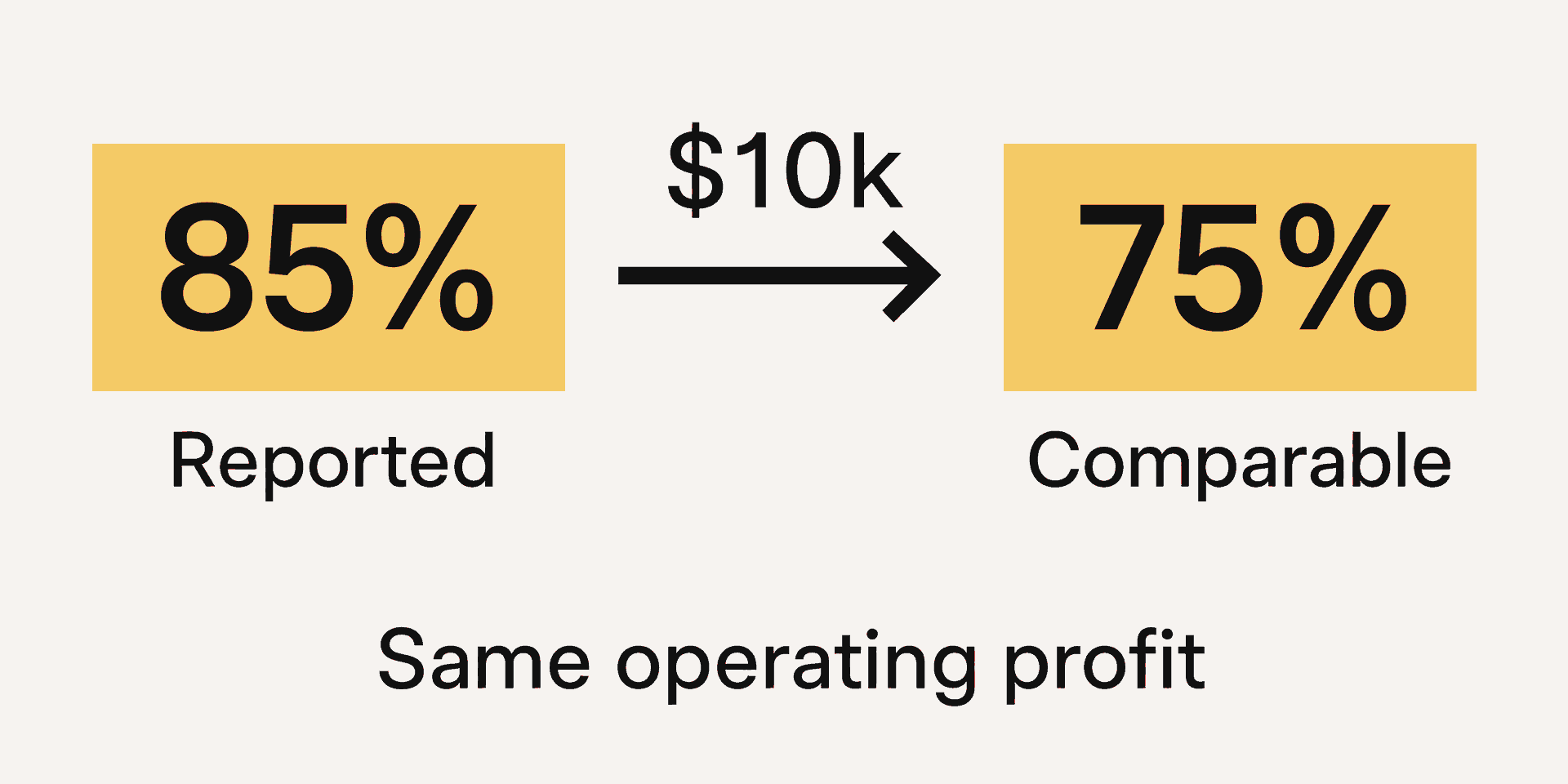
Suppose the hypothetical startup reports only $15,000 of COGS and puts its $10,000 of delivery-support payroll in operating expenses. Its reported gross margin is 85%.
Including that payroll in delivery costs brings COGS to $25,000 and gross margin to 75%. Moving the expense between categories leaves operating profit unchanged. The company hasn't become more or less profitable because the expense moved.
For diligence, ask the founder to explain the allocation and present a consistent comparison across periods. Any investor-adjusted calculation should remain separate from the company's reported accounts, with the adjustment made explicit. A margin improvement caused by moving expenses tells you something different from a reduction in the cost of serving customers.
What is a good gross margin for a startup?
A useful gross margin leaves enough gross profit to support the company's acquisition costs, operating expenses, and growth plan. The percentage alone can't establish that.
Business models have different cost structures. In Aswath Damodaran's January 2026 U.S. sector data, system and application software had a 71.72% gross margin, compared with 33.18% for general retail. Those public-company figures provide context. They aren't pass-or-fail targets for pre-seed companies.
Compare businesses with similar products, customers, delivery requirements, and accounting policies. Then separate the startup's observed margin from the margin it hopes to earn at scale.
Higher prices, lower delivery costs, and a shift toward higher-margin products can raise gross margin. A price increase that drives customers away can still damage the business. Lower service costs achieved by making the product unreliable can do the same.
How investors use gross margin in diligence
We connect gross margin to gross profit dollars, customer behavior, and the capital required to grow. A consistent set of questions helps you make those connections without treating one percentage as an investment verdict.
1. Translate the percentage into customer payback
In Democratizing Knowledge, our general partner Elizabeth Yin wrote, “it's the actual amount that you get that matters.” Her example connects gross profit per customer to the cost of acquiring that customer.
Continue the hypothetical SaaS example. At $200 in monthly revenue per customer and a 75% gross margin, the company earns $150 in monthly gross profit per customer. If customer acquisition cost (CAC) is $900, gross-profit payback takes six months:
$900 ÷ ($200 × 75%) = 6 months
Using revenue alone would give a misleading 4.5-month payback. At a 50% gross margin, the same customer produces $100 in monthly gross profit, and payback stretches to nine months.
These simplified calculations assume stable customer revenue and delivery costs, no customer departures, and no expansion revenue. They exclude overhead and differences in cash timing. Customers must stay long enough for acquisition spending to be recovered, and the business still needs to fund its other expenses.
Elizabeth describes the funding consequence in the same book: “you will need a lot of capital to bridge yourself for that long.” That payback discussion is a reason to read margin alongside cash available and the time a startup can keep operating before it runs out of money.
2. Establish what the revenue number represents
A marketplace's gross merchandise value is the value of transactions passing through it. That can be much larger than its own revenue.
Revenue presentation depends on the company's role in the transaction. A principal controls the specified good or service before transferring it to the customer; an agent arranges for another party to provide it. That distinction affects whether revenue is reported gross or as a net fee, as the IFRS Foundation's principal-agent discussion explains.
Ask how transaction volume becomes recognized revenue before comparing margin percentages. A marketplace's commission rate and its gross margin measure different relationships.
3. Separate product economics from sales mix
A startup can sell subscriptions, implementation work, and consulting at different margins. Its company-wide margin changes when the mix of those revenue streams changes, even if each stream's economics stay the same.
Request revenue, delivery costs, and gross profit by major revenue stream. Combine them by adding gross profit dollars and dividing by total revenue. An unweighted average of the separate percentages gives the wrong result when the streams have different revenue totals.
For an AI product, usage differences deserve attention too. Heavy users can consume more paid model calls, computing resources, or human review than lighter users on the same subscription price. An attractive company-wide average can hide customers who cost more to serve than they pay.
4. Make the path to a better margin specific
An early startup may do manual work that software could eventually replace. It may also benefit from free cloud credits or unpaid founder labor that won't support a larger business.
Ask the founder to separate current delivery costs from expected changes:
- Pricing: What customers already pay, and which future increases are assumptions.
- Supplier costs: Discounts already secured, and the volume needed for further reductions.
- Delivery work: Tasks already automated, and tasks still requiring employees or founders.
- Temporary support: Credits, subsidies, or free services that will expire.
If delivery costs exceed revenue, gross margin is negative. More sales at unchanged unit economics create more gross losses. A credible improvement plan needs a specific change in price, delivery cost, or product mix, plus enough capital to reach it.
For a pre-revenue startup, gross margin is undefined because the formula divides by zero. Estimates can help frame the business model, but they should stay labeled as assumptions until there are sales and delivery costs to measure.
Gross margin, net margin, and markup measure different things
These measures answer different questions about the same business:
- Gross margin: Gross profit divided by revenue. It measures what remains after COGS.
- Operating margin: Operating income divided by revenue. It includes operating expenses such as sales, administration, and product development.
- Net margin: Net income divided by revenue. It reflects the bottom line after other income, expenses, interest, and taxes.
- Markup: Gross profit divided by cost. It uses a different denominator from gross margin.
For a hypothetical product sold for $100 with $60 in COGS, gross profit is $40. Gross margin is 40%, while markup is about 66.7%. A 40% markup would produce a different selling price.
Gross margin helps you understand whether a startup has room to fund its business. It can't tell you whether the founders will execute, customers will stay, or your investment will succeed. Most bets in an early-stage portfolio may fail, including companies whose initial metrics looked promising.
If you want to practice connecting startup metrics to investment decisions with experienced operators and peers, apply to Angel Squad.
This material is educational and is not investment or accounting advice. Startup investments are speculative, illiquid, and long-term, and you can lose your entire investment.